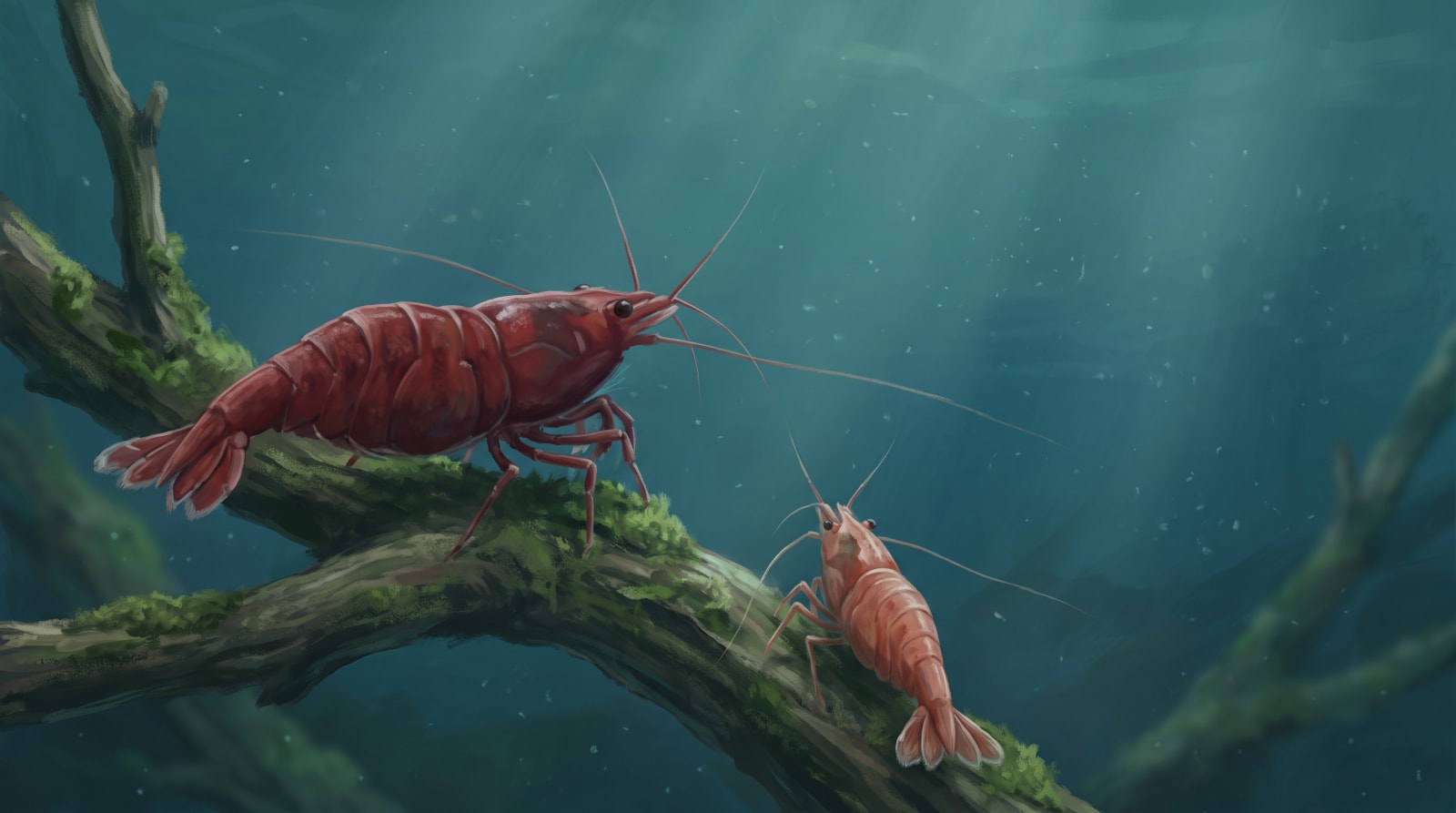
Healthy cherry shrimp breed almost without asking. A colony in stable, well-fed water usually throws its first berried females within a few months and then never really stops, which is why "how do I make them breed" is rarely the right question. When a tank sits stubbornly broodless, it's almost never bad luck — it's one specific thing holding them back. Here are the nine we work through, in roughly the order they catch keepers out, with the fix for each.
1. All your shrimp are the same sex
The most common reason of all, and the easiest to miss. Buy too few, or buy from a shop tank that happened to be picked over, and you can end up with ten males or ten females and no way to know until nothing happens. No pairing, no eggs, no matter how perfect the water.
Learn to tell them apart: females are larger, deeper in colour and carry a "saddle" of eggs behind the head, while males stay smaller, slimmer and paler. Our male vs female sexing guide walks through the four tells. The fix: always start with ten or more from a healthy mixed group — that all but guarantees both sexes and gives the colony room to grow.
2. They're simply too young
Impatience is behind a surprising number of "why won't they breed" tanks. Cherry shrimp reach maturity at roughly three to five months, and juveniles are near-impossible to sex reliably — a group sold young may be weeks away from breeding no matter what you do. People buy small shrimp, wait a fortnight, and assume something's wrong.
Nothing is wrong; the shrimp just aren't adults yet. The fix: patience, and the conditions that speed maturity along — stable water, steady warmth and good feeding. Keep the tank right and the first saddled female will appear on her own schedule. If the group genuinely looks adult-sized and months have passed, move on down this list.
3. The tank's too cold to trigger breeding
Cherry shrimp survive across a wide temperature band but only breed enthusiastically in part of it. We run our breeding tanks at 22–23°C, inside the 21–24°C sweet spot; drop much below 21 and breeding slows right down, even though the shrimp look perfectly healthy. An unheated tank in a typical UK room often sits at 18–20°C — fine for keeping, sluggish for breeding.
This catches out UK keepers especially in winter, when rooms cool and night heating clicks off. The fix: add a small preset heater and bring the tank gently up to 21–24°C — our guide on whether shrimp need a heater in the UK covers the choice. Don't chase heat past 26°C, though; hotter is not better, and it stresses the colony.
4. The water never sits still
Stability beats perfect numbers, and nowhere does that bite harder than breeding. A colony subjected to constant swings — oversized water changes, a heater that overshoots, TDS creeping up then being yanked back down — stays locked in survival mode, and survival mode doesn't spare energy for eggs. Stressed berried females sometimes drop a brood entirely.
The shrimp are telling you they don't trust the tank to hold steady long enough to raise young. The fix: small weekly water changes of 10–20%, temperature-matched and added slowly, and a routine that keeps the numbers boring. Our Neocaridina water parameters guide sets out the targets, but the real trick is holding whatever you've got steady rather than chasing an ideal.
5. GH is wrong for moulting — and mating
Breeding is tied to moulting: a female is receptive only just after she moults, and she'll berry within days of it. Anything that disrupts clean moulting therefore disrupts breeding, and the usual culprit is general hardness. GH supplies the calcium and magnesium a shrimp needs to harden a new shell; too little and moults fail, too much or too swingy and the shell binds.
The target is GH 6–12, nudged towards 8–12 for a breeding tank. Soft-water regions of the UK often sit well below that, quietly stalling the whole colony. The fix: test GH and remineralise up into range if you're soft — the mechanics are in our guide to failed moults and the GH connection. Get moulting right and mating tends to follow.
6. They're underfed — especially on protein
A tank can be clean, warm and stable and still not breed if the shrimp are running lean. Biofilm is the base of the diet, but producing eggs costs a female more than biofilm alone reliably provides. A spartan, under-fed tank keeps shrimp alive and grazing without ever tipping them into breeding condition.
The missing piece is usually a little protein. The fix: feed a quality staple two to three times a week and work in an occasional protein food — the balance is set out in our guide to protein, plants and the moulting diet. The caveat matters: overfeeding is the number-one killer of shrimp tanks, so add a touch more food, watch it get eaten within a few hours, and never leave the tank swimming in leftovers.
7. Predators keep them too stressed
Shrimp that share a tank with fish spend their lives hiding, and hiding shrimp don't breed well. Even so-called shrimp-safe tank mates change the picture: a fish that leaves adults alone will still hoover up shrimplets, so the colony never appears to grow even when breeding is happening. Chronic low-grade fear suppresses the whole business.
If you want a colony that visibly multiplies, the maths favours a species-only tank. The fix: for a breeding project, keep cherry shrimp on their own, with snails as the only companions — our cherry shrimp tank mates guide grades the usual candidates honestly. A community tank can hold shrimp, but it rarely grows a colony, and that trade-off is worth making on purpose rather than by accident.
8. The tank's too clean and too new
A brand-new tank scrubbed to a sparkle is a hostile place for breeding shrimp, however good it looks to us. Without a mature film of biofilm there's no reliable grazing, and shrimplets that do hatch struggle to find first food. Over-cleaning an established tank does the same damage in reverse, stripping out the surfaces the colony depends on.
Mature, slightly grubby tanks raise more young than pristine new ones — that's not a paradox, it's the food supply talking. The fix: give a new tank time to age before expecting broods, and stop over-maintaining an old one. Grow biofilm deliberately on wood, leaves and botanicals; our explainer on biofilm, the invisible buffet covers how to farm it. Patience and a bit of mess are breeding aids.
9. A chronic low-level toxin
The hardest cause to spot is the one that leaves no obvious mark: something quietly wrong in the water that lets shrimp live but not thrive. Trace copper is the classic — from a fish medication used months ago, an old copper hot-water line, or a snail treatment — but leaching décor and low-grade pesticide residue off plants do the same job. The colony ticks over, colour a little flat, and simply won't breed.
Copper deserves special suspicion because invertebrates are so sensitive to it. The fix: rule it out. The trace of chelated copper in a quality shrimp-safe fertiliser is fine, but anything stronger isn't — our guide to copper and shrimp covers the sources and how to test. Use shrimp-safe everything, quarantine new plants, and if a tank stubbornly won't breed with all eight causes above ruled out, assume an invisible toxin and start eliminating sources.
FAQ
How long does it take for cherry shrimp to start breeding?
Cherry shrimp reach breeding maturity at around three to five months, so a group bought as juveniles may simply be too young. Once they're adult, a stable, well-fed tank at 21–24°C usually produces its first berried females within weeks. If your shrimp are clearly adult-sized and months have passed with no eggs, work through the causes above — sex ratio and temperature are the two most common culprits.
Why are my cherry shrimp not getting berried?
The usual reasons are a single-sex group, shrimp that aren't mature yet, a tank below about 21°C, or water that keeps swinging rather than sitting steady. GH too low for clean moulting is another quiet stopper, since females can only mate just after a moult. Check you have both sexes, warm the tank into the 21–24°C range, and hold the parameters stable before looking further.
What temperature do cherry shrimp need to breed?
They breed best at 21–24°C — we run our breeding tanks at 22–23°C. They'll survive anywhere from 18–26°C, but below roughly 21 the breeding slows right down even though the shrimp look healthy. An unheated UK room often sits at 18–20°C, which is a common hidden reason a colony stalls. A small preset heater to lift the tank into range usually gets things moving.
Do cherry shrimp need a male and female to breed?
Yes. Cherry shrimp reproduce sexually, so you need both sexes, and buying too few is the classic way to end up with an all-male or all-female group by chance. Females are larger and deeper in colour with a saddle behind the head; males are smaller and paler. Starting with ten or more from a mixed group all but guarantees you have both.
How do I encourage my cherry shrimp to breed?
Give them stable, warm water at 21–24°C, GH in the 6–12 range, both sexes, and a bit more food than bare survival — including occasional protein. Let the tank mature so biofilm builds up, keep predators out with a species-only setup, and rule out trace toxins like copper. Get those right and you don't really encourage breeding so much as stop preventing it.