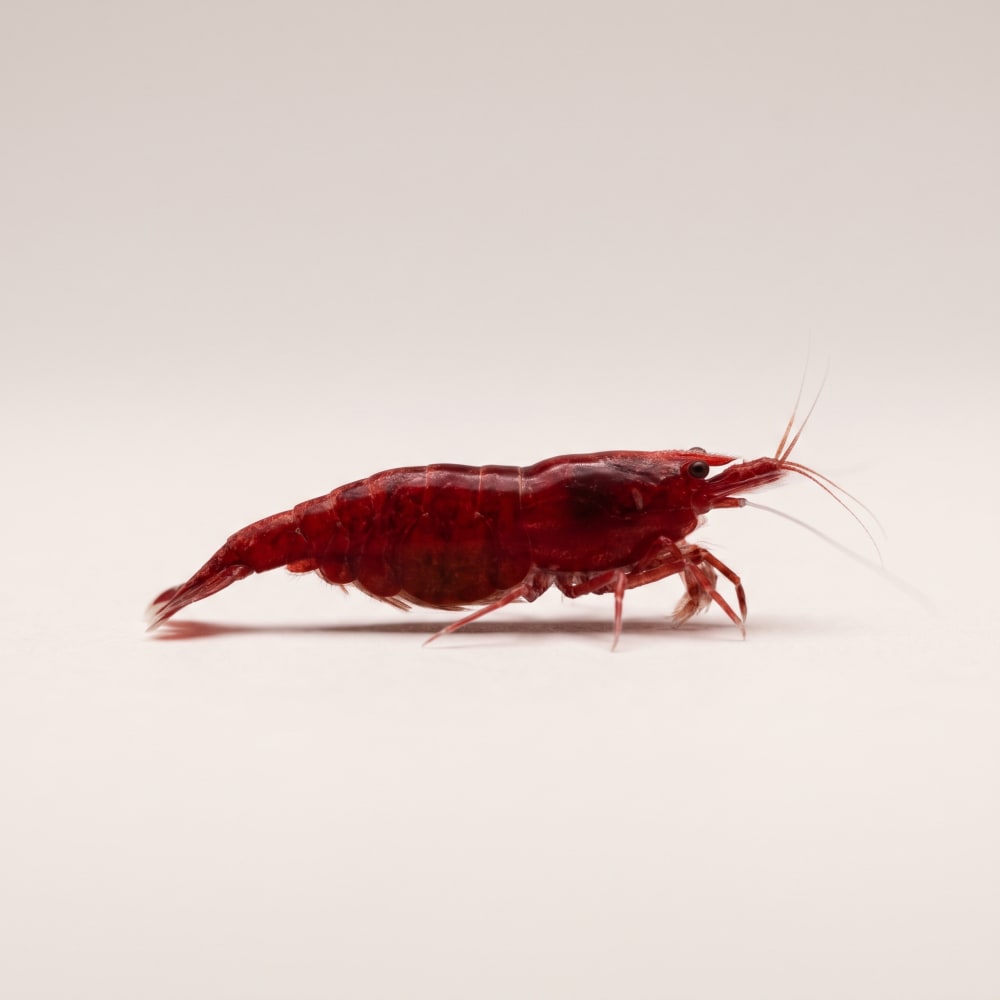
The first time you see a good Bloody Mary, the red looks almost wrong: too deep, too liquid, as if the shrimp is lit from inside. That's not the light — it's where the pigment sits. Of everything we breed, this is the line visitors to our racks ask about most.
Bloody Mary shrimp at a glance
| Fact | Detail |
|---|---|
| Species | Neocaridina davidi (a cherry shrimp colour line) |
| Adult size | 2.5–3cm; females larger and deeper in colour |
| Lifespan | 1–2 years |
| Temperature | 18–26°C (we run our racks at 22–23°C) |
| pH | 6.8–7.6 (tolerates 6.5–8.0 with stability) |
| GH / KH | 6–12 / 2–8 |
| TDS | 150–250 (180–250 for breeding) |
| Ammonia / nitrite / nitrate | 0 / 0 / under 20ppm |
| Difficulty | Easy — identical care to any Neocaridina |
| UK price | £30–50 per 10, high grade |
What makes a Bloody Mary different
Every red Neocaridina gets its colour from red pigment, but where that pigment sits changes everything. In the standard red lines, the colour is a coating on the shell. In a Bloody Mary, the red is in the flesh itself — the tissue under a largely translucent shell. Light passes into the shrimp and comes back through the red, which is why the colour reads as liquid and seems to glow rather than sit painted on the surface.
The line wasn't pulled out of the ordinary red ladder either. Bloody Marys were developed from the chocolate line, which gives them a different background to the Fire Reds they're so often compared with.
Bloody Mary vs Fire Red vs Painted Fire Red
First, the question behind the question: yes, Bloody Marys are cherry shrimp. Every Neocaridina colour line — red cherry, blue dream, Bloody Mary — is the same species, selectively bred in different directions, and care is identical across the lot.
Fire Red and Painted Fire Red sit at the top of the standard red grading ladder (Cull → Cherry → Sakura → Fire Red → Painted Fire Red), where grade is judged on how completely red covers the shell. A top Painted Fire Red is solid and uniform. A Bloody Mary comes at red from the other direction: colour in the flesh, seen through a glassy shell.
| Bloody Mary | Fire Red / Painted Fire Red | |
|---|---|---|
| Where the red sits | In the flesh (tissue) | On the shell (coverage) |
| The look | Deep, translucent, "liquid" | Solid and uniform |
| Lineage | Chocolate line | Red cherry grading ladder |
| Graded on | Depth and evenness of red | Shell coverage |
Which is better is taste, and we'll be honest: a top Painted Fire Red is a striking shrimp. But side by side, the Bloody Mary's red has a depth the coverage lines can't match, and it's the one visitors point at. Our Neocaridina grades guide covers the ladder in full.
Colour and grading
Because the red lives in the tissue, Bloody Mary grade is judged on depth and evenness rather than coverage percentages. You're looking for red that's dark, saturated and consistent from nose to tail, with no washed-out patches. As in every Neocaridina line, females show the deeper, more opaque colour while males run smaller, slimmer and paler.
The line's other virtue is that it tends to hold its colour well, which makes a Bloody Mary tank rewarding to keep long term rather than just impressive on arrival.
Care
There's nothing new to learn: keep them like any cherry shrimp and they'll thrive. The table above has the ranges, and the principle that matters more than any single number is stability, because sudden swings do more damage than slightly imperfect values. Feed a quality, varied diet with a protein component, dechlorinate every water change, and keep copper-based medications and pesticide-carrying plants well away — standard Neocaridina sensitivities apply in full.
Our cherry shrimp care guide covers the day-to-day. If you're in a soft-water part of the UK, read our UK tap water guide before buying, because you may need to remineralise to reach a GH of 6–12 for reliable moulting.
Do Bloody Marys breed true?
Kept as a single line, yes — this line holds its colour well across generations. You'll still see normal grade variation within each brood, some shrimplets deeper and some paler, and building quality is simply selection: move your deepest, most even reds into the breeding tank and rehome the rest, exactly as our how to breed cherry shrimp guide lays out. The cycle itself is standard Neocaridina — 20–30 eggs carried for 14–21 days, shrimplets grazing biofilm from day one, maturity at around 3–5 months.
The one rule: don't mix colour lines. Cross a Bloody Mary with a Blue Dream, or any other Neocaridina colour, and within a few generations you're back to brownish wild-type shrimp. That's genetics, not bad luck, and it's why serious keepers run one colour per tank. The mechanics are in mixing Neocaridina colours.
Buying Bloody Mary shrimp in the UK
Expect to pay £30–50 per 10 for high-grade Bloody Marys in the UK. That's a step up from the £2–4 of standard cherries, and worth it when the line is real. Good stock is easy to recognise once you know the tell: deep red that clearly sits in the body, visible through a glassy shell, and consistent across the whole group rather than carried by two show shrimp in the listing photo. Walk away from anything patchy or washed out.
Buy ten or more rather than a "pair" — cherry shrimp breed as a colony, and ten gives you the genetic spread to keep the line strong. We're not selling Bloody Marys ourselves right now; join the waitlist on this page if you'd like an email should that change.
FAQ
Are bloody mary shrimp hard to keep?
No. They're Neocaridina davidi, the same species as every cherry shrimp, so they get the same easy care: 18–26°C, pH 6.8–7.6, GH 6–12 and stable, clean water. If you can keep a standard cherry alive, a Bloody Mary is no harder.
What is the difference between bloody mary and cherry shrimp?
A Bloody Mary is a cherry shrimp — one colour line of Neocaridina davidi. The difference from the standard red lines is where the colour sits: Fire Red and Painted Fire Red carry red on the shell, while Bloody Marys carry it in the flesh, which gives the deeper, glowing look. They also descend from the chocolate line rather than the ordinary red ladder.
Do bloody mary shrimp breed true?
Yes, kept as a single line they hold their colour well, which is one of the reasons we rate them. You'll still see grade variation in every brood, so select your best into the breeding tank. Never mix them with other colour lines, or the offspring drift back to wild-type brown within a few generations.
How big do bloody mary shrimp get?
The same as any Neocaridina: 2.5–3cm as adults, with females noticeably larger and deeper-coloured than the slimmer, paler males. Lifespan runs 1–2 years, so a breeding group is the way to keep the display going.