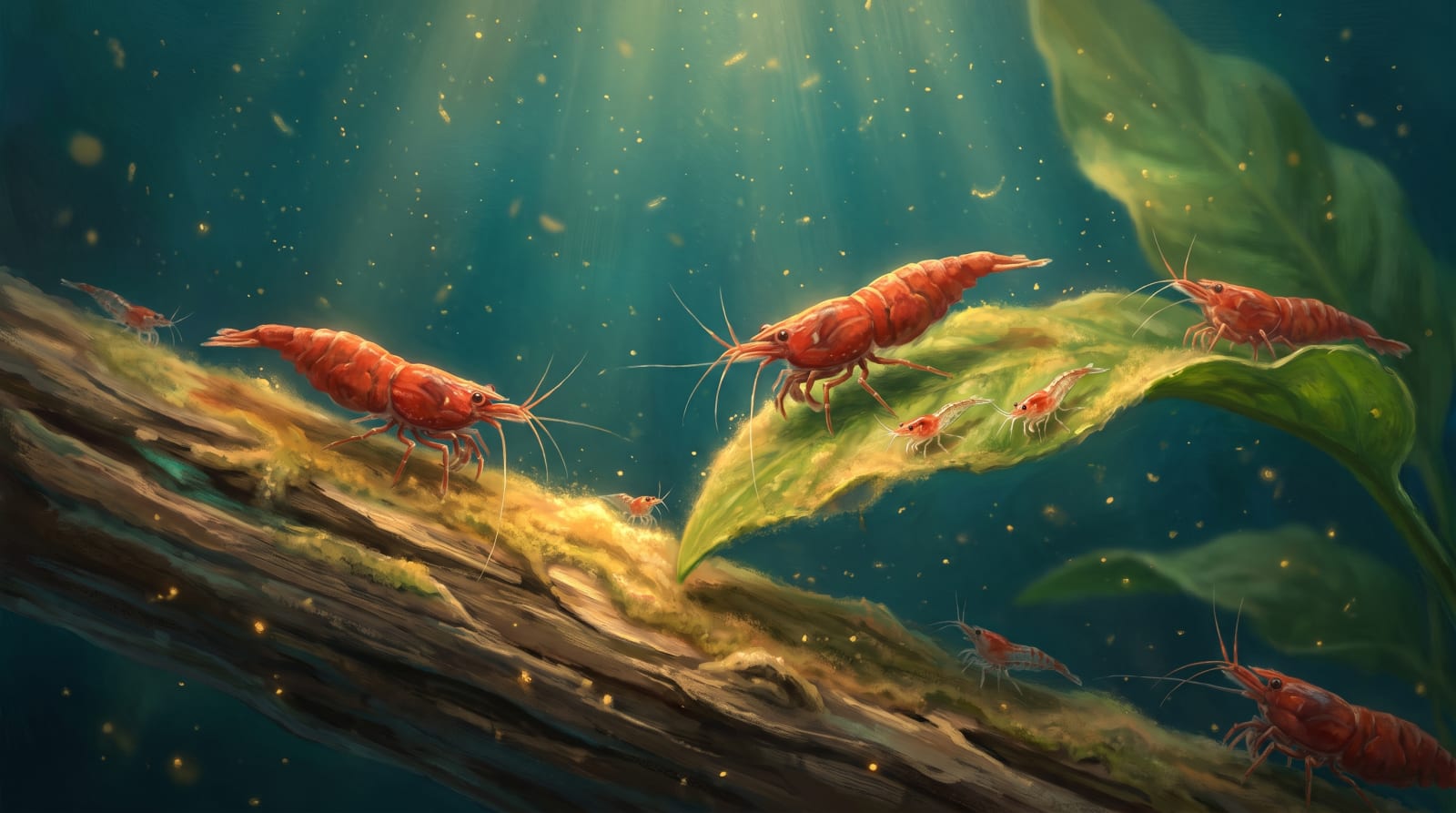
Watch a cherry shrimp for a minute and you'll see it doing the same thing over and over: picking at a leaf, a stone, the glass, the filter sponge, mouthparts flickering the whole time. It isn't cleaning up for you, and it isn't finding nothing. It's grazing biofilm, the thin living layer that coats every surface in a mature tank. Biofilm is the primary food of every Neocaridina colony — the meal that's always being served — and understanding it quietly changes how you keep shrimp.
What biofilm actually is
Biofilm is a microscopically thin, faintly slippery layer of life that forms on any surface left in water long enough. It's a community rather than a single thing: bacteria settle first, then algae, diatoms, protozoa and other microbes join them, all bound together in a sticky matrix they secrete around themselves. To us it shows up as the slight slickness on the glass, or the soft fuzz on a piece of wood. To a shrimp, it's a pasture.
Aquarists sometimes borrow the German word aufwuchs for the whole grazing layer — the biofilm plus the fine algae and the tiny creatures living within it. It's the same idea under a different name: the living skin on submerged surfaces that grazing animals eat. Whichever word you prefer, this is what a shrimp's day is built around. That constant picking you see isn't tidying, it's a colony working its way across an all-day, all-surface buffet.
Why it's the primary food
Cherry shrimp are grazers by design. Their small forelimbs and mouthparts are built to scrape fine, soft food off surfaces continuously, not to tear chunks from a big meal. Biofilm suits them perfectly because it's always there and always renewing, hour after hour, across every leaf, stone and pane in the tank. Nothing you drop in can match it for sheer consistency.
This is why the food you add is only ever a supplement. A mature, biofilm-rich tank feeds a colony most of the time on its own — the pellets and veg are toppings, not the meal itself. Feed a shrimp tank as if the shrimp depend on you and you'll overfeed it; feed it as if the tank is doing most of the work, which it is, and you'll land about right. It's also why an established tank asks so little of you: the more surface area growing biofilm, the more food is on tap, which is one of the reasons we plant heavily and never scrub a tank back to bare glass and stone. We've written separately about what cherry shrimp eat across their whole diet, and about how often to feed once you account for all this grazing.
Farming biofilm: surfaces, light and patience
Growing biofilm is less a task than a set of conditions you provide and then leave well alone. Three things drive it: surface area, light and time.
Surface area is the plate the food grows on, so more of it means more grazing. This is where hardscape and plants earn their keep beyond looks. Wood is a shrimp favourite — a piece of spider wood or cholla grows a thick, soft biofilm that shrimp mob for weeks, and our guide to shrimp-safe wood and rock covers which to use. Botanicals do the same job while slowly breaking down: catappa (Indian almond) leaves, alder cones and oak leaves all soften underwater and grow a rich film, and a colony will graze a leaf right down to its skeleton over a fortnight. Mosses are biofilm magnets too, with an enormous surface of fine leaflets, which is one of several reasons a well-mossed tank raises more shrimplets.
A trick we use in the breeding tanks is to keep a rotation of botanicals on the go — a fresh catappa leaf or a couple of alder cones dropped in every few weeks — so there's always something at the soft, heavily grazed stage rather than everything breaking down at once. Cholla wood does the same job more slowly and permanently, its hollow tubes packing in far more grazing surface than they look. None of it costs much, and shrimplets in particular will cluster on a decomposing leaf as though it's the best spot in the tank.
Light drives the algal side of the layer, so a modest daily photoperiod feeds the garden. Too little and the film stays thin; too much and you tip into nuisance algae. And then there's patience, the ingredient nobody wants to hear about. Biofilm builds over weeks, not days, and there's no additive that genuinely shortcuts a mature surface — time is the active ingredient. The one thing that reliably sets it back is over-cleaning: scrub every surface bare and you've thrown out the food. We clean the front glass for viewing and leave the rest to grow.
Is biofilm the same as algae?
Not quite, though the line is blurry and it rarely matters to the shrimp. Biofilm is the bacterial and microbial base layer; algae is the plant side that grows in and on it, from the fine brown diatom dust on a new tank's glass to soft green film. Shrimp graze both happily, along with the tiny creatures living in the mix — it's all aufwuchs to them. What they mostly leave alone are the tough nuisance algae like black beard and staghorn, which are a subject in their own right. The short version: the soft, grazeable stuff is what we mean by biofilm here, and a healthy shrimp tank grows plenty of it.
One thing worth clearing up, because it worries new keepers, is the slimy — sometimes faintly smelly — film that can appear on wood, ornaments and the water surface in the first weeks of a fresh tank. That's a bacterial bloom, not a fault. It's biofilm in its rawest, most enthusiastic phase, feeding on nutrients the new system hasn't balanced yet. Shrimp and snails graze it down, it settles as the tank matures, and it never needs treating — only patience.
Shrimplets live on it from day one
Biofilm matters most at the smallest scale. Cherry shrimp have no larval stage — a berried female releases fully formed miniatures a millimetre or two long — and those shrimplets start grazing biofilm the day they hatch. It's the perfect first food: everywhere they look, soft enough for the tiniest mouthparts, and asking no effort from you at all.
This is the single biggest lever on shrimplet survival, and it explains one of the hobby's quiet truths — a slightly grubby, mature, biofilm-covered tank raises far more young than a pristine new one. The film is nursery and canteen in one. It's why our guides to raising shrimplets and feeding shrimplets keep coming back to the same point: build the biofilm first, and the babies mostly raise themselves.
New tank versus mature tank
The gap between a new tank and a mature one is largely a gap in biofilm. A tank that's only just finished cycling — which itself takes four to six weeks or more — has the bacterial groundwork laid but hasn't yet grown the thick grazing layer a colony leans on. This is why we're wary of adding shrimp, and especially of expecting babies to thrive, in a tank that's too clean and too new.
You can give biofilm a head start, though. A handful of mulm, a squeeze of an established filter sponge, or a rock or piece of wood moved across from a running tank all seed the surfaces of a new tank with the microbes and spores that get a biofilm going, in the same way seeded media speeds up cycling. After that, the honest answer is to wait. Let light, surface and time do the work, resist the urge to keep everything spotless, and within a couple of months a new tank grows into the rich, self-feeding pasture a shrimp colony actually wants.
You'll also see biofilm "starter" products and powdered boosters sold for exactly this job. Some keepers swear by a light dose to a fresh tank, and there's no harm in it; we've never found one that beats a squeeze of old filter sponge and a fortnight's patience, and an overdose only clouds the water and feeds a bloom. If you use one, go light. The surfaces will get there either way.
FAQ
What is biofilm in an aquarium?
Biofilm is a thin, slightly slippery layer of bacteria, algae, diatoms and other microbes that forms on every underwater surface — glass, wood, plants, substrate and filter — bound together in a sticky matrix the microbes produce. Aquarists also call the whole grazing layer aufwuchs. It's harmless, natural and, for shrimp, essential: that constant picking you see is a colony grazing biofilm off the surfaces of the tank.
How do I grow biofilm for shrimp?
Give it surface area, light and time, then leave it alone. Add wood, botanicals like catappa leaves and alder cones, and plenty of moss for the film to grow on; run a modest light period to feed the algal side; and be patient, because biofilm builds over weeks rather than days. Avoid over-cleaning, since scrubbing surfaces bare removes the food. A handful of mulm from an established tank speeds things along.
Is biofilm enough to feed shrimp?
In a mature tank, biofilm feeds a colony most of the time — it genuinely is the primary food. That said, we still supplement two to three times a week with a staple food, veg and the occasional protein, because a growing, breeding colony benefits from the extra. Think of biofilm as the constant base of the diet and added food as the top-up, rather than one replacing the other.
How long does biofilm take to grow?
Weeks rather than days. A newly cycled tank — and cycling itself takes four to six weeks or more — has the bacterial foundation but still needs time to grow a thick grazing layer, usually a couple of months to reach the rich, self-feeding state a colony thrives on. Seeding it with mulm, an established filter squeeze or a piece of mature wood gives it a head start, but time remains the real ingredient.