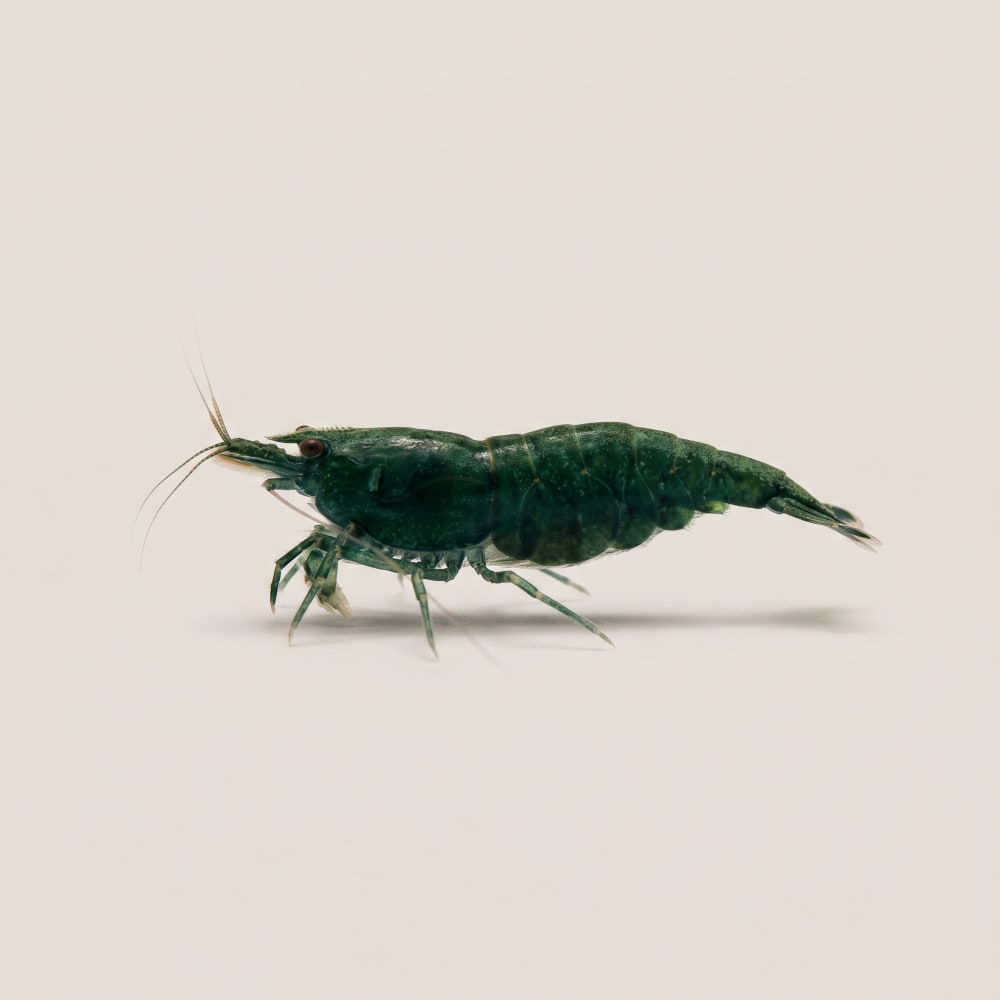
Green Jade is the darker of the hobby's two green Neocaridina lines, and the one that rewards a second look. Under bright light it's a deep, dense forest green; in the shade of a planted tank it reads almost black until the shrimp turns and the green flares along its flank. If the emerald line is green done loud, the jade is green done quietly — and it's every bit as scarce in UK shops.
Green Jade shrimp at a glance
| Difficulty | Easy |
| Adult size | 2.5–3cm |
| Lifespan | 1–2 years |
| Temperature | 18–26°C |
| pH | 6.8–7.6 |
| GH | 6–12 |
| TDS | 150–250 |
| Breeding | Prolific |
What is a Green Jade shrimp?
Green Jade is a colour line of Neocaridina davidi, the same species as every cherry shrimp, bred towards deep bottle-green instead of red. Listings call it "jade shrimp", "green jade" or simply "green neocaridina", and the care behind every name is identical: easy, hardy, prolific.
Where the jade came from is the interesting part. Most breeders credit the line to chocolate ancestry — the same deep-brown foundation stock that gave the hobby its Bloody Marys and black rose lines — although, as with almost every Neocaridina pedigree, that's received wisdom rather than paperwork, and you'll meet breeders who tell it differently. We lean towards the chocolate story for a practical reason: it predicts exactly how the line behaves. Jade broods regularly throw brownish and olive shrimplets, which is just what you'd expect from a green selected out of brown, with the old colour still sitting close beneath the surface.
Green Jade vs Emerald Green
The two greens get confused constantly, sometimes honestly and sometimes not. Emerald green is the brighter line — a rich, lit-up green whose background is genuinely debated — while the jade is deeper and darker, a forest green that holds more shadow. Side by side the difference is obvious: emeralds glow, jades smoulder. Jade broods also throw brown or olive offspring more readily than emerald broods, which matters if you plan to breed rather than just keep. Neither green is the better shrimp; they're different moods, and plenty of keepers end up running both — in separate tanks, for reasons covered below.
Colour and grading
Jades are graded on depth and evenness, like any solid colour line. A top jade is dense, even forest green from rostrum to tail fan with no translucent windows; standard grade shows lighter patching, often with an olive cast over the shoulders. As in all Neocaridina, females are larger and hold far deeper colour, males run slim and pale, and youngsters darken as they mature — so never write off a jade brood until its females are grown. How grading works across the colour lines is in the Neocaridina grades guide.
Setting matters too. Over dark substrate a jade colony looks carved from stone; over pale sand the same shrimp go grey-green and flat. Dark floor, heavy planting, and the line does the rest.
Care
Identical to any other cherry shrimp, so the full cherry shrimp care guide applies wholesale: a cycled tank from 19L, sponge filtration, and stable water at 18–26°C, pH 6.8–7.6, GH 6–12, TDS 150–250. Chase stability, not perfect numbers. Unheated UK rooms are fine; breeding simply runs slower at 18–21°C than it does in the low twenties.
Hard-water regions can generally run jades straight from the dechlorinated tap, while soft-water regions should remineralise to reach GH 6–12 — check where you sit in the UK tap water guide. Keep copper-based medications and pesticide-carrying plants out of the tank entirely.
Do Green Jades breed true?
Kept unmixed, yes — jade to jade gives you mostly jade, generation after generation. What the line also gives you, more than most, is throwbacks: brownish and olive shrimplets turning up in otherwise clean broods. If the chocolate ancestry story is right, that's the foundation colour resurfacing — not a fault in your keeping, and not automatic proof your line was mixed. It's normal jade behaviour. Pull the off-colour shrimplets into a separate tank before they mature at 3–5 months and breed only from your deepest greens; the throwback rate falls noticeably within a few generations. The cycle itself is standard cherry breeding — 20–30 eggs, carried 14–21 days — and the whole process is in how to breed cherry shrimp.
What you must not do is house jades with any other Neocaridina colour. All the lines interbreed freely, and mixed offspring drift back to brownish wild-type within a couple of generations — and with a line that already throws brown, you'll barely see it coming. One colour per tank, always; the genetics are in mixing Neocaridina colours.
Buying Green Jade shrimp in the UK
Jades are, if anything, harder to find in the UK than emeralds. Chains don't stock them, few breeders work the line, and most jades change hands privately or through waitlists. Expect £2–4 per shrimp for standard grade where it surfaces, and £30–50 per 10 for genuine high grade — like the other greens, jade sits at the top of that range because supply is thin.
Before paying, look at group photos of the actual stock and count the olive animals. One or two culls visible in a breeding tank is honest reality; a listing photo full of olive shrimp is a low-grade line being sold on the strength of its best female. Ask the breeder how hard they cull — the good ones will tell you without being offended.
We're not selling Green Jade right now, so join the waitlist on this page if you'd like an email should that change.
FAQ
What is the difference between green jade and emerald green shrimp?
Depth. Green jade is the darker forest green, most often credited to chocolate ancestry and more prone to throwing brownish or olive shrimplets; emerald green is brighter, and its background is genuinely debated among breeders. Care is identical for both, so choose on the shade — jade for a darker, moodier tank, emerald for maximum visibility.
Why are some of my green jade shrimp brown?
Most likely the line doing what jade lines do. Green jade is widely believed to descend from chocolate stock, and that brown resurfaces in broods as olive or brownish shrimplets even in well-kept, single-line colonies. Separate them before they breed and select your deepest greens. If brown offspring suddenly dominate, though, ask whether another Neocaridina colour has been in the tank — mixed lines collapse to wild-type brown within a couple of generations.
Are green jade shrimp hard to find in the UK?
Yes — of the two green lines, jade is usually the scarcer. Chain shops effectively never carry it, and most stock is sold breeder-to-keeper, often via waitlists. The keeping is easy; the finding is the hard part.
How much do green jade shrimp cost?
Standard-grade jades run £2–4 per shrimp where they appear. High-grade groups sell at £30–50 per 10 in the UK, and jade sits at the top of that range on scarcity. A "high grade" price far below that band usually means olive-heavy or loosely selected stock — ask for group photos before you commit.