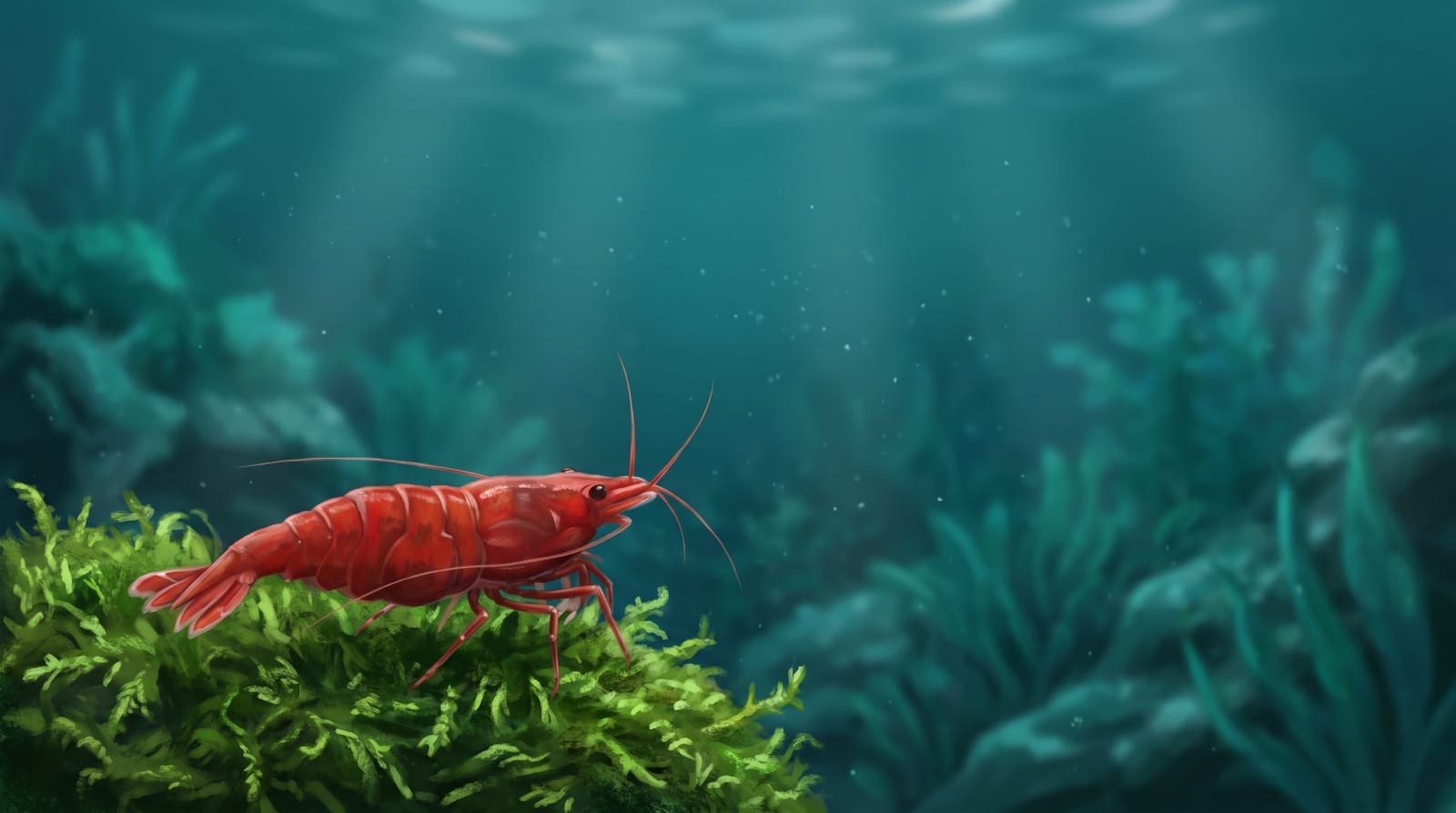
Cherry shrimp are the first animal we recommend to anyone getting into shrimp keeping, and years of breeding Neocaridina at home haven't changed that. They're hardy, they're cheap, they breed readily, and in most of the UK they'll live happily in dechlorinated tap water. This guide covers everything we actually do to keep our colonies healthy, written for UK water, UK room temperatures and UK prices.
What are cherry shrimp?
Cherry shrimp are Neocaridina davidi, a freshwater dwarf shrimp. Adults reach 2.5–3cm, with males noticeably smaller and slimmer and females larger and more deeply coloured. Lifespan is short at 1–2 years, but a breeding colony renews itself faster than individuals age out, so a healthy tank never feels like it's winding down.
Telling the sexes apart is straightforward once they mature. Females are the ones you notice: bigger, deeper in colour, and often carrying a "saddle" of undeveloped eggs visible behind the head. Males stay smaller, slimmer and paler. Buy a group of ten and you'll have both, which is all a colony needs.
Strictly, "cherry shrimp" means the red cherry line, the classic red form. In practice the name has stretched to cover the whole species. Blue dreams, bloody marys, yellows, oranges: all the same species wearing different colours, all kept exactly the same way.
Three things make them the best beginner shrimp. They tolerate a wide band of water conditions as long as those conditions hold steady. They breed with zero help from you, because there's no larval stage; a berried female simply releases fully formed miniature shrimp. And they earn their keep, grazing algae and biofilm off every surface in the tank all day long.
They're cheap to start with, too. In the UK, expect £2–4 per shrimp for standard grades and £3.50–5 for high grades, with high-grade groups usually sold at £30–50 per 10. A starting colony of ten standard shrimp is a £20–40 purchase. We've covered where to buy cherry shrimp in the UK separately, including how to spot a seller worth your money.
Cherry shrimp care at a glance
| Care factor | Our recommendation |
|---|---|
| Difficulty | Easy |
| Adult size | 2.5–3cm |
| Lifespan | 1–2 years |
| Tank size | 10L absolute minimum, 19L+ recommended |
| Temperature | 18–26°C |
| pH | 6.8–7.6 |
| GH | 6–12 |
| KH | 2–8 |
| TDS | 150–250 |
| Diet | Biofilm and algae, supplemented 2–3× weekly |
| Breeding | Prolific, no larval stage |
| Price (UK) | £2–4 standard grade, £3.50–5 high grade |
Tank setup
10L is the absolute minimum and 19L or more is what we'd actually recommend. That's not gatekeeping. Small volumes of water change temperature and chemistry fast, and shrimp hate fast; a 19L tank is more forgiving than a 10L, not less. Bigger also means more surface area growing biofilm, which is the food supply. Our shrimp tank setup guide walks through a complete build step by step; the short version follows.
Filter. A basic air-driven sponge filter is the standard, and it's what runs on every tank in our breeding room. There's no intake to pull shrimplets into, and the sponge itself becomes a huge grazing surface. You'll see shrimp picking over it constantly. If you're reusing a filter with an intake, cover the intake with a sponge prefilter.
Substrate. Inert substrate, meaning plain sand or fine gravel, is all Neocaridina need. Active buffering soils are aimed at Caridina species that want soft acidic water; for cherries they're an unnecessary expense that drags pH somewhere you don't need it to go. We use dark substrates because colour shows better against them, but that's cosmetic, not care.
Plants. Plant heavily if you can. Java moss, anubias and java fern are the classic trio: undemanding, shrimp-safe and dense with the surfaces biofilm grows on. Moss especially is shrimplet habitat, and cover equals survival. One warning: pesticide residue on new plants kills shrimp, so buy invertebrate-safe stock or quarantine and rinse anything new before it goes near the tank. We keep a catappa (Indian almond) leaf in most tanks as well; as it softens, the shrimp graze the biofilm off it down to the leaf skeleton. More planting ideas are in our aquascaping guide for shrimp tanks.
Cycling. None of the above matters if the tank isn't cycled. A shrimp tank needs a fully established nitrogen cycle, which typically takes 4–6 weeks or more, before any shrimp go in. Ammonia and nitrite at any measurable level are killers, and in our experience an uncycled tank is behind most week-one shrimp deaths. If cycling is a new word to you, stop here and read how to cycle a shrimp tank first.
Heater. Most UK homes don't need one. An unheated tank in a normal room sits around 18–21°C, comfortably inside the 18–26°C range; the colony just breeds slower than it would at 21–24°C. If your room drops below 18°C in winter, add a small preset heater. We heat our breeding tanks and leave the rest unheated.
Water parameters, and what UK tap water actually gives you
Here's what we aim for, and what each number is doing.
| Parameter | Target | Notes |
|---|---|---|
| Temperature | 18–26°C | 21–24°C for fastest breeding |
| pH | 6.8–7.6 | Tolerates 6.5–8.0 if stable |
| GH | 6–12 | The minerals new shells are built from |
| KH | 2–8 | Buffers pH against swings |
| TDS | 150–250 | Watch the trend, not the number |
| Ammonia | 0 | Any reading is an emergency |
| Nitrite | 0 | Same |
| Nitrate | Under 20ppm | Managed with water changes |
The rule that overrides the whole table: stability beats perfect numbers. A colony sitting steady at pH 7.8 will do better than one being chased towards "perfect" with additives. Sudden swings in temperature or TDS kill more cherry shrimp than any individual out-of-range reading. The reasoning behind each line is in the full Neocaridina water parameters guide.
You don't need a lab to track any of this. A liquid test kit for the basics, a cheap TDS pen and a thermometer cover the whole table. The TDS pen earns its keep most, because it's the fastest way to spot drift before drift becomes a swing.
Now the UK-specific part. If you're in London or the South East, your tap water is almost certainly hard: GH often 12–18 or higher, roughly 250–320ppm as CaCO3 — London averages around 260. Your water company publishes the exact figure for your postcode. That's the high side of ideal, but for Neocaridina it's generally fine straight from the tap once dechlorinated. Hard water builds good shells.
If you're in Manchester, Glasgow, much of Wales or Cornwall, you likely have the opposite situation: soft water, with GH around 2–6. That's not enough mineral for reliable moulting, and you'll need to remineralise. A GH+ remineraliser dosed into RO water or into your tap brings it into range. Our UK tap water guide covers this region by region.
Whatever your postcode, always dechlorinate. Some UK water companies use chloramine rather than chlorine, and chloramine doesn't gas off if you leave a bucket standing overnight. Use a water conditioner that explicitly neutralises chloramine as well as chlorine, every single time.
Introducing your shrimp
Buy at least 10. A group that size all but guarantees a mix of sexes and gives the colony enough genetic breadth to grow from; buying three "to test the water" mostly gets you three stressed shrimp and no momentum.
When they arrive, drip acclimatise them over 1–2 hours. Shrimp and their transport water go into a jug, an airline tube siphons from the tank, and a loose knot in the line slows the flow to a steady drip. The point is to close the gap between the seller's water and yours gradually; a sudden jump in TDS or temperature is exactly the kind of swing that kills shrimp. Then net them across. The transport water goes down the drain, not into your tank. The full drip acclimation guide covers it step by step.
Expect new arrivals to look washed out and hide for a day or two. Colour returns as stress drops. It isn't a refund situation; it's just shrimp.
The care routine: about 15 minutes a week
Feeding is the part beginners overcomplicate. A mature tank feeds cherry shrimp most of the time: biofilm and algae are the primary diet, and everything you add is a supplement. We feed 2–3 times a week, using a quality shrimp food as the staple, rotated with algae wafers, spirulina and blanched veg like courgette or spinach, plus an occasional protein treat. Blanching just means a brief dip in boiling water so the veg sinks and softens. Any fresh food still sitting there after a few hours comes out. Overfeeding fouls water and kills far more shrimp than underfeeding ever does; in an established tank, a missed feed costs nothing. The full breakdown is in what do cherry shrimp eat.
Shrimplets barely need you at all. They live on biofilm, which is why an older, slightly grubby tank raises more young than a spotless new one.
Water changes. We change 10–20% weekly on our colonies. Small and regular beats large and occasional, because every big change is a TDS and temperature event. New water gets dechlorinated, temperature-matched and added slowly. Between changes, keep the tank topped up: evaporation leaves minerals behind, so TDS creeps upward in a tank left to drop. If you top up with tap water, dechlorinate that too.
Watching. Daily care is thirty seconds of looking while the kettle boils. Shrimp fanning their mouthparts, picking at surfaces, mooching about: all fine. A tank gone still, with shrimp sat motionless in the open, is your cue to test the water before doing anything else. Add a TDS check and a glass wipe at water-change time and the whole week's maintenance genuinely fits inside 15 minutes.
Moulting, and the white ring of death
Shrimp grow by moulting — climbing out of their own exoskeleton. Adults moult every 3–6 weeks, juveniles more often because they're growing faster, and for 24–48 hours afterwards the new shell is soft, so they hide. A shrimp you haven't seen all day is usually under the moss hardening up, not dead.
The empty shell fools everyone at first. If it's translucent and complete, it's a moult, not a body. Leave it in the tank; the colony will usually have eaten it within a day or two.
The moult to worry about is the failed one. The white ring of death is a pale band where the exoskeleton has split behind the carapace but the shrimp can't pull itself free, and most shrimp that reach that stage don't survive it. It's linked to GH and mineral imbalance and to sudden parameter swings; the classic trigger is a big water change with mismatched water. Keep GH at 6–12, change water gently, and you may never see one.
Breeding: the short version
If your parameters are in range, breeding isn't something you do. It's something you'd have to work to prevent.
Females mature at around 3–5 months and develop a "saddle" behind the head: undeveloped eggs in the ovaries, visible through the shell. Within days of her next moult a saddled female becomes "berried", carrying 20–30 eggs under her swimmerets and fanning them constantly. The male's involvement ends at fertilisation; she does all the carrying. Eggs hatch in 14–21 days, faster at the warm end, and what emerges are 1–2mm fully formed miniature shrimp. No larval stage, no special food: shrimplets graze biofilm from day one.
Run those numbers forward and a group of ten becomes a proper colony in months, not years. Grading, selective breeding and what to do when the colony outgrows the tank are all in the full guide to how to breed cherry shrimp.
Colour lines and grading
Every Neocaridina colour line is the same species, so the care never changes. Only the price does.
Red is graded on depth and coverage of colour, running Cull → Cherry → Sakura → Fire Red → Painted Fire Red, and each step up the ladder costs more. That premium is honest work: holding a line at the top grades takes constant selection, because every generation throws variation and someone has to keep pulling the weak colour out. How grading works in practice, and why "Fire Red" from two sellers can mean two rather different shrimp, is covered in the Neocaridina grades guide. Beyond red, the two lines we're asked about most are blue dream, a deep opaque navy, and bloody mary.
One rule matters more than any grade: don't mix colour lines. They're all one species, they interbreed freely, and within a couple of generations mixed offspring trend back towards wild-type brown. One line per tank, always.
Tank mates
The honest answer is that the safest cherry shrimp tank is a cherry shrimp tank, and that's how we run every breeding colony. Snails are the exception we trust completely. Small, peaceful nano fish will mostly leave adults alone but will pick off shrimplets, though a well-mossed colony can absorb those losses; anything with a mouth big enough to fit a shrimp will eventually use it. The full cherry shrimp tank mates guide grades the usual candidates honestly.
When shrimp start dying
When cherry shrimp die, it's nearly always water before it's disease. Our checklist, in order: ammonia or nitrite in a tank that wasn't fully cycled; chlorine or chloramine from an unconditioned water change; a sudden temperature or TDS swing; copper; pesticide residue on recently added plants. Work through that list before reaching for treatments; the longer version lives in why are my shrimp dying.
Keep the numbers in perspective too. One dead shrimp in a busy colony is normal attrition for an animal that lives 1–2 years. Several in a week is a pattern, and patterns are water until proven otherwise.
Copper deserves its own paragraph. Copper-based medications kill shrimp, so never dose them in a shrimp tank, even "just for the fish". The trace copper in a quality shrimp-safe plant fertiliser is fine; a copper treatment is not.
Actual shrimp diseases exist but come a distant second in our experience. Vorticella shows as white fuzzy patches, scutariella japonica as tiny worms on the rostrum, and bacterial infections as opaque or pink tissue inside the body. Each has its own treatment route, and none of them is copper.
FAQ
Are cherry shrimp easy to keep?
Yes — the easiest dwarf shrimp in the hobby, and one of the easier aquarium animals full stop. The two things that catch beginners out are uncycled tanks and unstable water. Cycle the tank properly, keep parameters steady and dechlorinate every drop of new water, and cherry shrimp mostly look after themselves. They'll also forgive the odd late water change, which is more than can be said for much of this hobby.
How many cherry shrimp should I start with?
Ten or more. A group that size all but guarantees both sexes, gives the colony genetic room to grow, and absorbs the odd mistake while you're learning. Starting with two or three saves a few pounds and usually costs you the colony.
Do cherry shrimp need a heater in the UK?
Usually not. Cherries are comfortable anywhere from 18–26°C, and an unheated tank in a typical UK room sits around 18–21°C, which is fine for health and merely slower for breeding. If your room drops below 18°C in winter, or you want the faster breeding you get at 21–24°C, add a small preset heater.
How long do cherry shrimp live?
1–2 years. That sounds short, but in a breeding colony the generations overlap so completely that the tank itself never ages. You stop tracking individuals and start thinking in colony terms.
Can cherry shrimp live in tap water?
In most of the UK, yes: dechlorinated tap water is exactly what our own colonies live in. Hard-water regions like London and the South East are generally fine straight from the tap; soft-water regions such as much of Wales, Cornwall, Manchester and Glasgow need a GH+ remineraliser to bring minerals up to GH 6–12. The non-negotiable is dechlorinator rated for chloramine, every water change.
Do cherry shrimp clean your tank?
They're a cleanup crew, not a cure. Cherries graze algae and biofilm all day and clear leftover food, and a large colony makes a visible difference to every surface. What they won't do is fix the cause of an algae problem — that's light and nutrients — and they add a small bioload of their own. Think maintenance staff, not reset button.
How fast do cherry shrimp breed?
Quickly, once they start. Females mature at 3–5 months, carry 20–30 eggs for 14–21 days, and can berry again within days of a moult. Warmth towards 21–24°C shortens the cycle. In practice, a group of ten bought in spring is usually a self-sustaining colony by autumn.