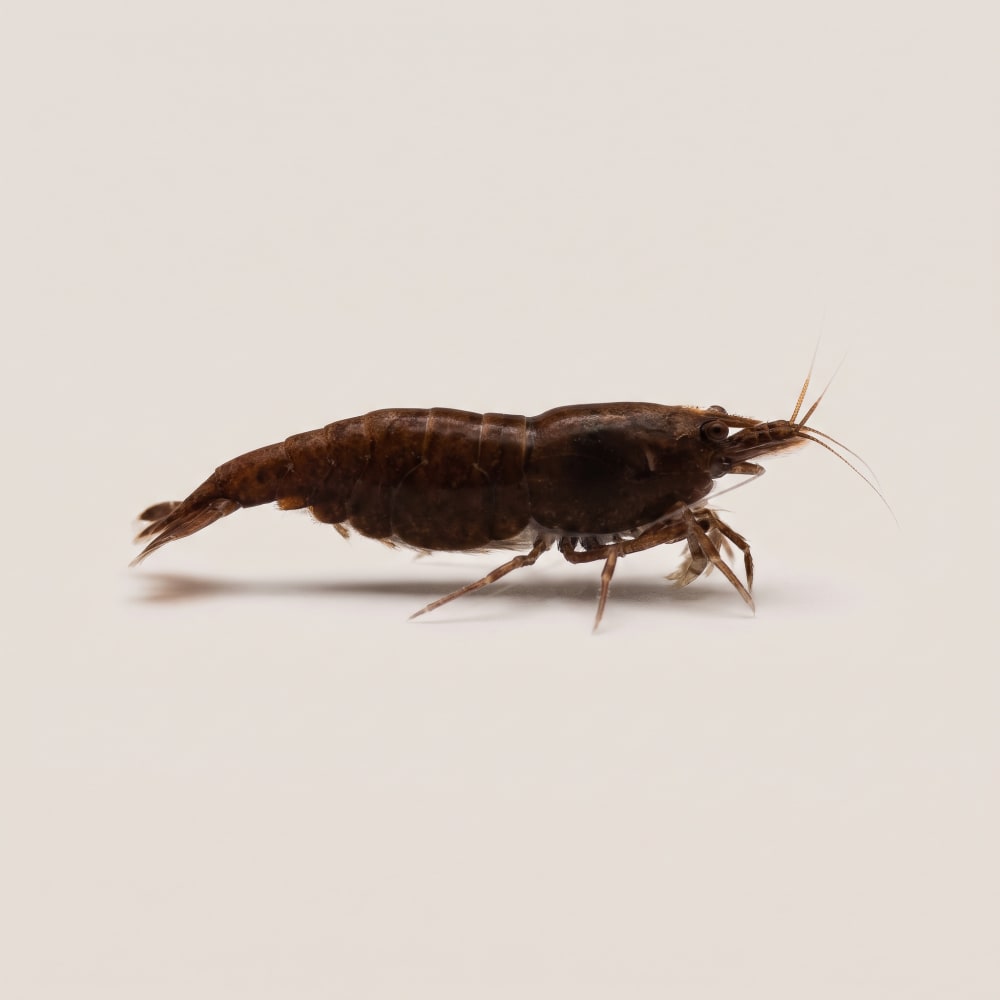
Nobody points at the chocolate tank first. Visitors to our breeding room walk straight past it to the reds and blues, and we understand why — "brown shrimp" is a hard sell on paper. Give a good chocolate colony five minutes under proper light, though, and the colour starts doing what dark chocolate does: deep, saturated cocoa with a gloss on it, warmer the harder you look. And there's a secret the brights don't have — several of the most celebrated lines in the hobby are credited to this unfashionable brown one.
Chocolate shrimp at a glance
| Difficulty | Easy |
| Adult size | 2.5–3cm |
| Lifespan | 1–2 years |
| Temperature | 18–26°C |
| pH | 6.8–7.6 |
| GH | 6–12 |
| TDS | 150–250 |
| Breeding | Prolific |
What is a chocolate shrimp?
Chocolate is the deep brown colour line of Neocaridina davidi — a cherry shrimp selectively bred away from red and towards a dense, glossy cocoa. That word "selectively" matters, because "brown shrimp" makes people picture the washy, translucent grey-brown of wild-type Neocaridina, and a chocolate is nothing like it. Wild-type is camouflage: thin, patchy, semi-clear, the colour of a shrimp trying not to be seen. A good chocolate is the opposite — pigment deliberately deepened over generations until it's even, opaque and rich, closer to 85% dark chocolate than to pond water. Put the two side by side and nobody confuses them again.
Care, size, lifespan and temperament are standard cherry shrimp throughout, which is to say easy, hardy and prolific.
The line behind the lines
Here's why we rate chocolates beyond the colour: the hobby quietly stands on them. The Bloody Mary — probably the most admired red in the hobby — was developed from the chocolate line rather than the ordinary red ladder, which is why its red sits in the flesh instead of on the shell. Blue Diamond and Black Rose are commonly credited to chocolate breeding programmes as well, though as ever with shrimp genetics the exact family trees are argued over between breeders and more than one claims the founding work. What isn't argued is the pattern: when breeders wanted deep colour saturated through the body rather than coated on the shell, chocolate stock is where they kept starting.
So the brown tank at the end of our rack is, in a real sense, a foundation stone. We keep ours partly for that reason and partly because, over the years, we've simply come to prefer looking at them.
Colour and grading
Chocolates are graded on depth, evenness and that characteristic gloss. Standard grade shows good brown with lighter panels and some translucence at the joints and legs. High grade is even, opaque cocoa from nose to tail, often with a warm reddish cast in strong light — the same deep-pigment tell you see in the lines bred out of them, and a mark of quality rather than a fault. Females carry the deeper, denser colour while males run smaller and paler, so judge a group by its females. The line rewards dark substrate and heavy planting, where the gloss reads richest; the general standards are in our Neocaridina grades guide.
Care
There's nothing new to learn: the table above has the canonical ranges, the cherry shrimp care guide has the day-to-day, and stability matters more than any single number. A cycled tank of 19L or more, a sponge filter, a weekly dechlorinated water change, a varied diet with a protein component, and copper kept out of the room entirely. An unheated UK room at 18–21°C suits them fine; broods just come a little faster at 22–24°C. Hard-water areas generally run them straight from the treated tap, while soft-water areas should remineralise to GH 6–12 — check your region in the UK tap water guide.
Breeding true
Chocolate breeds true kept as a single line, and it's as prolific as any Neocaridina: berried females carry 20–30 eggs for 14–21 days, shrimplets graze biofilm from day one, and maturity comes at 3–5 months, all covered in how to breed cherry shrimp. Broods vary from milk to dark, and selection is where the connoisseur's satisfaction lives — keep breeding your densest, glossiest browns and the line visibly deepens within a few generations. Push far enough in that direction and you're walking the same road that produced the black lines.
One line per tank, as always. Chocolates cross freely with every other Neocaridina colour, and mixed offspring slide back to thin wild-type brown within a couple of generations — which for a chocolate keeper is a particularly sly way to lose a line, because the early culls half-resemble what you started with. The difference is unmistakable once you know it: wild-type is washy and clear, chocolate is dense and glossy. Mixing Neocaridina colours explains the genetics.
Buying chocolate shrimp in the UK
Standard-grade chocolates cost £2–4 each, and deep high-grade stock runs £30–50 per 10. The practical snag is availability rather than price: chocolates are unfashionable, so shops rarely hold them and most good stock moves breeder-to-keeper. When you do find some, judge them the way you'd judge a black line — opaque, even colour in honest light, no washy panels — and be pleased rather than suspicious about a warm reddish cast under strong light. Buy ten or more; a colony, not a pair, is how every Neocaridina line is kept well.
We're not selling Chocolate shrimp right now — the waitlist on this page gets an email if we start breeding again.
FAQ
What are chocolate shrimp?
A deep brown colour line of Neocaridina davidi, the cherry shrimp, selectively bred for dense, glossy cocoa-brown. Care is identical to any cherry shrimp: easy, hardy, prolific. Their quiet claim to fame is serving as base stock behind several celebrated lines, most famously the Bloody Mary.
Are chocolate shrimp just wild-type cherry shrimp?
No. Wild-type Neocaridina are a thin, translucent, patchy grey-brown — camouflage colouring, the look mixed colonies drift back to. Chocolates are the product of deliberate selection in the other direction: saturated, even, opaque brown with a gloss to it. One is the absence of breeding; the other is years of it.
What shrimp lines come from chocolates?
The Bloody Mary red was developed from chocolate stock, and Blue Diamond and Black Rose are commonly credited to chocolate programmes too. Exact lineages are debated between breeders — shrimp family trees rarely come with paperwork — but chocolate's role as the hobby's deep-colour foundation is broadly accepted.
How much do chocolate shrimp cost UK?
£2–4 each for standard grade and £30–50 per 10 for high-grade deep lines. Finding them is harder than affording them — few UK shops stock chocolates, so expect to buy from breeders and be patient about timing.