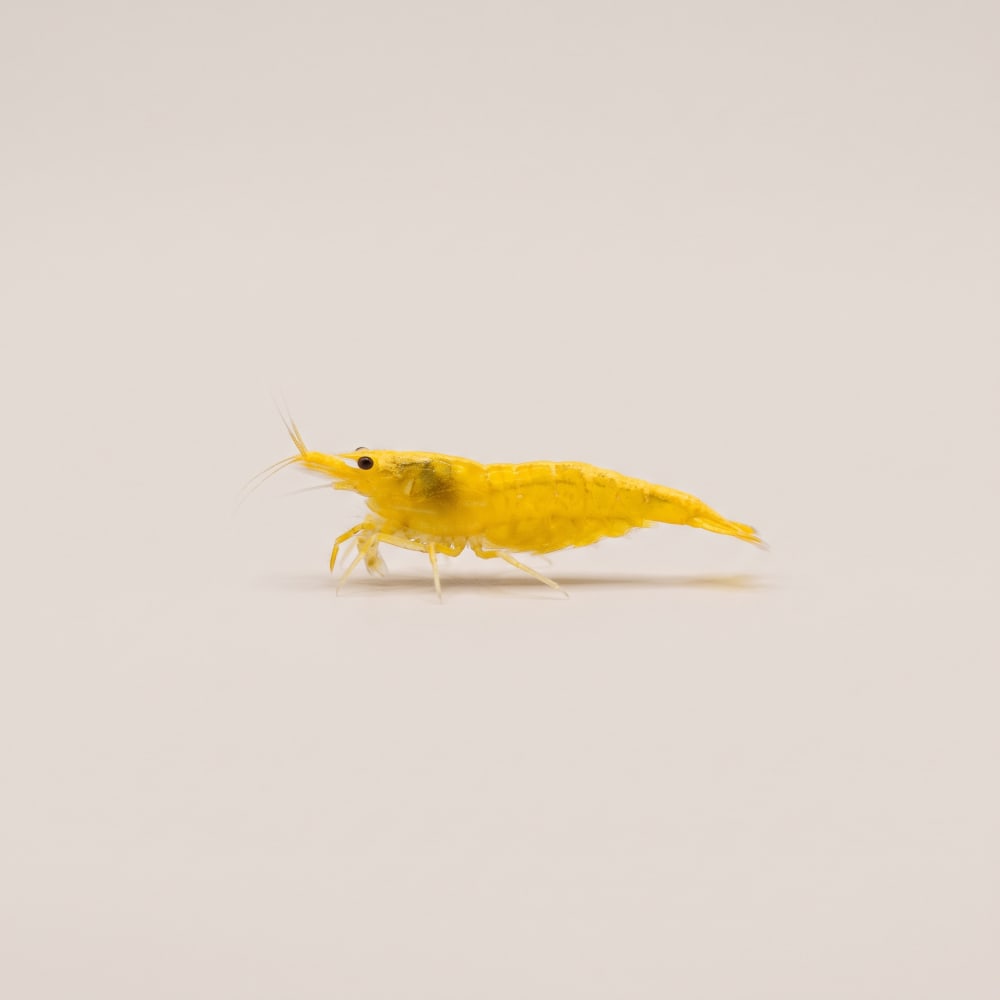
Nothing else in the genus glows like a Yellow Fire. Red is handsome and blue is dramatic, but over dark substrate and green planting a colony of good yellows looks lit from within — the one Neocaridina you spot from across the room before you've found any of the others. They're also one of the toughest, most forgiving lines we've ever kept, which is a rare combination: the loudest shrimp in the fishhouse and the easiest.
Yellow Fire shrimp at a glance
| Difficulty | Easy |
| Adult size | 2.5–3cm |
| Lifespan | 1–2 years |
| Temperature | 18–26°C |
| pH | 6.8–7.6 |
| GH | 6–12 |
| TDS | 150–250 |
| Breeding | Prolific |
What is a Yellow Fire shrimp?
Yellow Fire is a colour line of Neocaridina davidi — the same species as the red cherry shrimp, selectively bred for solid yellow instead of red, and one of the earliest directions the hobby took after red. The names stack by grade rather than by shrimp: "yellow shrimp" and "yellow cherry shrimp" cover the line loosely, "yellow fire" usually means solid, well-covered yellow, and "neon yellow" refers to high-grade animals showing the golden back stripe (more on that below). One animal, one care sheet, several labels.
The line yellows get mistaken for is orange sakura, especially under warm shop lighting that pushes everything amber. A true yellow is cool and clean, like lemon rind; an orange sakura is unmistakably warmer. If you're unsure at the shop, judge from a photo taken in neutral light rather than under the display tubes.
Colour, grading and the neon stripe
Yellows are graded on the depth and coverage of the yellow. Standard grade shows decent colour with translucent patches; high grade is opaque, even yellow across the whole body. At the top of the ladder sits the feature the "neon" name comes from: a golden, paler stripe running the length of the back, rostrum to tail. It shows strongest on well-fed, mature, high-grade females, and it's the main tell separating a neon yellow from an ordinary one. Grade for depth of body colour first and stripe second — a crisp stripe on a washed-out shrimp is still a washed-out shrimp. Where this ladder sits alongside the red and blue ones is covered in the Neocaridina grades guide.
As ever, females run larger, deeper and more opaque than males, juveniles deepen as they mature, and dark substrate earns you a full grade of apparent colour for free.
Care
When someone asks us what their first shrimp colony should be, this line is usually the answer. Yellows have a reputation as one of the hardiest colour lines in the hobby, and our racks bear it out: they shrug off the small mistakes every new keeper makes, provided the tank is cycled and the water is stable. The routine is the standard one in the cherry shrimp care guide: a cycled tank from 19L, a sponge filter, stable water inside the table's ranges, a varied diet with some protein, dechlorinator on every change and no copper anywhere near them.
Most UK hard-water areas can keep yellows straight from the dechlorinated tap; soft-water areas should remineralise to GH 6–12 so moults come away cleanly. An unheated room at 18–21°C works fine — colonies just breed faster in the low twenties.
Breeding true
Yellow to yellow gives yellow, reliably. This is an old, well-fixed line, and it's prolific even by cherry standards — a starter group of ten becomes a working colony faster than most keepers expect. How to breed cherry shrimp covers the whole cycle, and nothing about it changes for yellows. Selection is the usual game: breed from your deepest, most opaque shrimp, favour the ones showing the stripe, and pull pale or patchy youngsters before they mature at 3–5 months.
Keep the line alone, though. Yellows interbreed with every other Neocaridina colour, and mixed-line offspring turn increasingly brownish wild-type within a couple of generations — a particular waste when the whole point of this shrimp is that clean, unmistakable yellow. Mixing Neocaridina colours explains why it happens.
Tank mates
Standard Neocaridina rules apply: snails are safe company, small peaceful nano fish will pick off shrimplets even when they ignore the adults, and breeding colonies do best species-only. Yellow is the colour that least needs company anyway — it's the highest-visibility line in the hobby, and a planted, shrimp-only tank shows it at full strength. The tank mates guide grades the usual candidates if you want more than shrimp. And if you're after a two-tank display, yellow next to emerald green is a pairing we've never tired of — in separate tanks, for the reasons above.
Buying Yellow Fire shrimp in the UK
Yellows are among the easier colour lines to find in the UK — decent shops see them periodically — but shop stock is usually standard grade at £2–4 per shrimp: honest value, and a perfectly good starting colony. Genuine neon-grade groups with the back stripe mostly come from breeders and run £30–50 per 10. The usual checks apply: the seller's own photos, colour judged across the group rather than the best female, and yellow that's actually yellow rather than washed amber under warm lighting.
Buy ten or more rather than a pair — cherries breed as a colony, and ten gives the genetics room to work. We're not selling Yellow Fires ourselves right now — join the waitlist on this page and we'll email you if we start breeding again.
FAQ
Are yellow shrimp the same as cherry shrimp?
Same species, different colour line. "Cherry shrimp" strictly names the red line of Neocaridina davidi but gets used for the whole species, which is why yellows are often sold as "yellow cherry shrimp". Size, lifespan, care and breeding are identical — only the pigment differs.
What is the neon stripe on yellow fire shrimp?
A golden, paler line running along the top of the back from head to tail, strongest on mature, high-grade females. It's a grade marker rather than a separate variety: shrimp showing a clean stripe over deep, opaque yellow are what listings mean by "neon yellow". Juveniles and males show it faintly or not at all.
Are yellow fire shrimp easy to keep?
Among the easiest in the hobby. They're a hardy, long-established Neocaridina line that tolerates the full 18–26°C range, breeds readily and forgives the small mistakes every new keeper makes. If it's your first colony, yellow is one of the lines we'd genuinely point you at.
How much do yellow shrimp cost in the UK?
Standard-grade yellows run £2–4 per shrimp and are decent value at that. High-grade neon yellows with the full back stripe sell at £30–50 per 10 through breeders. Anything advertised as neon grade at bargain prices deserves a hard look at the seller's actual stock photos first.