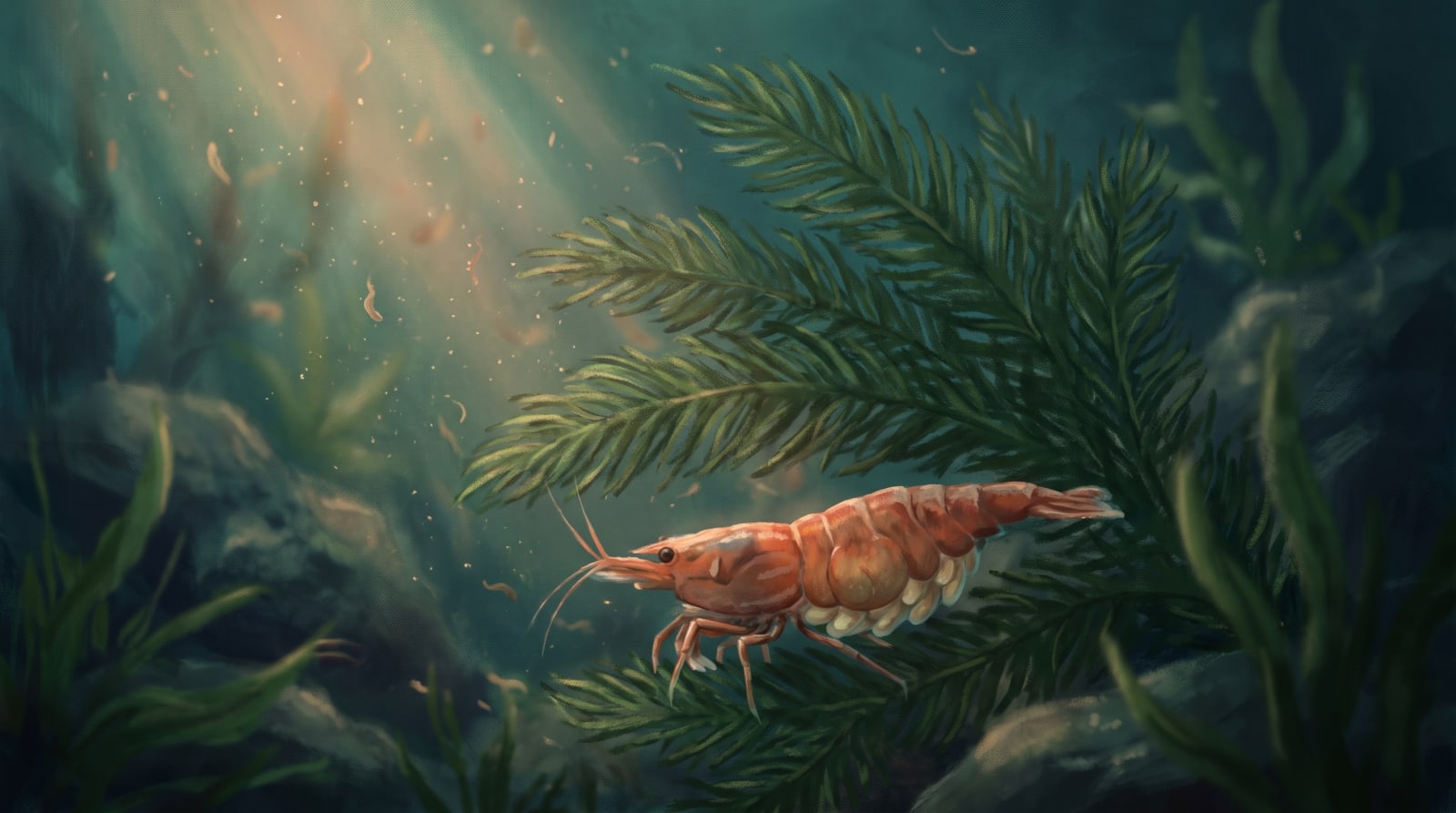
Spotting your first clutch of cherry shrimp eggs is the moment the hobby clicks. A female tucked under the moss with a tight cluster of eggs held beneath her tail means your water is right, your shrimp are settled, and a colony is about to build itself. This guide covers what those eggs should look like, how they change over the two to three weeks she carries them, and the handful of things that can go wrong — so you know when to sit on your hands and when to test the water.
What "berried" means
Cherry shrimp don't get pregnant in any internal sense. The female carries fertilised eggs on the outside of her body, clustered under her abdomen among the small swimming legs called pleopods, and a female carrying eggs this way is described as "berried" — the clutch looks like a little bunch of berries. It's the single clearest sign of a happy, breeding colony.
Berrying follows a set sequence. First the female develops a "saddle": a patch of colour behind the head, on top of the body, which is a batch of undeveloped eggs sitting in her ovaries and showing through the shell. A saddled female is one preparing to breed. Within days of her next moult, those eggs are fertilised and moved down under her tail, and she goes from saddled to berried. If you're still learning to read these markers on your shrimp, our male vs female cherry shrimp photo guide lays out the saddle, the size difference and the rest side by side.
From that point on, her job is simple and constant: keep the clutch clean and oxygenated. She fans the eggs with her pleopods around the clock, and you'll see them ripple as she works. New keepers sometimes read that fanning as a shrimp in distress. It's the opposite — a fanning female is doing exactly what she should.
How many eggs, and where they come from
A healthy female carries 20–30 eggs in a clutch. First-timers usually carry fewer, and a young female's debut brood might be half a dozen; the count climbs as she matures over her next few cycles. That's normal, not a fault in your water.
The eggs are fertilised at berrying and developed entirely on the female — there's no separate spawning site, no need for you to provide anything special, and nothing to move or protect. This is the beauty of Neocaridina and the reason they're the beginner's breeding shrimp. Everything happens on the mother's body, in open view, on its own schedule. The wider picture of how one clutch becomes a colony, and how fast, is worked through in how fast do cherry shrimp breed.
Egg colour: your progress bar
Egg colour is the most useful thing you can read off a berried female, because it tells you roughly how far along she is. The colour comes from the yolk feeding the developing embryos, not from the shrimp's own colour line in any simple way, so don't expect a red shrimp to carry red eggs.
Fresh clutches are darkest and most saturated. Depending on the line and the individual, they start anywhere from a warm yellow through to a greenish or olive tone — yellow and green are both entirely normal, and neither is a sign of anything wrong. As the embryos grow they consume the yolk, so the clutch gradually pales and becomes more translucent over the fortnight.
The moment to watch for comes near the end. In the last few days before hatching, two dark dots appear in each egg: the developing eyes of the shrimplet inside, showing through the shell. Once you can see eye-spots, you're only days from hatch. It's the most reliable signal there is that a brood is nearly here, and spotting your first set is genuinely exciting.
The timeline from berried to hatch
A cherry shrimp carries her eggs for 14–21 days. Where a given clutch lands in that window is mostly down to temperature: warmer water within the safe range speeds embryo development and shortens the carry, which is one reason we hold our breeding tanks at 22–23°C. A cool room-temperature tank sits at the longer end.
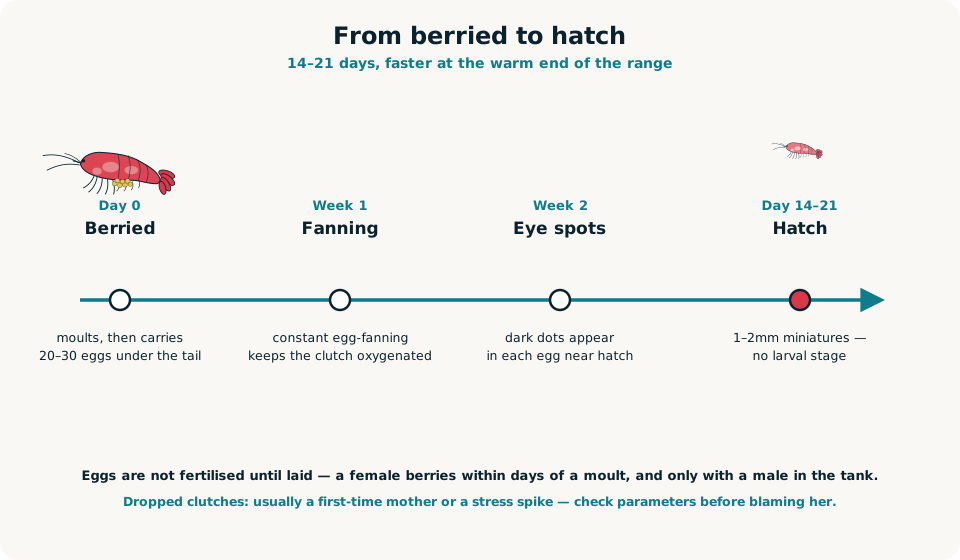
| Stage | What you'll see | Rough timing |
|---|---|---|
| Berried | 20–30 eggs appear under her tail, darkly coloured | Day 0, within days of a moult |
| Mid-carry | Constant fanning; the clutch slowly pales | Days 1–14 |
| Eye-spots | Two dark dots visible in each egg | Final few days |
| Hatch | Eggs gone; tiny shrimplets loose in the tank | Day 14–21 |
Nobody actually witnesses the hatch. One evening the clutch is there; the next morning she's carrying nothing and a fleck of moss turns out to be a 1–2mm shrimplet. There's no larval stage and no metamorphosis — what hatches is a perfect, fully formed miniature of the adult that grazes biofilm from its first hour. This direct development is what makes cherry shrimp so much easier to breed than almost anything else in freshwater, and what to do the moment they arrive is covered in raising shrimplets.
What can go wrong
Most berried females carry to term without a hitch if you leave them alone. When something does go wrong, it usually falls into one of these.
Dropped eggs. A female shedding her whole clutch before hatch is the most common worry, and it has three usual causes. Young, first-time mothers drop eggs more readily as they get the hang of carrying — frustrating but not a problem with your tank. Stress is the big one: netting her, a house move, aggressive tank mates or a sudden shock will make a female jettison her brood to save herself. And occasionally the eggs were never fertilised — a female with no mature male present can carry unfertilised eggs briefly, then drop them. If a young or newly berried female drops one clutch, give her the next cycle; if it keeps happening, look at stress and stability first.
Once eggs are off the mother, though, they're gone. A clutch scattered on the substrate can't be rescued, because developing eggs need her constant fanning and oxygenation to survive — there's no incubating them yourself in a cup. That's why the whole job is keeping her calm enough to carry them to term rather than intervening after the fact.
A few white or fuzzy eggs. The odd egg turning opaque white, or growing a woolly fungus, is normal. It's an individual egg that was infertile or has died and fungused, and the mother will usually groom it out of the clutch herself. A couple of bad eggs in an otherwise healthy clutch is nothing to act on.
A whole clutch failing. Losing the entire brood — all eggs going white, fungusing, or the female dumping the lot — points away from the shrimp and towards the water. A sudden swing in temperature, TDS or pH, or a spike in ammonia or nitrite, is the usual culprit. This is the moment to test rather than blame the female. Steady, in-range water is what carries a clutch to term, and the targets to check against are in our Neocaridina water parameters guide.
Eggs that seem to take forever. If a clutch looks stalled, it's almost always just a cool tank stretching the carry towards the full 21 days, or beyond by a day or two. As long as the eggs are still being fanned and haven't gone white, patience is the answer. Warmth speeds things up, but don't crank the heater mid-carry — a temperature swing is exactly what causes a drop.
Will she breed again straight away?
Often, yes. A female can be berried again within days of releasing a brood — sometimes she'll moult, mate and be carrying a fresh clutch before the last of the shrimplets has spread out into the moss. In a settled tank each mature female produces a brood roughly every five to six weeks, back to back, for much of her adult life. A first clutch isn't a one-off event to fuss over; it's the start of a rhythm.
If she doesn't re-berry for a while, it's usually the tank rather than the shrimp: too cool for breeding, or no mature male present to fertilise the next batch. Both are common culprits in our why won't my shrimp breed rundown, and neither means anything is wrong with the female herself.
Caring for her while she carries
The whole care plan for a berried female fits in one word: stability. Don't move her, don't do a big or cold water change, and don't reorganise the tank. Keep maintenance small and gentle, keep the water steady, and let her get on with it. A berried female eats a little less and hides more than usual, both of which are fine.
The one exception is a female berried in a tank where the brood stands no chance — a community setup full of hungry fish. There, moving her to a species-only tank can be worth the risk, done gently and underwater so she never leaves the water, and early in the carry rather than days before hatch. The full playbook for the fortnight, including that move, is in berried female care: protecting the brood, and the whole breeding process front to back sits in our cornerstone guide, how to breed cherry shrimp.
FAQ
How long do cherry shrimp carry their eggs?
Between 14 and 21 days, with temperature setting the pace. Warmer water in the safe range — around 22–24°C — speeds embryo development and brings hatch towards the 14-day end, while a cooler room-temperature tank stretches it towards 21 days or a little beyond. You'll get a few days' warning of hatch when dark eye-spots appear in the eggs.
What colour are healthy cherry shrimp eggs?
Anywhere from warm yellow to greenish or olive when fresh, both perfectly normal and varying by the individual and line. The clutch pales and grows more translucent as the embryos develop and use up the yolk, then shows two dark eye-spots per egg in the final days. Egg colour doesn't match the mother's body colour, so don't expect red eggs from a red shrimp.
Why did my cherry shrimp drop her eggs?
Usually stress, inexperience or a fertilisation miss. Young first-time mothers drop clutches more readily, and any shock — netting, moving, aggressive tank mates, a sudden water change — can make a female jettison her brood. Occasionally the eggs were never fertilised because no mature male was present. One dropped clutch from a young female isn't a worry; a repeating pattern points to stress or unstable water.
Why are my cherry shrimp eggs not hatching?
Most often the tank is simply cool and the carry is running long — up to 21 days or slightly more is normal. If the eggs turn white or fungus over, that's a failed clutch, and a whole clutch failing usually means a water problem: test for a temperature or TDS swing, or an ammonia or nitrite spike. As long as eggs are still being fanned and haven't gone white, give her time.
How many eggs do cherry shrimp lay?
A mature female carries 20–30 eggs per clutch. First broods from young females are often much smaller, sometimes only a handful, and the count builds as she matures over her next few cycles. Not every egg becomes an adult, but in a settled species-only tank most shrimplets survive, so each brood adds a couple of dozen shrimp to the colony roughly every five to six weeks.