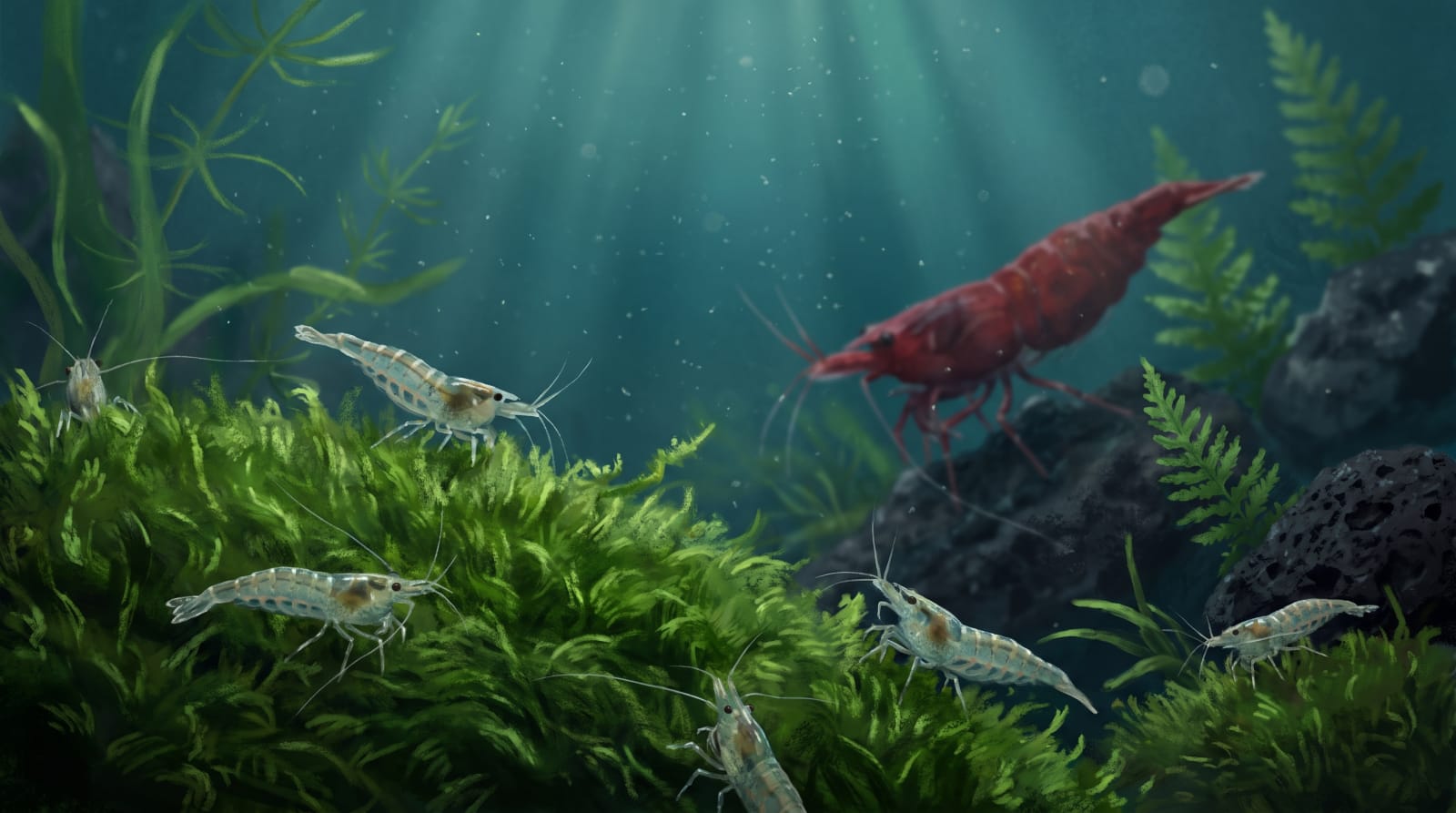
The gap between a colony that limps along and one that explodes isn't fertility — cherry shrimp breed the same for everyone. It's how many shrimplets survive their first few weeks. In a bare community tank with hungry fish and an open filter intake, a handful of babies make it per brood, if that. In a mature, planted, species-only tank set up the way we describe below, most of them live. This guide is about closing that gap and turning your broods into a growing colony.
The good news is you're not raising these babies so much as not killing them. Shrimplets hatch fully formed and self-sufficient, grazing biofilm from their first hour with no larval stage to nurse through. Your whole job is to remove the things that pick them off and provide the conditions they'd choose themselves.
Why shrimplets die
Before the fixes, the honest list of what actually kills baby shrimp, roughly in order of how often we see it. Predators eat them — almost anything with a mouth counts a 1–2mm shrimplet as food. Filter intakes suck them in. They starve in tanks too new or too clean to grow the biofilm they live on. And they can't cope with the water swings that adults shrug off, so an ordinary large water change hits a brood far harder than it hits their parents.
Every lever below targets one of those four. Get all of them right and survival climbs from single digits towards the majority of each brood. None of it is expensive or clever — it's mostly about what you leave out.
Lever one: no predators
The biggest single dial is whether anything in the tank eats shrimplets. In a species-only tank — just shrimp, maybe some snails — nothing hunts the babies, and this alone is what carries survival from a trickle to the majority. It's why every serious breeder runs a dedicated shrimp tank and why we do too.
A community tank is the opposite. Fish sold as "shrimp-safe" leave adults alone but will happily pick off shrimplets one by one, and even peaceful nano fish clear a brood over a few days. Snails are the exception that's genuinely safe; they share the tank without touching the young. The adult shrimp are no threat either — cherry shrimp don't eat their own young, so a female's shrimplets are perfectly safe among the whole colony. The danger is always something else in the tank, never the parents. If a colony is your goal, keep it species-only, and if you want fish, keep them in a different tank. The full grading of what's safe and what isn't is in cherry shrimp tank mates.
If a display tank with fish is all you have, you can still get some survivors by drowning the tank in cover, but be realistic: you're aiming for a trickle that slowly adds up, not a population boom.
Lever two: a filter that can't eat them
A shrimplet is small enough to be pulled through a standard filter intake, and once it's in the filter it's gone. The fix is the humble air-driven sponge filter, which is the standard on every tank in our breeding room for exactly this reason. There's no intake to worry about, the flow is gentle, and — a bonus we'll come back to — the sponge itself becomes a grazing surface the babies feed on.
If you already run a filter with an open intake, don't rip it out; cover the intake with a prefilter sponge, which blocks shrimplets while still letting the filter work. Either way, the goal is the same: no part of your filtration should be able to swallow a baby shrimp. The wider case for sponge filters and the honest alternatives is in our guide to the best filters for shrimp tanks.
Lever three: mature biofilm
Shrimplets eat biofilm from day one — the thin, living film of microbes, algae and micro-organisms that coats every surface in an established tank. It's their whole diet for the first weeks, and it's the reason an older, slightly grubby tank raises far more babies than a spotless new one.
This is the lever people miss. You can pass every water test and still starve a brood if the tank is too young to have grown a decent biofilm layer, because there's simply nothing for the babies to graze. A tank that's been running for a few months, with biofilm on the glass, the leaves, the wood and the sponge filter, is a self-serving nursery. If you're setting up specifically to breed, plant the tank and let it ripen for a month or two before the shrimp go in. Everything about farming that food layer is in biofilm: the invisible buffet.
Lever four: cover
Even in a predator-free tank, shrimplets want somewhere to graze without being exposed, and cover doubles as the surface their food grows on. Moss is the classic shrimplet habitat — a dense clump of java or christmas moss is a three-dimensional maze of grazing surface and hiding space rolled into one, and cover genuinely equals survival. A well-mossed tank will out-raise a bare one every time.
Back the moss up with leaf litter and botanicals. A catappa (Indian almond) leaf or two softens over weeks, grows biofilm, and gives shrimplets both food and shelter as it breaks down. Bits of cholla wood and dense low planting do the same job. The aim is a tank a baby shrimp can cross without ever being far from cover. For which mosses do this best and how to attach them, see our moss guide for shrimp tanks.
Lever five: go gentle on maintenance
Shrimplets handle water swings far worse than adults. The temperature and TDS jolt of a big, mismatched water change — the kind that just stresses grown shrimp — can quietly clear a brood. So during the weeks you've got babies loose in the tank, shrink your changes rather than skip them.
We drop to small, frequent changes when a tank is full of shrimplets: 10% at a time, temperature-matched, dechlorinated, and added slowly rather than poured. It keeps the water fresh without ever giving the babies a shock. This is a moment to resist the urge to "help" with a big clean; steady beats thorough here. The safe way to run changes generally, and why small-and-often wins, is in water changes: how much, how often, how safely. Be careful with a gravel vacuum too — it'll happily hoover up shrimplets along with the detritus, so run it lightly over open substrate only, if at all.
Lever six: first foods, sparingly
In a mature, mossy tank the biofilm does most of the feeding, but a little extra helps once shrimplets are loose — the operative word being little. Powdered or finely crushed shrimp foods designed for babies give them concentrated nutrition, and a light dusting a few times a week is plenty. A soya-husk snowflake food is ideal here because it's safe to leave in the tank as a slow grazing station rather than a portion that fouls the water.
The rule that governs the adult tank governs the nursery even harder: overfeeding is the number-one killer, and uneaten food in a tank of babies fouls the water they're least able to cope with. Feed less than you think you need to, watch it get grazed, and let the biofilm carry the rest. The full first-foods breakdown — what, how much, how often — is in feeding shrimplets: first foods.
What survival actually looks like
Put those six levers together and you shift the odds hard. A brood is 20–30 eggs; in a bare community tank you might see a couple of survivors, while in a mature species-only tank with moss, a sponge filter and steady water, the majority reach adulthood. That's the difference between "5% and 80%" in the title — not a promise of an exact number, but the real span between a tank fighting its babies and one raising them.
You won't see much of the drama. Shrimplets spend their first weeks tucked in the moss, and you'll spot them as tiny grazing specks rather than watch them grow day to day. They reach breeding age at roughly 3–5 months, at which point they start the cycle again and the colony's growth compounds. Hold your nerve, keep the tank boring and well-covered, and the numbers take care of themselves.
When to go back to normal maintenance
You don't baby the tank forever. Once the shrimplets are a few weeks old and visibly juvenile — grazing in the open, no longer specks — they cope with water changes much like adults, and you can ease back to a normal 10–20% weekly routine. There's no hard cut-off; just watch the tank. As long as you can see young shrimp of a decent size moving about confidently, the fragile window has passed.
The habits worth keeping for good, though, are the ones that built the colony in the first place: temperature-matched water, small and regular changes, and a light hand with the food. A colony in full swing is really just a tank that never stopped being run gently. The whole breeding arc, from first moult to a full colony, is in our cornerstone how to breed cherry shrimp, and what happens just before the babies arrive is in cherry shrimp eggs: colours, timeline and what can go wrong.
FAQ
How do I keep baby cherry shrimp alive?
Remove predators, run a sponge filter with no open intake, give them a mature tank full of biofilm and moss, and keep the water steady with small, gentle water changes. Shrimplets feed themselves on biofilm from day one, so your job is mostly to stop things eating them and to avoid the water swings they can't handle. A species-only, planted, cycled tank does most of the work for you.
What do baby shrimp eat?
Biofilm — the living film of microbes and algae coating every surface in an established tank — from their first hour, with no special food needed. In a mature, mossy tank that's often enough on its own. You can add a light dusting of powdered or finely crushed shrimp food a few times a week, but feed sparingly, because uneaten food fouls the water and overfeeding kills more shrimplets than under-feeding ever does.
Why do my baby shrimp keep dying?
The usual culprits are predators eating them, a filter intake sucking them in, a tank too new to have grown the biofilm they live on, or water swings from large changes. Work through those in order: go species-only, fit a sponge or prefilter, let the tank mature before breeding, and shrink your water changes while babies are present. Most shrimplet losses trace back to one of those four.
Do I need a separate tank to raise shrimplets?
Not separate from the adults — shrimplets are raised right alongside their parents in the same species-only tank. What you do need is for that tank to have no predators, so if your shrimp live in a community tank with fish, a dedicated shrimp tank is the single biggest thing you can do for survival. Babies and adults share the tank happily; it's fish that are the problem.
How long until shrimplets are fully grown?
Shrimplets hatch at 1–2mm and reach sexual maturity at roughly 3–5 months, topping out at 2.5–3cm as adults. They grow gradually and spend the early weeks hidden in cover, so you'll notice them as tiny grazing specks long before they look like proper shrimp. Once they mature they start breeding themselves, which is when a colony's growth really compounds.