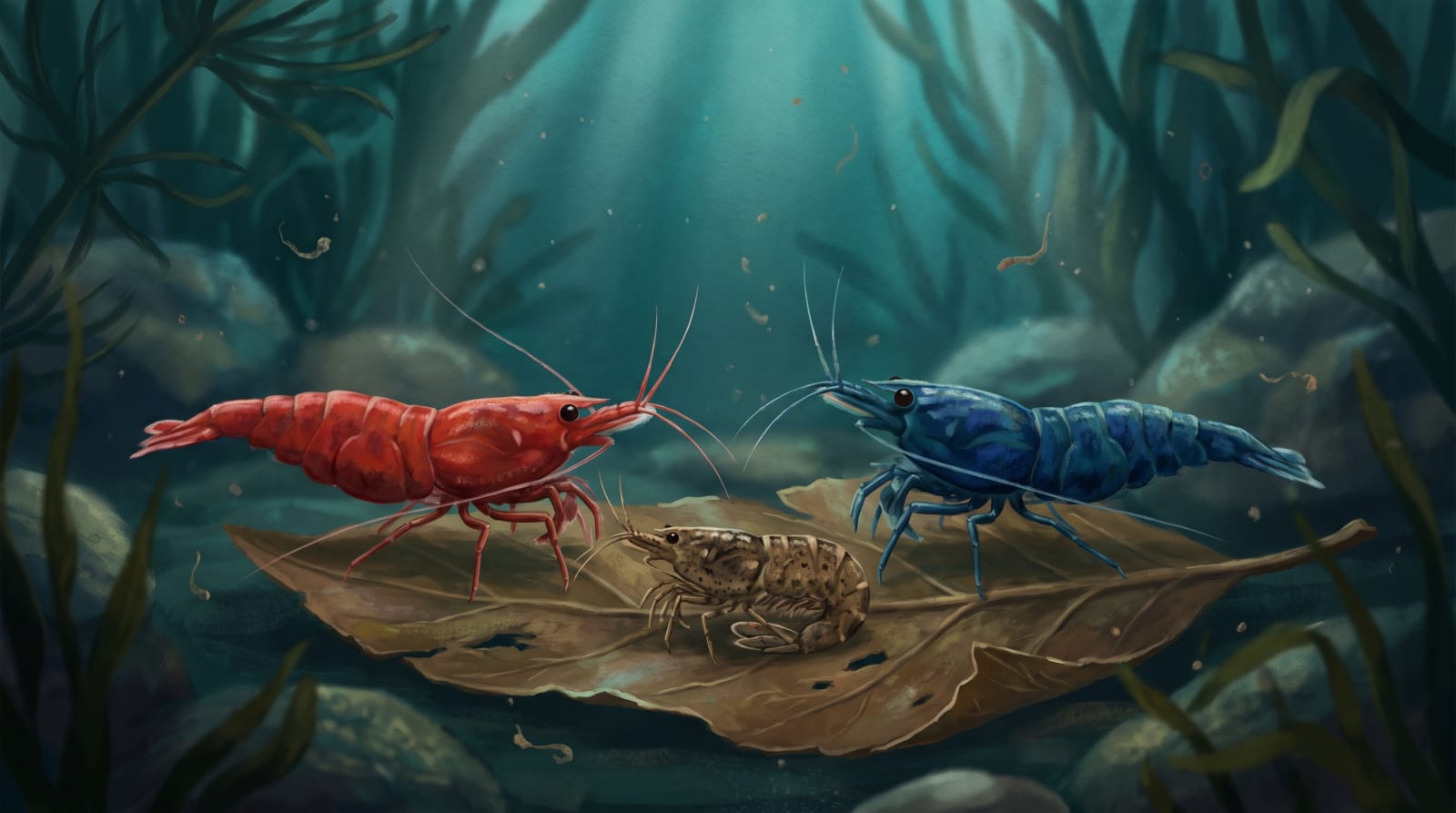
Whether cherry shrimp can crossbreed depends entirely on how far apart the two shrimp sit. Put two different colours of cherry shrimp together and they'll interbreed as easily as two of the same, then hand you a colony sliding towards brown. Put a cherry shrimp next to a crystal shrimp and nothing happens at all, because they're not even the same genus. The whole subject makes sense once you stop asking "can shrimp crossbreed?" and start asking "how closely related are these two?"
The short answer, by distance
Crossbreeding in the shrimp hobby runs along a scale, and where a pairing falls on it decides everything.
At the near end are the colour lines of Neocaridina davidi — red cherry, blue dream, yellow, chocolate, the lot. These are one species in different coats, so they interbreed freely and their offspring revert to wild-type brown. At the far end are Neocaridina and Caridina, two separate genera whose members can't produce offspring together no matter how long they share a tank. And there's a fuzzy middle — the Snowball line — that sits close enough to cherries to muddy the picture.
So the honest one-liner is: cherry shrimp crossbreed readily with other cherry shrimp colours and not at all with Caridina. The rest of this guide is what that means for a real tank.
Crossing colour lines: the road back to brown
Cross two Neocaridina colour lines and you don't get a blend, a hybrid, or an exciting new shade. You get, over a couple of generations, a tank of drab brown shrimp. This is wild-type reversion, and it's the single most important thing to understand before you mix anything.
The reason lives in the genetics, which we set out in full in Neocaridina colour genetics: every hobby colour is a trait that breeders concentrated out of a plain, mottled wild ancestor, and that wild-type brown is still the species' default setting underneath. A pure line stays bright only because a breeder keeps pairing like with like, generation after generation, holding the selected colour in place. Think of a colour line as a deck of cards someone spent years sorting into order. Crossing two lines shuffles the deck, and a shuffled deck averages out to the random, ancestral brown the sorting was fighting against.
Crucially, the reversion isn't the shrimp "turning brown" as individuals. The red cherries and blue dreams you buy keep their colours for the whole of their 1–2 year lives. It's their descendants who inherit the muddle. That delay is exactly why so many keepers get caught out, and it's worth walking through generation by generation.
What wild-type reversion looks like, generation by generation
Reversion runs on a timeline, not a switch, and knowing the stages tells you what you're seeing when a mixed tank starts to disappoint.
The shrimp you buy (the parents). Stock ten bright reds and ten bright blues and all twenty stay bright for life. Nothing you do to house them together changes their own colour. A mixed adult tank looks fantastic, which is where the trouble starts — it looks like proof that mixing is fine.
The first generation of mixed babies. When a red and a blue breed, their offspring carry a jumble of colour genes with no single target. Some first-generation shrimp still show enough pigment to look passable, if a bit dilute or patchy, so the tank can still seem colourful. This is the stage that fools people into thinking they've got away with it.
The second and third generations. When those mixed offspring grow up and breed with each other, the wild pattern floods back through. The babies of the babies are where you see real brown — muddier every generation, until the tank is a colony of wild-type shrimp wearing the camouflage their bright ancestors were bred away from. Because cherries mature in 3–5 months, this endgame arrives within roughly a year of the first cross, not overnight.
There's a twist that makes mixed tanks look better than they are. In a community tank where fish eat most shrimplets, the brown offspring rarely survive to grow up and spoil the view, so the display stays colourful on the back of the surviving adults. Move that same mix into a safe, planted, species-only tank where shrimplets thrive, and the browning turns up right on cue. We dig into the day-to-day of this in can you mix Neocaridina colours; the takeaway is that "my mixed tank looks fine" almost always means "it hasn't been mixed for long enough yet".
The Snowball caveat: close, but not quite the same species
One popular "cherry" muddies this neat picture, and it's worth flagging honestly. Snowball shrimp — the milky-white line whose eggs look like little snowballs — often aren't Neocaridina davidi at all, but a close relative, Neocaridina cf. zhangjiajiensis.
They're still in the same genus, and close enough that they'll generally interbreed with your cherry lines given the chance. That's the problem: crossing a Snowball into a colour line doesn't just risk the usual reversion, it stirs a second, slightly different set of genetics into the mix, making the offspring even less predictable. Their care is identical to any cherry — same water, same temperature — so there's no husbandry reason to keep them apart. There's every genetic reason. If you want a stable white line or a stable colour line, run Snowballs in their own tank.
Neocaridina and Caridina can't crossbreed
Now the far end of the scale, and the good news on it. Neocaridina (cherries and their colours) and Caridina (crystal reds, crystal blacks, bees, Taiwan bees, tigers) are different genera. They cannot interbreed. Keep a cherry colony and a crystal colony in the same tank and you'll get two colonies, never a hybrid — the genetic gap between the genera is simply too wide for viable offspring.
This is genuinely reassuring for a keeper worried about contamination. A Caridina shrimp can't brown-out your cherry line, because it can't breed into it in the first place. The reversion problem is strictly a within-Neocaridina affair. If you've ever seen "cherry × crystal cross" shrimp advertised, treat it as a red flag — no such animal exists.
The catch is that "can't crossbreed" is not the same as "can live together". Cherries and crystals want opposite water: cherries thrive in the hard-ish, neutral-to-alkaline tap water most of the UK has, while Caridina need soft, acidic, low-mineral water over an active substrate. Housing them together means neither gets the conditions it needs. We lay out the two care regimes side by side in Neocaridina vs Caridina; the short version is that you keep them in separate tanks for water reasons, not breeding ones. Worth noting the other half of the picture too: within Caridina, lines like crystal red and crystal black are the same species and will cross with each other, so a crystal keeper faces their own version of the purity question — it just never crosses the fence into your cherries.
What it all means in practice
Boil the scale down and you get three working rules.
If you want colour that lasts, keep one Neocaridina line per tank. A single colour, kept closed to other lines, breeds true indefinitely and can even be improved over time — that's the whole engine of selective breeding for colour, and it's undone the moment a second colour line shares the water. Guarding a line also means eyeballing new stock before it joins a project, because even "the same" colour from another source can carry hidden variation.
You can safely run a cherry tank and a crystal tank side by side on the same shelf. They won't interbreed across the genus wall, so your only job is giving each the water it wants. And if a mixed tank has already started browning, understand that there's no additive or trick that reverses it — a reverted colony has to be rebuilt from clean, single-line stock, selecting the best each generation, which is where a culling routine earns its keep.
None of this is a reason to fear mixing so much as a reason to do it on purpose or not at all. Cross cherry colours knowingly, accepting brown as the destination, and a "skittles" tank is honest fun. Cross them by accident, expecting the colours to hold, and wild-type reversion will quietly take the tank back to where the whole hobby began.
FAQ
Can cherry shrimp crossbreed?
Different colours of cherry shrimp crossbreed very easily, because they're all one species — Neocaridina davidi — wearing different selectively bred colours. Their offspring don't blend into a new colour, though; they revert to wild-type brown over a couple of generations. Cherry shrimp cannot crossbreed with Caridina shrimp such as crystal reds, which are a separate genus. So it's yes within the cherry family, no across it.
Can Neocaridina and Caridina interbreed?
No. Neocaridina (cherry shrimp and their colours) and Caridina (crystal reds, blacks, bees and tigers) are different genera, and the genetic gap is too wide to produce viable offspring. You can keep a cherry colony and a crystal colony without any risk of them crossing. The reason to keep them in separate tanks isn't breeding — it's water, since cherries want hard neutral water and Caridina want soft acidic water.
What is wild-type reversion?
Wild-type reversion is what happens when you cross two Neocaridina colour lines: the offspring drift back to the drab, mottled brown of the species' wild ancestor. Every hobby colour is a trait bred out of that wild-type background, which stays the genetic default underneath. Mixing lines stops the selection that held the colour in place, so within two or three generations the ancestral brown reasserts itself and the colony muddies.
Will my cherry shrimp babies be the same colour as the parents?
Only if all the parents are the same, unmixed colour line. A single-line colony breeds true, so red parents give red babies indefinitely. If two colour lines are in the tank, the babies carry mixed colour genes and trend toward wild-type brown over the generations, even though the adults you bought keep their own colours for life. For reliable colour in the next generation, keep one line per tank.
Can you crossbreed cherry shrimp with crystal shrimp?
No — cherry shrimp are Neocaridina and crystal shrimp are Caridina, two different genera that can't produce offspring together. Any listing for a "cherry-crystal hybrid" is mistaken or misleading. The two also need opposite water conditions, so they aren't kept together in practice anyway. If you want both, run them as separate colonies in separate tanks, each with the water chemistry its genus needs.