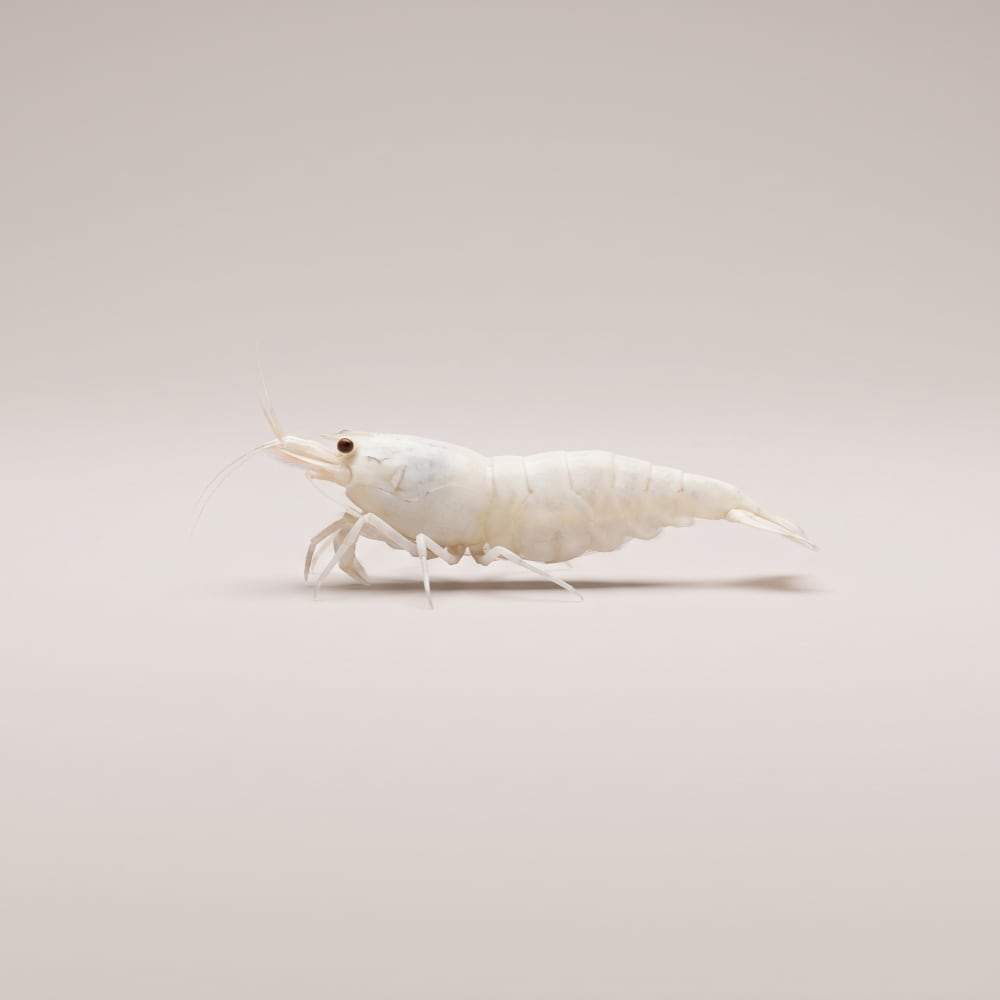
The name isn't about the body. A berried snowball female carries a clutch of pure white eggs under her tail — little snowballs, unmistakable once you've seen them — and after that the name never needs explaining again. The shrimp itself is porcelain: milky white over glass, and against dark substrate and green planting one of the cleanest-looking animals in the hobby.
Snowball shrimp at a glance
| Difficulty | Easy |
| Adult size | 2.5–3cm |
| Lifespan | 1–2 years |
| Temperature | 18–26°C |
| pH | 6.8–7.6 |
| GH | 6–12 |
| TDS | 150–250 |
| Breeding | Prolific |
What is a snowball shrimp?
Snowball is the white line of the Neocaridina hobby: a shrimp bred for clean, milky white, from near-porcelain opacity in the best females down to a frosted translucence in males and juveniles. White is rarer on UK shop shelves than it deserves to be, which is odd, because it does something none of the bright lines do — in a heavily planted tank, snowballs read like porcelain figures moving through the green.
The name, as above, comes from the eggs. Most Neocaridina carry yellowish-to-greenish clutches; snowball females carry snow-white ones, plainly visible in the saddle and then under the tail. It's a small thing that turns out to be the line's party trick, because it makes breeding unusually watchable — more on that below.
The honest bit: which species are you buying?
Snowballs come with a naming tangle the trade rarely mentions, so here it is straight. Much of the stock sold in the UK as "snowball" — often also labelled "white pearl" — is generally traced not to Neocaridina davidi but to a closely related Neocaridina, usually given as Neocaridina cf. zhangjiajiensis. Whether every white line in circulation is that species, a davidi line, or a muddle of both is exactly the sort of thing breeders disagree about, and a shop label won't settle it for you.
For care it makes no difference at all: same water, same food, same easy temperament, same ranges in the table above. It matters in one place only — mixing. You usually can't be certain which cross you'd be making, so if you want white shrimplets, keep snowballs as their own colony rather than running them alongside davidi colour lines like red cherries or yellow fires. Treat it as a naming-and-lineage quirk of the trade rather than a problem: the shrimp doesn't care what's on the label.
Colour and grading
Snowballs are graded on opacity and evenness. Standard grade is frosted — clearly white, but with glassy panels, especially in males. High grade is a dense, even milk-white body with minimal see-through anywhere; the best females look dipped in porcelain. Juveniles run more translucent and whiten as they mature, so judge young stock gently. Dark substrate and heavy green planting show white off better than anything else, and unlike the dark lines there's no lighting trick to learn — white reads in any light.
Care
Care is standard Neocaridina and genuinely easy, whichever species your snowballs turn out to be: the cherry shrimp care guide covers everything. A cycled tank of 19L or more, a sponge filter, stable water in the table's ranges, a weekly dechlorinated water change, a varied diet and no copper-based medications, ever. An unheated UK room at 18–21°C is fine, with breeding a touch quicker at 22–24°C. Hard-water areas can usually run them straight from the treated tap; soft-water areas should remineralise to GH 6–12 — the UK tap water guide covers the map. One observation from our own tanks: whites make stress easy to read, because a stressed snowball goes glassy. Treat that as your prompt to test the water.
Breeding snowball shrimp
Breeding runs exactly as it does for any cherry shrimp — a colony of ten or more, stable water, berried females carrying their eggs for 14–21 days, the whole routine in how to breed cherry shrimp — but with snowballs you can watch it happen. White eggs show against the body like nothing else in the hobby: you'll spot a berried female from across the room and can follow a clutch day by day until it hatches. For a first breeding project, that visibility is worth a lot, and they're every bit as prolific as the rest of the genus.
Keep the colony pure. Mixed with other Neocaridina colour lines, offspring turn increasingly wild-type brown within a couple of generations — and with snowballs there's the added species question, which makes crosses doubly unpredictable. One white tank, run properly, will fill itself. Mixing Neocaridina colours explains what happens if you ignore this, and if you want a second colour, run a second tank — blue velvet beside snowball is a cold, clean pairing we're fond of on our own rack.
Buying snowball shrimp in the UK
Standard-grade snowballs cost £2–4 each in the UK, with dense high-grade white at £30–50 per 10. Expect to meet the "white pearl" label — for practical purposes it's the same animal — and judge stock on opacity: even milk-white bodies across the whole group, not one porcelain female fronting a bag of glass. It's worth asking whether the seller's line has been kept away from other colours, because with whites, purity is the whole product. And buy ten or more; snowballs live and breed as a colony like every Neocaridina.
We aren't selling snowballs right now; join the waitlist on this page and we'll email you if we start breeding them.
FAQ
Why are they called snowball shrimp?
Because of the eggs. Berried females carry clutches of pure snow-white eggs — most Neocaridina eggs are yellowish-green — and under the tail they look like a handful of tiny snowballs. The porcelain-white body helps the name along, but the eggs earned it.
Are snowball shrimp the same species as cherry shrimp?
Sometimes — and often, honestly, not. Much trade stock sold as snowball or white pearl is generally traced to a closely related Neocaridina, usually given as N. cf. zhangjiajiensis, rather than Neocaridina davidi. Care and breeding are identical either way; the one practical consequence is not to mix them with davidi colour lines if you want predictable offspring.
Are snowball shrimp easy to breed?
Yes — as prolific as any cherry shrimp, and easier to follow, because the white eggs make berried females visible from across the room. A colony of ten plus, stable water and patience: expect the first berried females within weeks of the colony settling in.
How much do snowball shrimp cost in the UK?
£2–4 each for standard grade and £30–50 per 10 for high-grade, densely white stock. Whites turn up less often than reds and blues in UK shops, so a good breeder line is worth waiting for when one comes up.