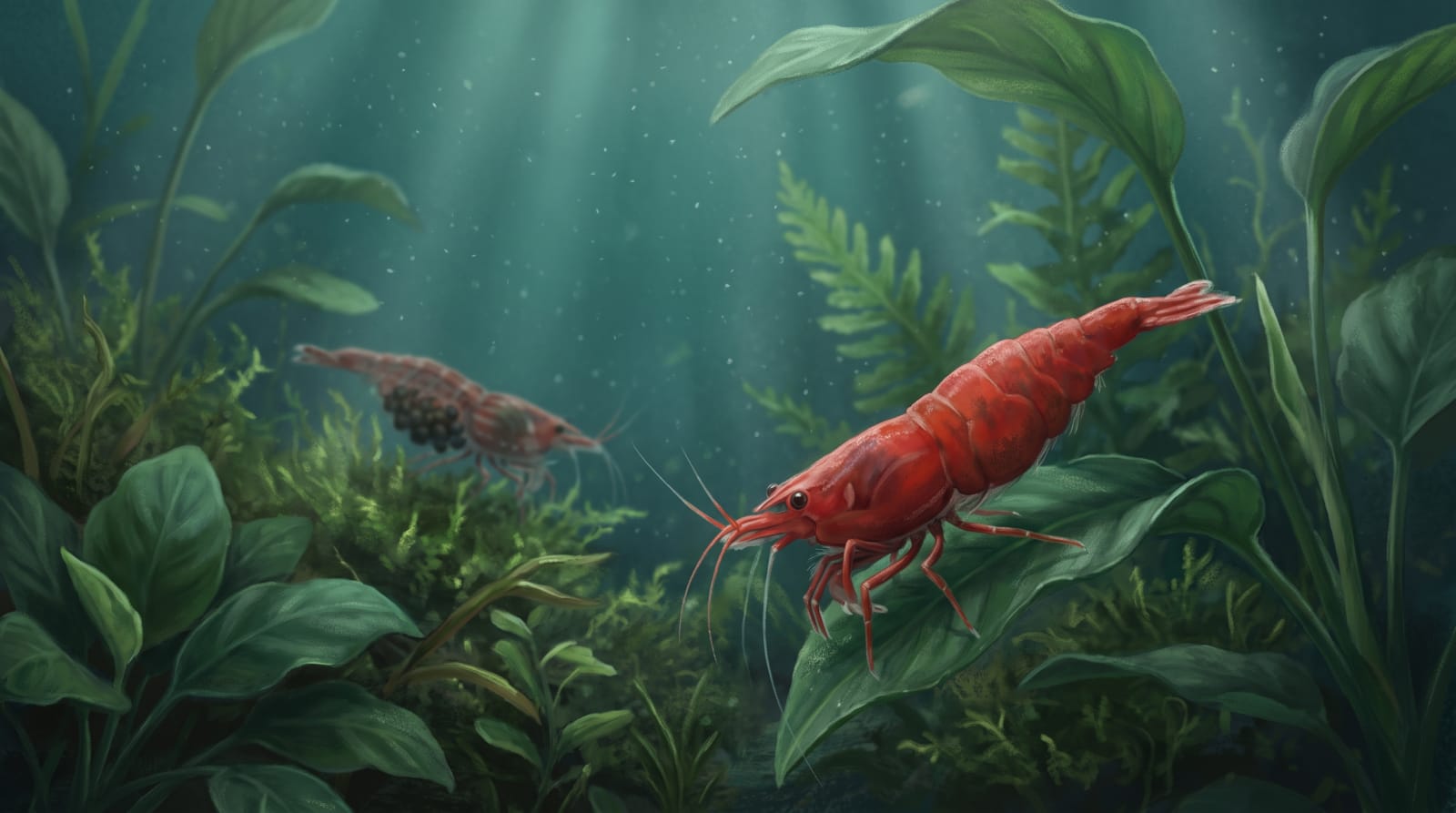
A healthy cherry shrimp announces itself, and once you know the signs you can size up a tank of them in under a minute — in a shop, or on a seller's video. The whole checklist comes down to one question asked five ways: is this animal behaving, moving and coloured like a shrimp that's thriving? Here's exactly what we look for before handing over any money, and the red flags that tell us to keep it in our pocket.
Active grazing: the one sign that beats all the others
If you take only one thing from this page, take this: a healthy shrimp grazes, constantly. A settled, comfortable cherry shrimp spends its day picking over every surface with its front legs, working the glass, the plants and the substrate in that busy, fidgety way that never quite stops. That behaviour is the single most reliable sign of health there is, because a stressed, sick or dying shrimp does the opposite — it sits still.
So before you inspect a single body part, just watch the tank for thirty seconds. Are the shrimp busy? Moving about, picking, mooching from surface to surface? That's a colony that's eating, unstressed and living in water that suits it. A tank of shrimp sitting motionless in the open, or clustered listless near the surface, is telling you something is wrong even if every individual looks flawless. Behaviour first, anatomy second.
One fair exception: a freshly moulted shrimp hides for a day while its new shell hardens, and recently moved or just-fed shrimp behave oddly for a while too. But across a whole tank, the healthy default is motion.
The whole-animal check: body, legs and antennae
Once the behaviour passes, look at the animals themselves. You're checking three things, and none of them needs a magnifier.
Legs and antennae should be intact. A healthy shrimp carries its full set of walking legs, the swimmerets underneath, and two long antennae up front. The odd shrimp missing a leg or sporting a shortened antenna is no crisis — the damage regrows at the next moult — but a whole group with stubby antennae and missing limbs points to rough handling, fighting over scarce food, or a tank they've been struggling in.
Colour should be even and solid for the line. Grade varies from seller to seller and that's a separate question, but within one tank of one line the colour should read consistent: deep and even across the group, not patchy and not washed out. One or two paler individuals are usually just males or youngsters; a whole tank of thin, faded colour on a line that ought to be rich signals stress, a poor diet or mixed heritage. If you're buying reds, our red cherry profile shows what even colour looks like rung by rung up the grades.
The body should look full and firm rather than thin or hunched, and the gut line running along the back should generally be visible and full rather than empty. You're building an overall impression of animals that are eating well and built solidly.
The disease check: three things you're scanning for
This is the part that separates a careful buyer from a hopeful one. Three specific problems are visible to the naked eye once you know to look for them, and any of them in a shop tank means you don't buy from it that day.
White fuzz on the shell. A patch of fine white fluff, most often around the head, the rostrum or a recent moult site, is usually vorticella — a stalked organism that takes hold on stressed shrimp in poor water. It's beatable, but its presence tells you the tank's conditions are off, and it's the last thing you want to import. Full identification is in our vorticella guide.
Tiny stalks or worms on the nose. Little white threads or stalks poking from the rostrum and head are scutariella, a commensal flatworm that arrives riding on infected stock. Mild cases are tolerable and treatable, but they pass from shrimp to shrimp, so catching them before you buy keeps them out of your tank — scutariella japonica shows what they look like up close.
Milky or opaque patches inside the body. A cherry shrimp's tail should look clear or evenly coloured; a spreading cloudy, cooked-white patch in the abdominal muscle is the sign to walk away from fastest. It points to muscular necrosis or an internal bacterial infection, it's usually fatal for that shrimp, and it can move through a tank. Our guide to bacterial infections and muscular necrosis shows the difference between this and a naturally pale line — white and pale-blue lines are opaque all over by nature, so you're looking for a patch of wrong, not overall colour.
Read the group, not just the star shrimp
A single gorgeous female posed at the front of the tank sells the whole tank, and she's exactly the wrong thing to judge by. Health lives in the group.
The best sign of the lot is berried females — females carrying a clutch of eggs beneath their tails. A colony that's actively breeding is a colony living in stable, unstressed conditions, because shrimp don't breed when they're struggling. Saddled females, with a patch of developing eggs visible behind the head, tell you the same story. If a good share of the tank is berried or saddled, the water and the care behind that glass are sound — and that's worth more than any single show specimen. What those egg-carrying females need next is covered in berried female care.
Scan for a healthy spread of sizes, too. A mix of full adults and smaller shrimp means the colony is reproducing and raising its own young. Then judge condition and colour across the whole group, front to back, rather than off the two best animals someone has arranged at the front glass.
Shop-tank red flags: when to walk away
Sometimes the tank itself makes the decision for you. Any of these, and we leave, whatever the shrimp are priced at:
- Dead shrimp in the tank. A single decomposing body spikes ammonia in a small volume and tells you nobody is watching closely. One casualty on the substrate turns a maybe into a no.
- A bare, stressed setup. Shrimp with no plants, no moss and nowhere to hide, huddled pale in the corners, are shrimp being kept badly. Cover and calm animals go together; a barren tank and cowering animals go together too.
- Staff who can't tell you the water. Ask what GH or TDS the shrimp are kept in. A seller keeping shrimp properly can answer, or go and find out; a blank shrug means the animals' history is a mystery and their move into your tank becomes guesswork. This one question sorts sellers faster than any other.
None of this is about being fussy. Each red flag predicts how well the shrimp will travel and settle, and a tank that fails them is selling you a problem however cheap the sticker.
Buying through a screen
Online you can't lean over the tank, but the same checklist works down a camera. Ask the seller for a recent video of the actual colony — not stock photos — and watch for the same grazing behaviour, the same even colour across the group, and ideally a few berried females. A seller happy to send a clip of their tank is showing you exactly what a good shop tank would show. One who'll only send a single polished photo is showing you their best angle and nothing behind it.
The rest of judging an online seller — the channels, the questions, the prices — sits in where to buy cherry shrimp in the UK, and how a good one packs the order once you've bought is in how shrimp are shipped. Whatever passes inspection, in person or on screen, still gets drip acclimated on arrival — a healthy shrimp bought well is still a shrimp you can lose to a careless first hour.
We're not selling shrimp right now, but if we start again, every group will be chosen against this exact checklist and photographed as the actual shrimp you'll receive — and the waitlist will hear first.
FAQ
What do healthy cherry shrimp look like?
Busy and richly coloured. A healthy cherry shrimp grazes almost non-stop, picking at surfaces with its front legs; it carries intact antennae and a full set of legs, even solid colour for its line, and a full body. Across a tank, look for plenty of movement and, best of all, females carrying eggs — a breeding colony is a healthy one. Stillness and faded colour are the warning signs.
What are the signs of a sick shrimp?
A sick shrimp sits still while the others graze, often out in the open or listless near the surface. Look for white fuzz on the shell (vorticella), tiny white stalks on the nose (scutariella), or a spreading milky-white patch inside the tail (muscular necrosis or bacterial infection). Faded colour, missing limbs across the group and an empty gut line add to the picture. Any of these in a shop tank means don't buy.
How do you choose healthy shrimp at the shop?
Watch before you inspect. Give the tank thirty seconds — you want shrimp actively grazing, not sitting still. Then check for intact legs and antennae, even colour, and no white fuzz, nose-stalks or milky tissue. Look for berried females as a sign of a thriving colony, and reject any tank with a dead shrimp in it, no cover for the animals, or staff who can't say what water the shrimp are kept in.
Should you buy a shrimp with a missing leg or antenna?
A single shrimp with one missing leg or a shortened antenna is usually fine — the damage regrows at the next moult, and minor knocks happen. What you're avoiding is a whole group showing stubby antennae and missing limbs, which points to rough handling, fighting over food or a stressful tank. Judge the group, not the one imperfect individual.
Are berried females a good sign when buying shrimp?
Yes — one of the best. A female carrying eggs under her tail (berried) means the colony is breeding, and shrimp only breed when they're unstressed and the water suits them. A tank with several berried or saddled females is showing you sound conditions behind the glass, which is worth more than a single show-quality shrimp posed at the front.