If you've spotted tiny white threads waving on the nose of one of your shrimp, the odds are you're looking at scutariella japonica. It looks like something has gone badly wrong — little worms on a shrimp's face is nobody's idea of healthy — but it's one of the more benign things a Neocaridina can pick up. This is our guide to recognising the rostrum worms, deciding whether they even need treating, and clearing them with the same salt dip we use for vorticella.
What scutariella japonica is
Scutariella japonica is a small flatworm — a temnocephalid — that lives on the shrimp rather than inside it. It's usually described as commensal rather than parasitic: at low numbers it appears to feed on organic debris and the shrimp's mucus around the head and gill region, taking a free ride and a meal without doing the host much measurable harm. That's the honest starting point, and it's why a light infestation is so often left alone.
The signature is the location. Where vorticella spreads as a general fuzz over the shell edges and legs, scutariella concentrates at the front end: fine white stalks projecting from the rostrum and the head, the "worms on the nose" people describe. It lays its eggs on the shrimp's exoskeleton, which — as you'll see below — is the single fact that dictates how you treat it. It's one of the external parasites we cover in the overview photo ID guide to cherry shrimp diseases; this page is the deep dive.
What it looks like
Look for tiny white stalks or threads, a fraction of a millimetre up to a millimetre or two long, sitting on and around the rostrum and head. They can appear to move or wave gently, which is what earns them the "worm" description, though what you're mostly seeing is the worm's body and the egg stalks it leaves behind. Under magnification a heavy case looks like a little cluster of white bristles specifically at the front of the shrimp.
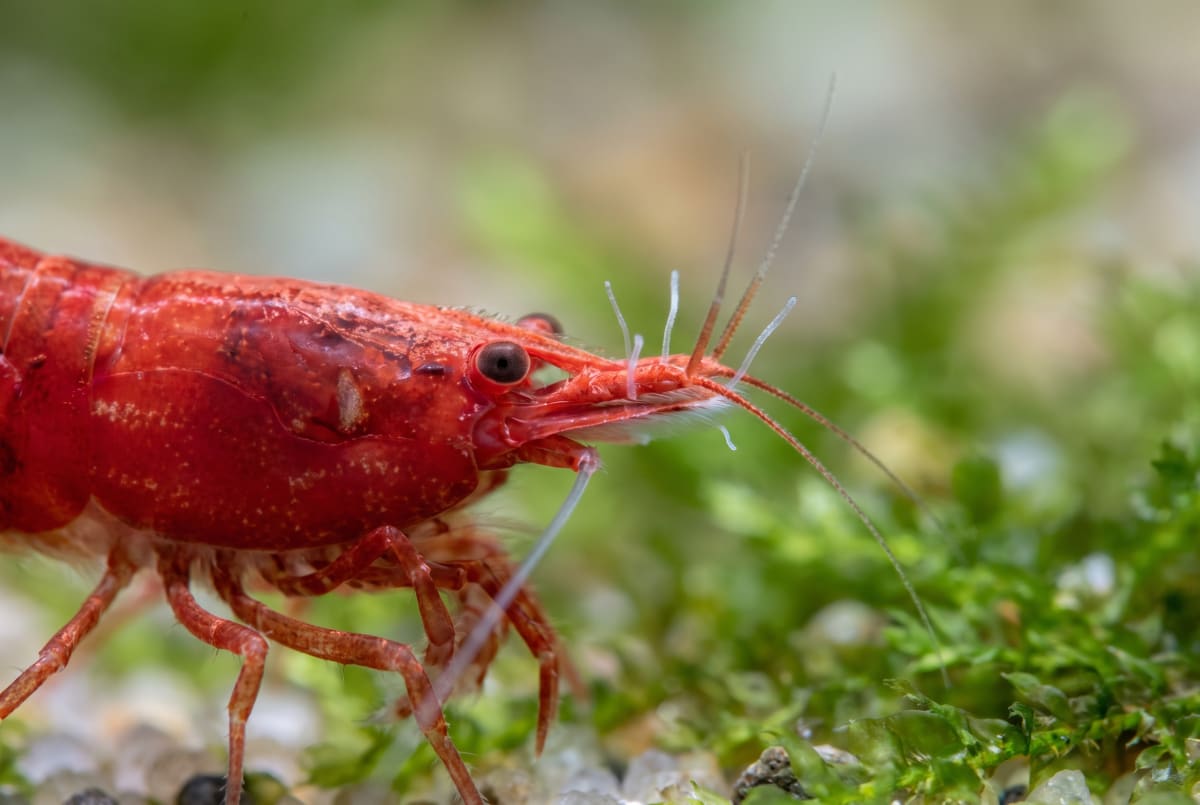
The location is what separates it from vorticella. Vorticella is a fuzzy, bottlebrush tuft that turns up anywhere on the shell — edges, joints, tail fan, moult sites. Scutariella is threads at the rostrum, and it stays there. If the white is spread over the whole shrimp it's vorticella; if it's a small crown of stalks on the nose, it's scutariella. Both, usefully, respond to the same treatment.
Is it actually harming the shrimp?
Most of the time, not much. A mild case of scutariella is often tolerated indefinitely — the shrimp grazes normally, moults normally, and breeds regardless, and some keepers quite reasonably leave light infestations entirely alone. We don't panic at a stalk or two on a single shrimp.
Where it earns treatment is when numbers build. A heavy load around the head and gills can irritate the shrimp, and it's most worth clearing on new arrivals, both to spare the individual and to stop it establishing across the colony. The other reason we treat it routinely on incoming stock is honesty about where it comes from: scutariella almost always arrives as a hitch-hiker on shrimp bought in, so a new shrimp wearing it is a new shrimp that could seed the whole tank. If you spot it on stock in a shop tank, factor it into whether you buy — our pre-purchase health checklist covers what else to look for before you hand over any money.
The salt dip treatment
The treatment is the same salt dip used for vorticella, and it's a spot treatment done outside the tank.
Dissolve one level tablespoon of aquarium or rock salt in 250ml of tank water — aquarium or rock salt, not table salt, which tends to carry iodine and anti-caking agents — and stir until it has fully dissolved. Catch the affected shrimp, lower it in, and hold it there for 30 to 60 seconds while you watch it the entire time. The salt is hard on the soft-bodied flatworm and it will usually let go; the shrimp, in its hard shell, handles a short dip far better than the parasite does. Lift the shrimp straight back into the tank afterwards.
As always, the concentration is for the dip and the dip only. Never add salt at one tablespoon per 250ml to the main tank — that's a brine no Neocaridina will tolerate as an environment, and it would do far more damage than the worms. Some flicking during the dip is normal; a shrimp in real distress comes out early.
Why you repeat it after the next moult
Here's the wrinkle that makes scutariella different from vorticella: the eggs. Scutariella lays its eggs on the shrimp's exoskeleton, and a salt dip clears the adult worms off the body without necessarily killing every egg capsule sitting in the shell. Left alone, those eggs hatch and you're back where you started.
Two habits close the loop. First, repeat the dip after the shrimp's next moult, when a fresh generation has hatched onto the new shell and can be knocked off before it matures and lays again. Second — and this is the one people forget — remove the shed moults from the tank during a treatment run. The old shell carries egg capsules, and a colony that eats or ignores a moult loaded with eggs simply re-seeds itself. Take the moults out, dip again after the next one, and you break the cycle rather than trimming the tops off it.
Where it comes from, and keeping it out
Scutariella is overwhelmingly a hitch-hiker. It rides in on new shrimp, and occasionally on shared nets, plants or water from an infected tank, rather than appearing from nowhere in an established closed colony. That makes it one of the clearest arguments for quarantine: a fortnight in a bare observation tank lets you spot rostrum stalks, run the dip-moult-dip cycle in isolation, and add clean stock to your display rather than importing the problem. Our guide to quarantining new shrimp walks through how we set that up.
If you skip quarantine — plenty of keepers do for a first tank — at least give new arrivals a close look at the head end before and after they settle in, and be ready to dip. Catching it on two or three new shrimp is a five-minute job; catching it once it's spread through a breeding colony is a long treatment campaign.
No copper, here or anywhere
It shouldn't need saying by this point in the silo, but it does: don't reach for a copper-based "anti-parasite" treatment for scutariella. Copper kills shrimp, and a commensal flatworm you could have cleared with salt is not worth risking a colony over. The full reasoning is in our guide to copper and shrimp. Salt dip, remove the moults, repeat after the next one — that's the whole toolkit, and it's enough.
FAQ
What are the white worms on my shrimp's head?
Almost certainly scutariella japonica — a small commensal flatworm that lives at the front of the shrimp, showing as tiny white stalks or threads on the rostrum and head. It's the "worms on the nose" people describe. It's generally mild and often arrives on newly bought shrimp. The location is the giveaway: threads at the nose is scutariella, while general white fuzz over the shell is vorticella.
Is scutariella japonica harmful to shrimp?
Usually only mildly. It's described as commensal rather than truly parasitic, and a light case is often tolerated indefinitely with the shrimp grazing, moulting and breeding as normal. A heavy load around the head and gills can irritate the shrimp, so it's worth clearing when numbers build or when it turns up on new arrivals. It won't wipe out a colony the way an internal infection can.
How do you treat scutariella on shrimp?
With a salt dip: one level tablespoon of aquarium or rock salt in 250ml of tank water, dipping the shrimp for 30 to 60 seconds while you watch it, then straight back into the tank. Never dose salt at that strength into the main tank. Crucially, repeat the dip after the next moult and remove shed moults during treatment, because the eggs sit in the old shell and will otherwise re-infect.
Where does scutariella come from?
It's a hitch-hiker. Scutariella almost always arrives on shrimp bought in from an infected source, and occasionally on shared equipment, plants or water. It doesn't spontaneously appear in an established closed tank. That's why quarantining new stock is the best defence — a bare observation tank lets you spot and clear it before it reaches your main colony.
Can scutariella spread to my other shrimp?
Yes, within a tank it can move between shrimp and build up over time, especially as eggs shed in moults hatch out. That's why you don't just dip the one obvious shrimp and stop: remove moults during treatment, dip again after the next moult, and watch the rest of the colony. Quarantining new arrivals stops it reaching an established tank in the first place.