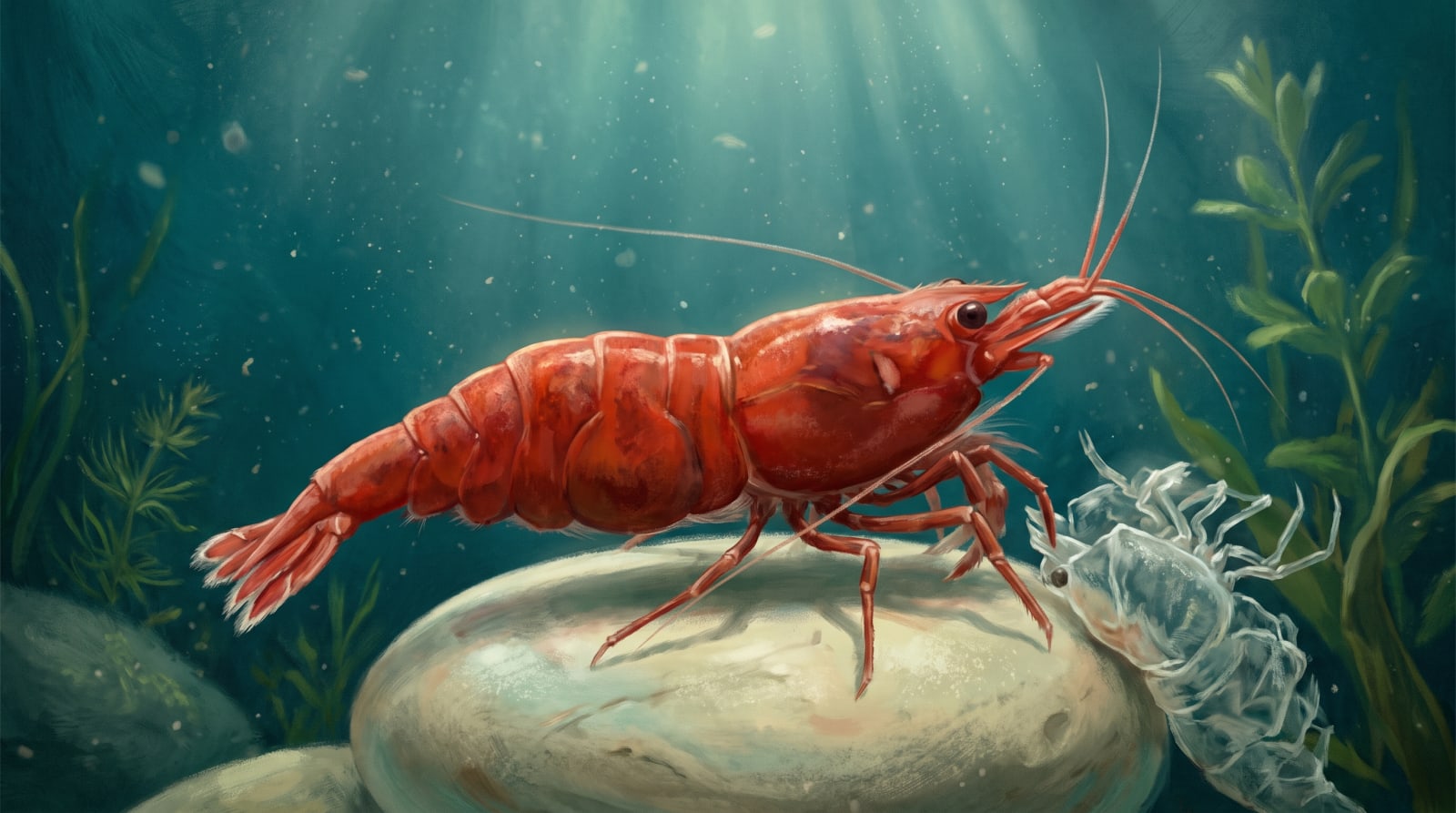
Vorticella is the first thing most keepers panic over, and the one that panics them least once they know what they're looking at. It shows up as fine white fuzz on a shrimp, usually one that has recently moulted or one in a tank that's drifted a little grubby, and at a glance it looks as if the animal is growing mould. It isn't. This is our guide to recognising vorticella, telling it apart from the things it gets confused with, and clearing it with a salt dip and a tidy-up rather than a bottle of medication.
What vorticella actually is
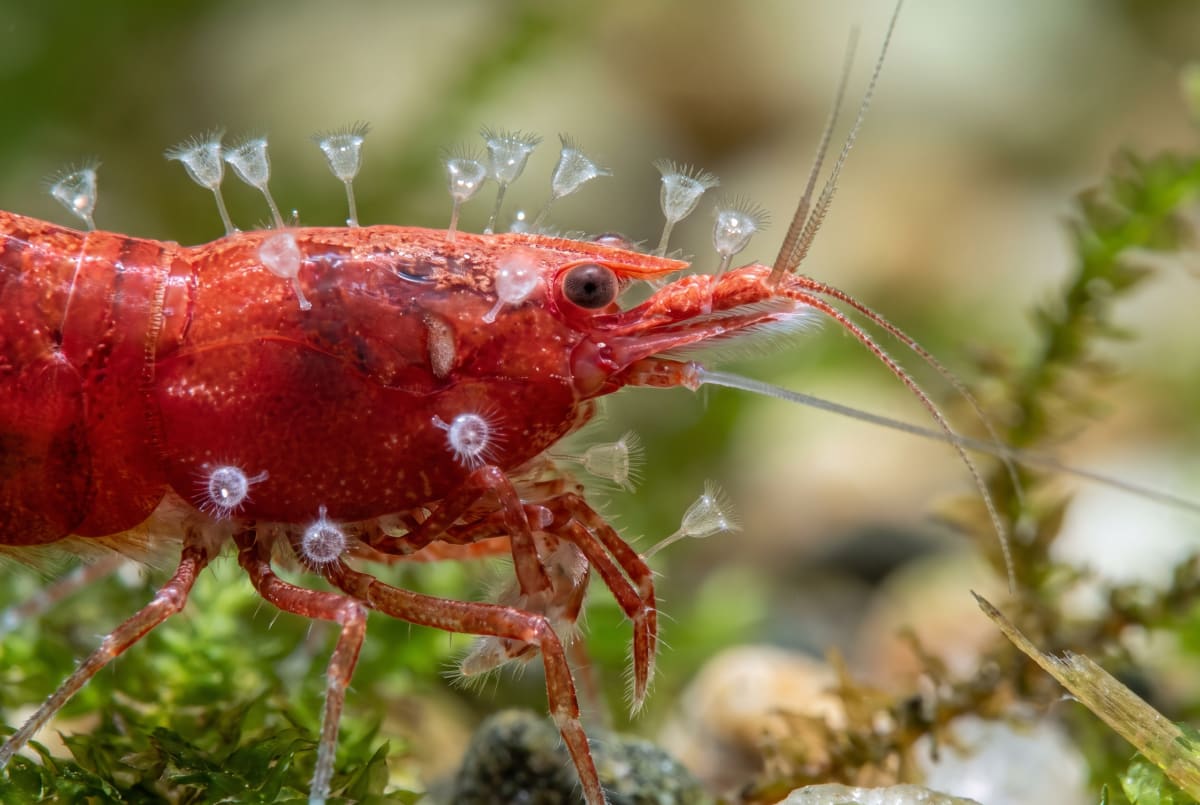
Vorticella is a stalked ciliate: a colony of single-celled organisms, each sitting on the end of a thin contractile stalk anchored to a hard surface. In the wild it lives on plants, wood and snail shells — anything solid in still, slightly organic water — filtering bacteria out of the current with a ring of beating cilia. On a shrimp, the shrimp is simply another perch.
That is the first thing worth taking in: vorticella is not eating your shrimp. It is a hitch-hiker feeding on the water, using the shell as somewhere to stand. The distinction changes the whole approach. You aren't killing an infection that has burrowed into the animal; you're removing an organism sitting on the outside of a shell the shrimp is about to shed anyway. It is the mildest of the conditions in our photo ID guide to cherry shrimp diseases, and by a distance the most survivable.
What it looks like on a shrimp
Vorticella reads as fine white fuzzy tufts, a little like tiny bottlebrushes or a dusting of white bristles. It favours the extremities and the edges: the tip of the rostrum, the antennae, the leg joints, the tail fan, the ridges of the carapace, and very often old moult sites. Under decent light and a bit of magnification you can sometimes make out the individual stalks, and if you watch long enough you may catch them flick or contract. Fungus and bacterial fuzz don't move like that; the twitch, when you can see it, is the giveaway.
On a dark line such as a blue dream the white tufts stand out immediately, while on a pale or translucent shrimp you have to look harder for them. It tends to appear after a moult, because a fresh shell is a clean new surface and a shrimp that has just moulted is often one that was already a touch stressed. You'll usually spot it on one or two individuals before you ever see it colony-wide.
Is it vorticella, or something else?
Three things get mistaken for vorticella, and telling them apart decides what you do next.
Scutariella japonica also shows as white on a shrimp, but it has a signature location and shape: distinct little stalks or "worms" projecting specifically from the rostrum and head, rather than a general fuzz spread across the shell edges and joints. If the white is only on the nose and looks like threads, read our guide to scutariella, the rostrum worms instead — the salt dip overlaps, but the follow-up is different.
A genuine bacterial or fungal fuzz is possible but far rarer than people assume; most "fungus on my shrimp" turns out to be vorticella. And the white ring of death is a completely different problem: that's a pale band inside the shell where a moult has failed, not something growing on the outside. We've written it up separately in moulting problems and the white ring of death. If the white is a solid band at the neck joint and the shrimp is stuck mid-moult, you're in that guide, not this one.
Why it takes hold
Vorticella is an opportunist. Its free-swimming stages are probably drifting through most mature tanks at a low level, settling wherever they find a surface, and they only bloom into visible tufts when conditions favour them: a heavy organic load, uneaten food breaking down, a filter overdue a clean, a jump in waste from overfeeding. Visible vorticella is therefore a water-quality readout as much as a parasite. A shrimp carrying it is often telling you the tank has slipped.
That's why we treat the water at least as seriously as the shrimp. Clear the conditions and you take away the reason the ciliate bloomed in the first place; skip that step and it comes straight back, dip or no dip.
How we clear it
Two things clear vorticella — cleaning up the water, and, for stubborn cases, a salt dip — and they go in that order.
Start with the water. Test ammonia and nitrite (both should read zero), check nitrate and TDS, and run a series of small water changes to bring the organic load down. Our guide to safe water changes covers the how; the short version is 10–20% at a time, temperature-matched and dechlorinated, rather than one big flush. Cut feeding right back while you do it — a couple of days grazing biofilm won't hurt the colony, and it starves the vorticella of the waste it thrives on. Plenty of mild cases resolve here on their own, because the ciliate is anchored to a shell the shrimp is about to shed. When a lightly affected shrimp moults, the fuzz leaves with the old exoskeleton, and if the water is back in order it doesn't return.
For a shrimp that's heavily coated, or one that hasn't cleared after its next moult, we use a salt dip. This is the consensus treatment, and it's simple, but the concentration matters and it is a dip — never a tank dose.
Dissolve one level tablespoon of aquarium or rock salt in 250ml of tank water. Use aquarium or rock salt, not table salt, which usually carries iodine and anti-caking agents you don't want near shrimp, and stir until it has fully dissolved. Catch the affected shrimp, lower it into the solution, and hold it there for 30 to 60 seconds while you watch it the whole time. The salt is hostile to the soft-bodied ciliate and it will generally detach; the shrimp, inside its hard shell, tolerates a brief dip far better. Then lift the shrimp straight back into the tank. A bit of flicking and a tail-curl in the dip is normal; a shrimp rolling helplessly or clearly in serious distress comes out early, no argument.
The rule you never break: do not add salt at that strength to the main tank. One tablespoon per 250ml is a spot-treatment brine, far above anything Neocaridina will live in, and dosing it into the display would do more harm than the vorticella ever could. The dip is a jug-and-back-again job, done over the sink. If one dip doesn't fully clear a stubborn case, repeat it a day later rather than leaving the shrimp in any longer than a minute.
Keeping it from coming back
Because vorticella is an opportunist, prevention is really just tank hygiene. Keep feeding modest — overfeeding sits behind more outbreaks than anything else — clean the filter on schedule, don't leave shed moults or dead shrimp sitting for days, and hold the parameters steady. A tank that isn't laying on a buffet of waste rarely grows visible colonies of it. It can also arrive on new plants and livestock, so rinsing and quarantining anything new keeps fresh spores out of an otherwise clean tank.
What never to reach for
One line runs through this whole silo: no copper. Copper-based medications — the general "anti-fungus" and "anti-parasite" fish treatments especially — kill shrimp, and reaching for one to treat a survivable case of vorticella is how keepers lose a colony to the cure. Vorticella needs no medication at all; it needs cleaner water and, at most, a salt dip. If you want the full picture on why the metal is so dangerous to invertebrates, it's in our guide to copper and shrimp.
FAQ
What is the white fuzz on my cherry shrimp?
Almost always vorticella — a stalked ciliate that anchors to the shell and waves in the current, showing as fine white tufts on the shell edges, leg joints, rostrum or old moult sites. It's an opportunist that blooms when water quality slips, so it's frequently mistaken for fungus. Genuine fungal or bacterial fuzz is far rarer. Improve the water first; many light cases clear at the next moult.
Will vorticella go away on its own?
Often, yes. Because the ciliate is anchored to the shell, a lightly affected shrimp usually sheds it with its next moult — and adults moult every few weeks. The catch is that it comes back if the underlying water quality hasn't improved, since that's what let it bloom. So don't just wait: run small water changes and cut feeding, and let the moult finish the job.
How do I do a salt dip for vorticella?
Dissolve one level tablespoon of aquarium or rock salt in 250ml of tank water, stir until clear, then dip the affected shrimp for 30 to 60 seconds while you watch it closely. Lift it straight back into the tank afterwards. Never add salt at that strength to the main tank — it's a spot treatment only. Repeat a day later if a stubborn case hasn't cleared.
Can vorticella kill shrimp?
Rarely on its own. Vorticella feeds on the water rather than the shrimp, so a light case is more unsightly than dangerous. A very heavy coating can irritate the gills and burden an already weak shrimp, and the poor water quality that let it bloom is often the real threat to the colony. Fix the water and treat heavy cases with a dip, and losses are unusual.
Is vorticella contagious to my other shrimp?
It can spread within a tank, since its free-swimming stages drift through the water and settle on any surface. That's why the fix is a tank fix, not just a single-shrimp one: improve the water for the whole colony and dip the worst-affected individuals. In practice, once the conditions that triggered the bloom are corrected, it stops spreading and the colony clears.