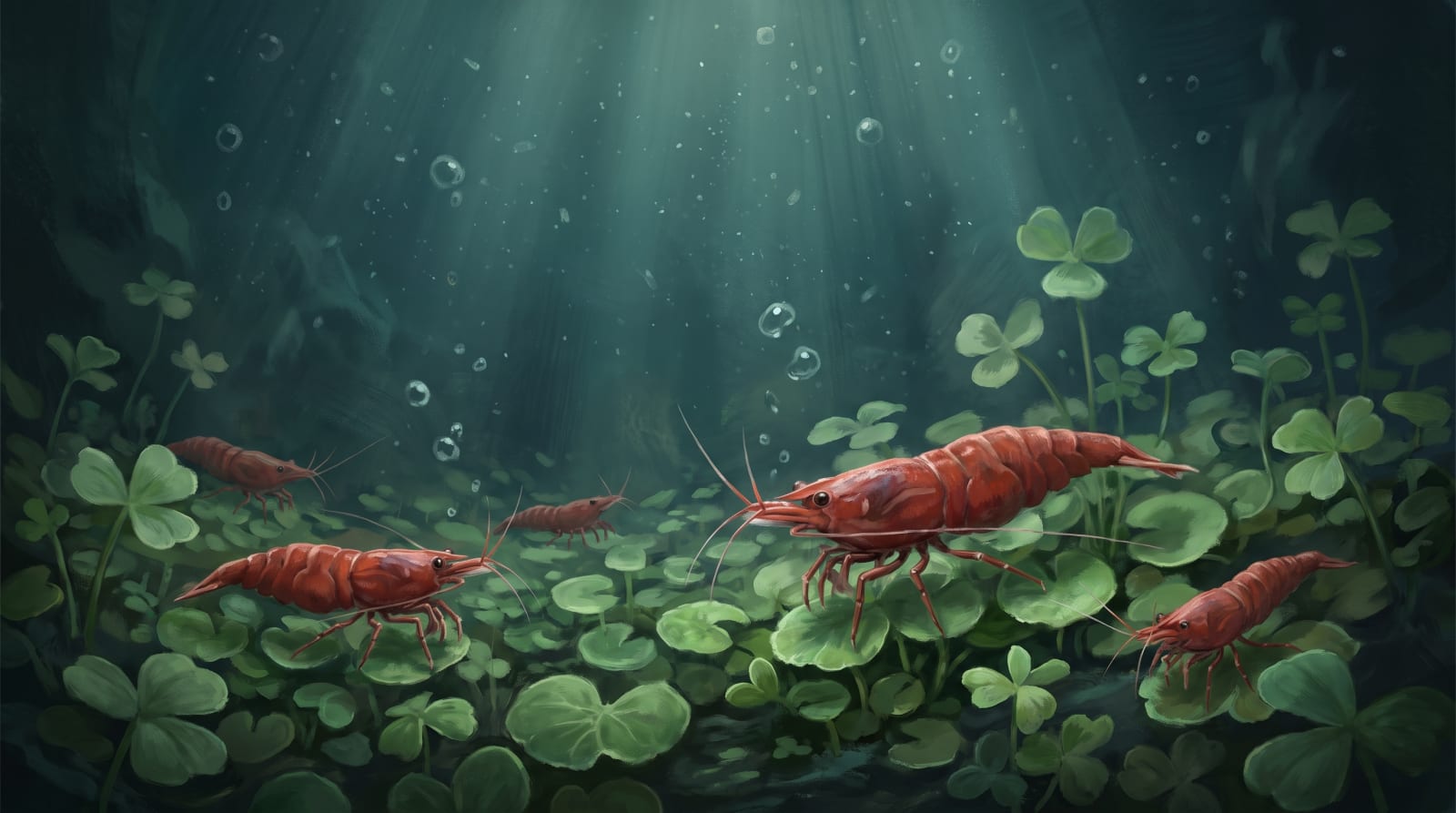
Here's the honest answer before the roster, because it saves a lot of wasted money: most of the carpet plants you see forming those perfect green lawns in aquascaping photos want bright light and injected CO2, and that is precisely the high-energy setup a shrimp tank neither needs nor wants. You can absolutely grow a green floor in a shrimp tank without any of that. You just have to pick the plants that will do it, accept that "slow" is the price, and know which lawn is really a shortcut in disguise.
The good news is that shrimp adore a carpet. A dense mat at the substrate is a huge horizontal grazing surface and a shelter for shrimplets right where they spend their first weeks. So the goal isn't to talk you out of a carpet — it's to steer you to the ones that thrive in the calm, stable, low-tech tank Neocaridina want anyway.
Why carpets and shrimp tanks pull in opposite directions
The showpiece carpets — dwarf baby tears, glosso, the tightest forms of monte carlo and dwarf hairgrass — are demanding plants. To stay low and dense they generally want strong overhead light, injected CO2, a nutrient-rich active substrate and fairly regular trimming. Give them less and they "grow up" instead of out, reaching for the light in leggy strands rather than hugging the floor.
That whole package sits at odds with a good shrimp tank. Bright light without CO2 is an open invitation to algae. Injected CO2 that isn't rock-steady swings the pH, and swings are what kill shrimp far more reliably than any single out-of-range number. The virtue of a shrimp tank is that it's low and stable, and stability is worth more to your colony than a manicured lawn. Chase the high-tech carpet and you're fighting your own setup.
There's a substrate catch too, and it's worth understanding before you buy anything.
The substrate tension
Rooted carpets root best in a nutrient-rich active substrate — the soft, dark aquasoils sold for planted tanks. The problem is what those soils are designed to do: they actively soften and acidify the water, buffering it down towards the soft, acidic conditions that Caridina shrimp want, not the moderately hard water Neocaridina thrive in. Putting a buffering soil under a cherry shrimp tank to grow a carpet means fighting your water chemistry to feed your plants, and the shrimp lose that argument. The full split between the two shrimp types is laid out in our Neocaridina vs Caridina guide.
The way round it is simple. Grow your carpet in plain inert substrate — sand or fine gravel — and feed the roots with root tabs tucked underneath where they're needed. It's slower than a full aquasoil, but it keeps your water where cherries want it, and most of the no-CO2 carpets below are perfectly happy rooting into inert gravel. Our substrate guide covers the inert-versus-active decision in full; for a Neo carpet, inert plus root tabs is almost always the right call.
The no-CO2 carpets that actually work
None of these needs CO2. All of them ask for patience instead, and a moderate light left running a sensible photoperiod.
Monte carlo (Micranthemum tweediei) is the best-looking true carpet you can grow low-tech. Small round leaves, a genuine creeping habit, and it will form a proper lawn without CO2 given decent light and time. The honest caveats: it's slow without gas, and in dim light it tends to stack and creep upward rather than carpet flat. It's the one to reach for if you want the classic lawn look and you're willing to wait months for it.
Dwarf sagittaria (Sagittaria subulata) is the reliable workhorse. It's grass-like rather than a tight carpet, spreading by runners into a green sward, and it shrugs off low-to-moderate light and hard water without complaint. It grows taller than a showpiece carpet, so think meadow rather than putting-green, but if you want a foreground that fills in and stays put with no fuss, this is the most foolproof plant here.
Marsilea (Marsilea hirsuta) is an underrated carpet for exactly this tank. It's a fern that throws little four-leaf-clover fronds, grows low and clover-like in good light and taller in dim light, and it's genuinely undemanding once it settles. Slow to spread, but slow and steady beats fast and doomed in a shrimp tank.
Dwarf hairgrass (Eleocharis parvula) can carpet without CO2, but this is where honesty earns its keep: it's slower, patchier and altogether happier with gas than the plants above. In a bright low-tech tank it will eventually spread by runners into a grassy lawn; in modest light it sulks. Buy it knowing it's the most likely of this list to disappoint without CO2, not because it can't be done.
Micro sword (Lilaeopsis) behaves much like hairgrass — grassy, slow, and easier with more light — and slots in the same bracket. Neither is a beginner's guaranteed win the way sagittaria and moss are.
Moss: the carpet that never fails
If you want a green floor that cannot fail, forget rooted plants entirely and lay a moss carpet. It's the cheat that works, and in a shrimp tank it's arguably the best carpet of the lot.
Pin a thin layer of java, christmas or taiwan moss between two sheets of plastic mesh, or simply spread it over the substrate and let it knit, and you get a dense low mat with no CO2, no special substrate and no real way to kill it. Better still, it does the two jobs a shrimp carpet exists to do better than any rooted lawn: it holds more biofilm for grazing, and it's a thicker refuge for shrimplets, who vanish into a moss mat the moment they hatch. A moss carpet is nursery and grazing station in one, which is why it turns up under so many of our colonies. The species-by-species rundown and the mesh-mat method are in the moss guide.
The one trade-off is texture: a moss carpet is a shaggy tangle, not the crisp lawn of a trimmed monte carlo. Most shrimp keepers happily take the tangle, because the tangle is what raises babies.
The gravel-vac question
People worry that a carpet means detritus building up in a foreground they can no longer gravel-vac, and in a fish tank that's a fair concern. In a shrimp tank it mostly isn't, for two reasons. First, you don't deep-clean a shrimp tank anyway — the mulm and biofilm a carpet traps are food, and stripping it out with a gravel vac removes the very thing your colony grazes. Second, the shrimp and any snails work the carpet surface constantly, turning trapped waste back into the food chain.
What that does mean is you lean harder on two habits instead: gentle flow so debris doesn't sit and stagnate in one dead spot, and not overfeeding, because uneaten food is what fouls a carpet you can't vacuum. A moss mat has a bonus here — you can lift it out, rinse it in old tank water and lay it back down, which no rooted carpet allows. Rooted carpets you simply leave alone and trust the colony to police.
Planting for the long game
Whatever you choose, plant it as small plugs spaced out rather than one dense clump, give it a decent but not blazing photoperiod, dose ferts lean, and then wait. A low-tech carpet fills in over months, not the fortnight the aquascaping videos imply, and the two ways people try to rush it both backfire: more light grows algae faster than it grows carpet, and adding erratic CO2 to speed things up swings the pH your shrimp depend on staying steady. If you want the fuller picture on dosing safely around inverts, our ferts and CO2 guide covers where the real risks are.
One last practical point, and it's a killer if you skip it: new carpet plants carry the same pesticide risk as any farm-grown stock, and shrimp are acutely sensitive to it. Buy tissue-culture pots where you can, and rinse and quarantine anything else before it goes near the colony — the safe routine is in our pesticide dip guide. Once the carpet is down and grown in, watching a line of red cherry shrimp work across it is worth every slow week it took.
Carpets are one look among several, and not the easiest starting point — if you're weighing up the whole planted scape, our best plants for shrimp tanks roster puts the foreground in context.
FAQ
Can you grow carpet plants without CO2?
Yes, but only certain ones, and slowly. Monte carlo, dwarf sagittaria and marsilea will all form a green floor in a low-tech shrimp tank given decent light and patience, while a moss mat carpets with no CO2 at all. The tight showpiece carpets like dwarf baby tears really do want CO2 to stay low and dense, so trying to force them in a shrimp tank usually ends in a leggy, algae-prone mess rather than a lawn.
What is the easiest carpet plant for a shrimp tank?
A moss carpet, hands down — java or christmas moss pinned to a mesh mat or spread over the substrate needs no CO2, no special substrate and is nearly impossible to kill, while doubling as shrimplet cover. If you want a rooted plant instead, dwarf sagittaria is the most foolproof: grass-like, spreads by runners, and tolerant of low light and hard water. Both suit the calm, stable tank cherry shrimp want.
Will cherry shrimp eat my carpet plants?
No — what looks like eating is grazing. Cherry shrimp work over a carpet's surface for the biofilm and algae growing on it, which keeps the leaves clean rather than damaging them. They'll process genuinely decaying leaves, so an old dying frond gets grazed down, but healthy carpet growth is completely safe. A thriving carpet and a happy shrimp colony go together; the shrimp are gardeners, not grazers of living plants.
Do you need special substrate for a carpet in a shrimp tank?
Not for a Neocaridina tank, and an active aquasoil is often the wrong choice because it softens and acidifies water away from what cherries want. Grow rooted carpets in plain inert sand or fine gravel with root tabs tucked underneath, and you feed the plants without fighting your water chemistry. A moss carpet sidesteps the question entirely, since it anchors to a mesh mat and needs no substrate at all.
Can you gravel vac a carpeted shrimp tank?
You mostly shouldn't, carpet or not — a shrimp tank runs on the biofilm and mulm a gravel vac would strip out, and the shrimp and snails recycle trapped waste anyway. Instead, keep gentle flow across the tank so debris doesn't stagnate in one spot, and avoid overfeeding, which is what fouls a foreground you can't vacuum. A moss mat has the edge here: you can lift it, rinse it in old tank water and set it back down.