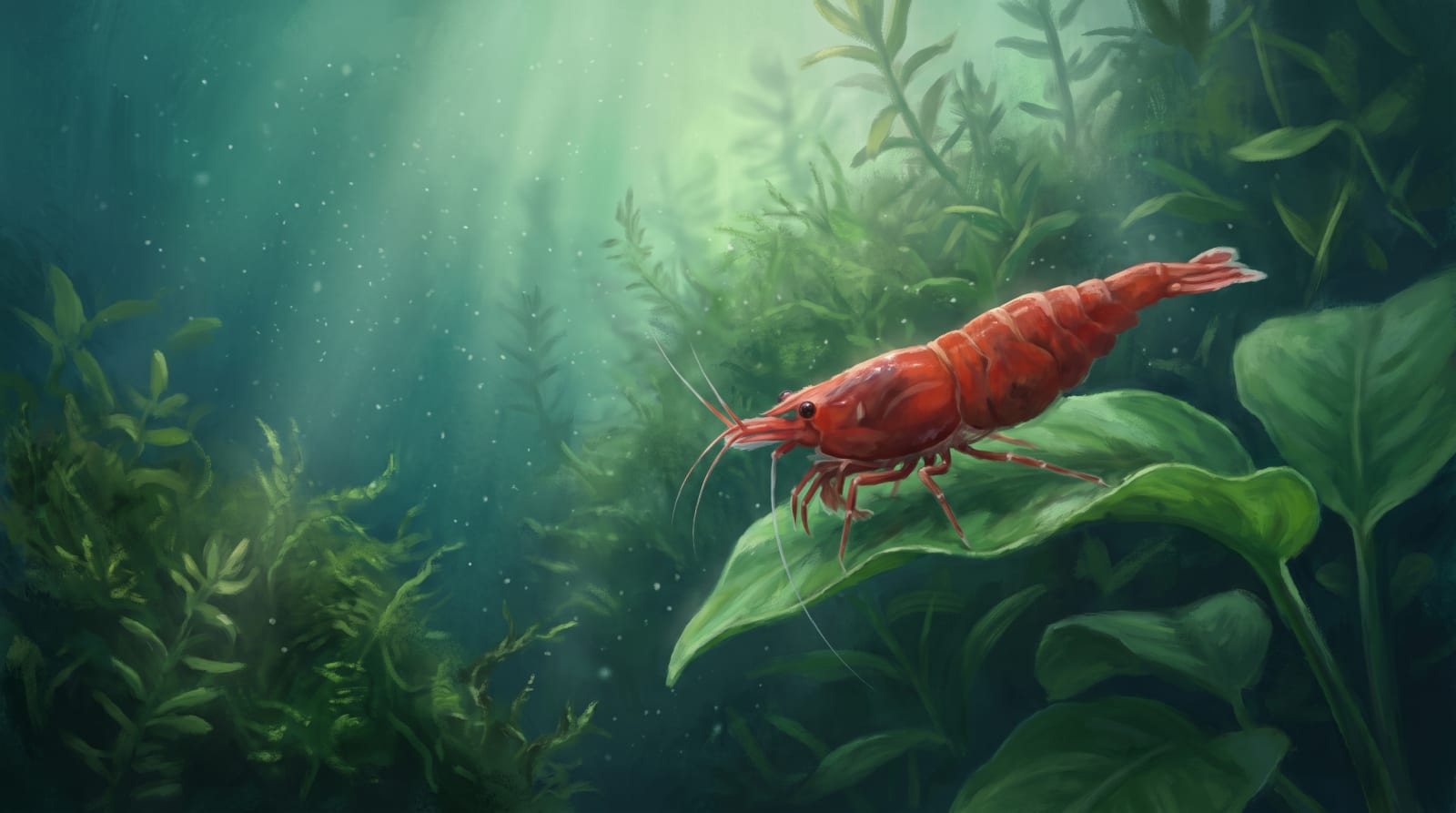
No — cherry shrimp don't strictly need live plants, and we've raised healthy colonies in near-bare tanks to prove it. But that's slightly the wrong question. The one that matters is whether plants make a shrimp tank easier and more productive, and there the answer is an emphatic yes. A planted tank grows more of the food shrimp actually live on, hides the babies that would otherwise be eaten or vacuumed out, and rides out the small mistakes a bare tank punishes.
The honest answer: not essential, but close to it
Neocaridina evolved among roots, leaf litter and submerged plants, grazing the film that grows on all of it. Drop them into a bare glass box and they'll survive, provided the tank is cycled and you feed it, but you're now doing by hand several jobs that plants would otherwise do for free.
That's the real trade. Live plants aren't decoration in a shrimp tank — they're infrastructure. You can replace what they do with more feeding, more hides and closer attention to the water, or you can let a handful of undemanding plants carry the load. Most keepers, once they've done it both ways, plant the tank and get on with their lives.
What live plants actually do for shrimp
Four jobs, in rough order of how much they matter to a colony.
They grow biofilm. Biofilm is the primary food for cherry shrimp — the invisible film of bacteria, algae and micro-organisms that coats every surface. Plants add enormous amounts of that surface: every leaf, stem and root is grazing ground. More plant, more biofilm, more food reaching more mouths, which in a breeding tank means more shrimplets surviving. Our guide to biofilm, the invisible buffet, explains why a living, slightly grubby tank feeds shrimp better than a spotless one.
They shelter shrimplets. Newly released shrimp are 1–2mm miniatures with no larval stage and no defences. For their first weeks they need somewhere dense to disappear into and graze without moving far. A thick plant, moss above all, is exactly that. In a bare tank a brood gets picked off or drawn into maintenance; in a well-planted one the same brood mostly makes it. Cover equals survival, and it's the single biggest lever on how fast a colony grows — the full picture is in raising shrimplets.
They steady the water. Growing plants take up ammonia and nitrate, and a living tank tends to buffer small swings better than a sterile one. We'll be honest about the size of the effect: in a small nano it's real but modest, not magic. Plants help keep nitrate down and the tank stable; they don't replace water changes or rescue an overstocked, overfed tank. Keeping nitrate under 20ppm is still your job, as covered in ammonia, nitrite and nitrate for shrimp.
They give shrimp somewhere to be. Cherry shrimp graze and shelter all day. A planted tank is simply better habitat: more surface to work, more cover to feel safe in, more places to moult unseen. Calmer shrimp colour up better and breed more readily. It's soft as benefits go, but anyone who's watched a colony move into a fresh moss pad has seen it.
Can you keep shrimp without live plants?
Yes, and breeders do it deliberately. Bare-bottom grow-out tanks, cull tanks and quarantine tanks often run with no planting at all, because they're easier to keep clean and to catch shrimp in. So a shrimp tank without plants is a proven working setup — but know what you're taking on.
You feed more, because there's far less biofilm to graze between meals. You add cover another way: cholla wood, botanicals, a clay pipe, a pile of smooth stones, or a clump of moss (which quietly makes it a planted tank again). You watch the water harder, because there's no plant uptake buffering nitrate and leftover food fouls a bare tank fast. And unless you add some form of cover, shrimplet survival drops, so a bare display without hides is the worst of both worlds for a growing colony.
None of that is a dealbreaker. It's simply the deal: a bare tank asks for more attention, not less. It's a tool, not a shortcut.
Do fake plants work?
Partly, and it's worth being precise about which parts. A silk or plastic plant delivers two of the four benefits above — it's a surface for biofilm to grow on, and it's cover for shrimplets to hide in. It delivers none of the water-quality help: no nutrient uptake, no living buffer, no growth into the dense thicket real moss becomes over a couple of months.
So a fake plant is a fair call for someone who genuinely kills every living plant they touch, or wants a fixed look that never grows in. If you go that way, choose silk over hard plastic — soft fronds with no sharp edges that could catch a shrimp mid-moult — and rinse anything new before it goes in. Fake plants are a downgrade from live ones, not a disaster. You'll raise fewer babies than a mossy tank would, but a well-fed colony over silk plants and hides can still tick along nicely.
The lazy planted tank: three plants that ask for nothing
If the phrase "planted tank" is what's putting you off, the entry bar is far lower than it looks. The classic shrimp trio — java moss, anubias and java fern — needs no CO2, no fertiliser dosing and barely any light. You tie or wedge them onto wood or rock (never bury the rhizome on anubias or java fern, it rots), and then you mostly leave them alone. Moss especially doubles as the shrimplet nursery, which is why it earns its own guide to the best mosses.
Add a floating plant for extra cover and nitrate uptake and you've built better shrimp habitat than almost any fake setup, for very little money and no ongoing work. Our best plants for shrimp tanks roster ranks the rest, all of them low-tech and forgiving.
One caution before anything wet goes near the tank: shop plants can carry pesticide residue that's lethal to shrimp, so treat every new plant as suspect and prepare it properly first. Our pesticide dip guide for new plants walks through the safe routine — skipping it is one of the more heartbreaking ways to lose a colony overnight.
How much planting is enough?
Not much, honestly. You don't need a jungle to get the benefits — you need broken-up space and grazing surface, and a surprisingly small amount of plant delivers both. A single generous moss pad plus one floating plant already covers the two jobs that matter most to a colony: a nursery for shrimplets and cover for everyone else. Everything beyond that is for your eyes, not the shrimp's wellbeing.
Density beats variety here. One species grown thick does more for survival than six species dotted thinly around bare glass, because a shrimplet's world is measured in centimetres and it wants somewhere solid to hide right where it hatched. If you're starting out, plant one easy species heavily, let it fill in, and add others later once you've seen how the colony uses the space.
There's a practical ceiling too. Very dense planting in a small tank can trap detritus and slow the flow, so leave open lanes the current can reach and you can siphon. Thick where the shrimp live, clear where the muck collects — that's the balance a colony tank wants.
So, do you need them?
No. You need a cycled tank, stable water, food and cover. Plants are the easiest way to supply three of those four at once, which is why we plant every colony tank we run — not because the rulebook demands it, but because it's less work for a better result. Keep shrimp bare if you have a reason to; plant them if you'd rather the tank did some of the caretaking for you.
FAQ
Do cherry shrimp need live plants to survive?
No. Cherry shrimp survive perfectly well in a bare, cycled, well-fed tank, and breeders keep them that way on purpose in grow-out and quarantine tanks. What plants change is how easy the tank is to run: more biofilm to graze, more cover for babies, steadier water. Most keepers plant because it's less work overall, not more.
Can I keep shrimp with fake plants instead?
Yes, with caveats. Silk or plastic plants give two real benefits — a surface for biofilm and cover for shrimplets — but do nothing for water quality, since they don't grow or take up nutrients. Choose silk over hard plastic to avoid sharp edges, rinse before use, and feed a little more. You'll raise fewer babies than in a mossy tank, but a colony can still hold its own.
What live plants are best for a beginner shrimp tank?
The undemanding trio: java moss, anubias and java fern. None needs CO2, dosing or strong light, and all three tie or wedge onto wood and rock rather than needing to be planted in substrate. Moss especially doubles as the shrimplet nursery. Add a floating plant for cover and you have a proper shrimp tank with almost no ongoing effort.
Do live plants help keep a shrimp tank clean?
They help, within limits. Growing plants take up some ammonia and nitrate and support the biofilm that shrimp graze, which keeps surfaces turning over and slows nitrate build-up. In a small tank the effect is real but modest — plants are not a filter and won't rescue an overfed, overstocked tank. Regular water changes still do the heavy lifting.