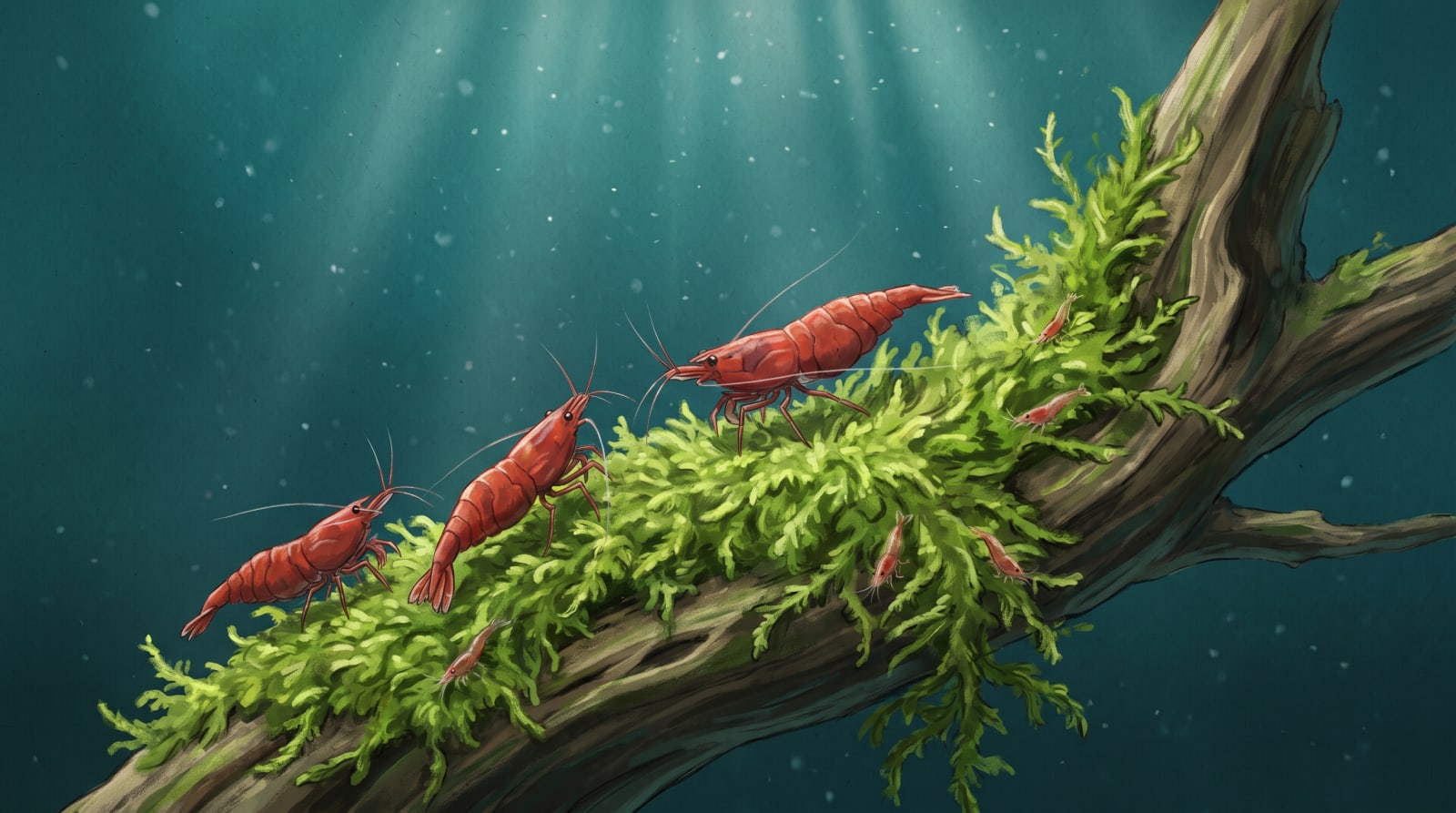
If we could keep only one plant in a shrimp tank, it would be moss, every time. Moss is where shrimplets vanish in their first fragile weeks, it carries a permanent film of the biofilm they graze, and it forgives the low light and hard water most shrimp tanks run on. This guide covers the eight mosses we actually reach for, how they differ, and how to fasten them down so they grow in place instead of drifting round the tank.
Why moss beats every other plant for shrimp
The case for moss is really the case for the nursery. Newly released shrimp are 1–2mm miniatures — direct development, no larval stage — and from day one they need somewhere dense to shelter and a surface to graze without travelling far. A thick moss pad is both at once. In a bare tank a brood gets picked off or drawn into maintenance; in a well-mossed tank the same brood largely survives. Cover equals survival, and nothing provides cover like moss. It's the biggest single lever on how fast a colony grows, which is why we lean on it all through raising shrimplets.
Moss earns its keep the rest of the time too. Every frond holds biofilm, the film of algae and micro-organisms that is a cherry shrimp's primary food, so a moss pad is a permanent grazing station. And it asks for almost nothing in return: low light, no CO2, no fertiliser, no substrate. Moss anchors to hardscape rather than rooting into the ground, so it goes anywhere. That combination is why it heads our best plants for shrimp tanks list and turns up in nearly every scape we build.
The eight mosses at a glance
The first six are true mosses; the last two are honorary — a floating liverwort and a ball of algae that both behave enough like moss, and shrimp treat closely enough, to belong here. Difficulty below is about keeping the moss looking good; shrimp are happy on all of them.
| Moss | Growth | Light | Look and texture | Best for |
|---|---|---|---|---|
| Java | Fast | Low+ | Wild, untidy tangle | The default — beginners, dense cover |
| Christmas | Moderate | Low–med | Layered "fir branch" fronds | A tidier java, wood and trees |
| Flame | Slow–moderate | Low–med | Vertical, flame-like swirls | Upright structure and accents |
| Taiwan (peacock) | Moderate | Medium | Flat, teardrop "peacock" fronds | Neat carpets and wood |
| Weeping | Moderate | Low–med | Downward-draping teardrops | Draped over wood, weeping trees |
| Phoenix (fissidens) | Slow | Low–med | Tight, feathery cushions | Detail work, small tanks, stones |
| Riccia (honorary) | Fast | High | Bubbly clumps, no roots | Pearling display, high effort |
| Marimo (honorary) | Very slow | Low | Soft green algae ball | A no-effort curiosity shrimp love |
The eight, one by one
Java moss
The one we'd hand any beginner. Taxiphyllum barbieri grows in almost any light, shrugs off hard water, and spreads into the messy tangle shrimplets love. It's near-impossible to kill and near-impossible to keep tidy, so trim it or it takes over the tank. If you buy a single moss for a java moss shrimp tank, buy this one — it does the nursery job better than anything fancier, at a fraction of the price.
Christmas moss
Vesicularia montagnei is the tidy cousin of java. Its side branches grow in neat, layered fronds like tiny fir branches, and on a piece of wood it forms the classic "moss tree". It grows a touch slower than java and shows its best pattern in slightly brighter light with gentle flow. The christmas moss vs java moss question comes up constantly, and the honest answer is simple: java for fast, cheap, foolproof cover; christmas for the same cover with a smarter look, if you'll put in the trimming.
Flame moss
Taxiphyllum 'Flame' grows upward in twisting, flame-shaped columns rather than spreading flat, which gives a scape vertical structure nothing else quite matches. It's slower and more deliberate than java. Shrimp graze the columns happily; keep it trimmed near the base so the dense inside doesn't brown out from lack of light.
Taiwan moss (peacock moss)
Taxiphyllum alternans is often sold as peacock moss, named for the flat, teardrop, peacock-tail pattern of its fronds. It's a moderate grower that likes a little more light than java, and it's one of the prettiest mosses on wood or grown as a low carpet. Once established it holds its shape well and doesn't sprawl the way java does.
Weeping moss
Vesicularia ferriei does exactly what the name says: its fronds hang downward like a weeping willow. Tie it to the top of a branch and it curtains down into the kind of shaded overhang shrimplets shelter under all day. Moderate speed, undemanding on light, and one of the most natural-looking mosses in a shrimp scape.
Phoenix moss (fissidens)
Fissidens fontanus is the jeweller's moss: tight, feathery, dark-green cushions that stay small and neat instead of sprawling. It's slow-growing and usually the priciest here, but it rewards patience with the most refined texture on this list — ideal for small tanks and detailed stonework. Glue it in place and it stays exactly where you put it.
Riccia — the honorary moss
Riccia fluitans isn't a true moss at all but a floating liverwort, and it behaves like one: no roots or rhizoids, so it lifts off and floats the moment it's untied. Pinned under mesh in bright light it pearls with oxygen into a stunning lawn, but it's high-maintenance — constant trimming and re-tying to keep it down. We keep it for display tanks rather than working colonies. Left loose on the surface it does make a decent floating raft that shrimplets graze and hide in.
Marimo — the honorary moss ball
The famous "moss ball" is neither a moss nor naturally a ball: Aegagropila linnaei is a colony of algae rolled smooth by water movement. It asks for nothing — low light, any water, the occasional roll and rinse to keep its shape — and shrimp graze its surface constantly, picking biofilm and trapped food from the dense fibres. It won't give the broad cover a moss pad does, so treat it as a bonus grazing spot rather than a nursery. As a first "plant" for a jar or a child's tank, it's genuinely shrimp-safe and almost unkillable.
How to attach moss so it stays put
Moss grips surfaces with tiny rhizoids; it does not root into substrate, so never bury it — buried moss rots. Give it wood, rock or mesh to hold and it takes anchor in a few weeks. Attaching moss to wood or rock comes down to four methods we use:
- Thread-tie. Lay the moss thin over the hardscape and wind cotton thread loosely across it. Cotton rots away within a few weeks once the moss has gripped, leaving no trace; fishing line stays put if you want it permanent. This is the go-to for attaching moss to wood and branches.
- Glue. A dab of cyanoacrylate gel (superglue gel) on dry hardscape, press the moss on, hold it a moment. It cures inert and shrimp-safe. Keep the moss layer thin so the base beneath the glue doesn't rot in the dark.
- Mesh mats and walls. Sandwich a thin layer of moss between two pieces of plastic mesh for a flat carpet, or fix a sheet vertically for a moss wall — the tidiest route to a solid green surface.
- Just wedge it. Java in particular will attach itself if you stuff it into a crevice or under a stone and leave it be. The lazy method, and with the tough mosses it genuinely works.
Two rules hold whatever you choose. Thin layers beat thick pads, because thick moss browns and rots underneath where light can't reach. And give it gentle flow so detritus doesn't settle in and smother it. Trim with scissors when it thickens, and the trimmings re-attach elsewhere — that's how one small portion becomes a tankful, and how a breeding colony's cover pays for itself. For the wider mix of cover a growing colony wants, our breeding décor guide covers the tubes and botanicals that round moss out.
One last check before any new moss goes in. Shop-grown moss can carry the same pesticide residue as any aquarium plant, and that residue is lethal to shrimp, so prepare it exactly like the rest of your planting — our pesticide dip guide has the safe routine. If you're still weighing up whether the tank needs planting at all, we make the honest case in do shrimp need live plants.
FAQ
What is the best moss for a shrimp tank?
Java moss, for most people. It's hardy, cheap, low-light and grows the dense tangle shrimplets shelter and feed in, so it does the nursery job better than anything more demanding. If you want the same cover with a tidier look and don't mind trimming, christmas moss is the natural step up. Everything fancier — flame, phoenix, weeping — is chosen for appearance, not because shrimp need it.
Is java moss or christmas moss better for shrimp?
Both are excellent, and shrimp use them identically. Java grows faster, costs less and tolerates lower light, so it's the better workhorse and beginner choice. Christmas moss grows a little slower and holds a neater, layered shape, making it the better-looking option if you'll keep it trimmed. For a breeding colony where cover means surviving babies, java wins on sheer speed of growth.
How do I attach moss to wood or rock?
Two easy ways. Tie it on with cotton thread, which rots away once the moss grips in a few weeks, or dab it down with cyanoacrylate superglue gel on dry hardscape. Keep the layer thin, give it gentle flow so debris doesn't smother it, and never bury it in substrate — moss anchors to surfaces, it doesn't root. Java will even wedge itself into a crevice unaided.
Are marimo moss balls good for shrimp?
Yes, and they're genuinely easy. A marimo is really a ball of algae rather than a moss, but shrimp graze its surface for biofilm and trapped food, and it needs almost no care — low light and the odd rinse and roll to keep its shape. It won't provide the dense cover a broad moss pad gives, so think of it as a bonus grazing spot, not a shrimplet nursery.