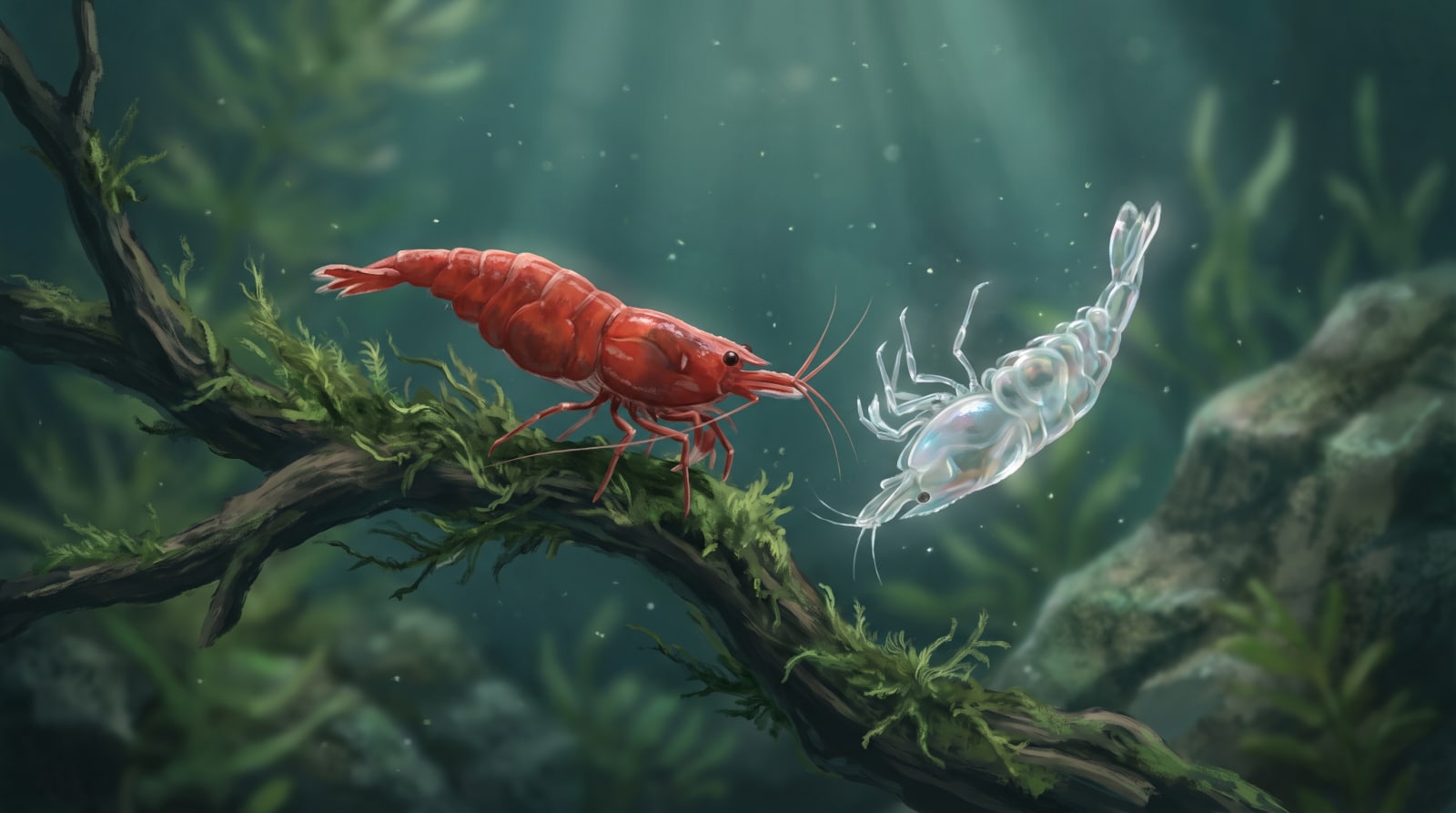
The white ring of death is the moult that kills, and it's the moulting problem every cherry shrimp keeper eventually hears about. It shows as a pale band or gap opening across the shrimp's body — the shell has split, but the shrimp can't finish climbing out of it. Most that reach that point don't survive. The good news buried in that grim opening is that it's largely preventable, and once you understand how a moult is supposed to work you'll see exactly where it goes wrong.
How a healthy moult works
Shrimp wear their skeleton on the outside, so the only way to grow is to shed it. A cherry shrimp builds a soft new shell underneath the old one, takes up water to crack the old shell along a seam behind the head, and then flicks its body — a sharp backflip — to pop itself out through the gap in one movement. The whole thing takes seconds. What's left behind is a perfect, hollow, translucent copy of the shrimp.
Adults do this every three to six weeks; juveniles moult more often because they're growing faster. For the first 24 to 48 hours afterwards the new shell is soft, so the shrimp is vulnerable and knows it. A freshly moulted shrimp hides, which is why a shrimp you haven't seen all day is usually tucked under the moss hardening up rather than dead. During that window it also takes up minerals from the water to harden the new shell, and that detail — minerals, from the water — is the hinge the whole problem turns on.
That soft-shell window is also the most dangerous stretch of a shrimp's life. For a day or two the new shell is too soft to offer any protection and the shrimp can barely move at speed, so a tank without cover leaves fresh-moulted shrimp exposed — even normally peaceful tankmates will take advantage of a soft one. Dense moss, leaf litter and tight planting are what let a colony moult in safety. Cover isn't decoration in a shrimp tank; it's how the animals get through their own growth, and it's the first thing we'd add to a bare tank where shrimp keep vanishing around moulting time.
The moulted shell isn't a body
Before we go further, settle the panic that sends new keepers straight to the forums: that white shape on the substrate is almost certainly a moult, not a corpse. The two look alike at a glance and completely different once you know the tell.
A moult is translucent and hollow, usually split across the back, and holds no colour — light passes straight through it. A dead shrimp is opaque and keeps its body colour, turning pink or orange as it breaks down. Leave a moult where it is; the colony grazes it back within a day or two and recycles the calcium into the next round of shells. Fishing out every "body" you see just robs the tank of minerals it wants back.
What the white ring of death actually is
A normal moult splits cleanly along that seam behind the head and the shrimp is out in a second. The white ring of death is that same seam failing. Instead of a clean split the shrimp can complete, a pale, opaque band appears around the body at the join between the head section (the carapace) and the abdomen, and the shrimp gets stuck there — half out, unable to make the backflip that should free it.
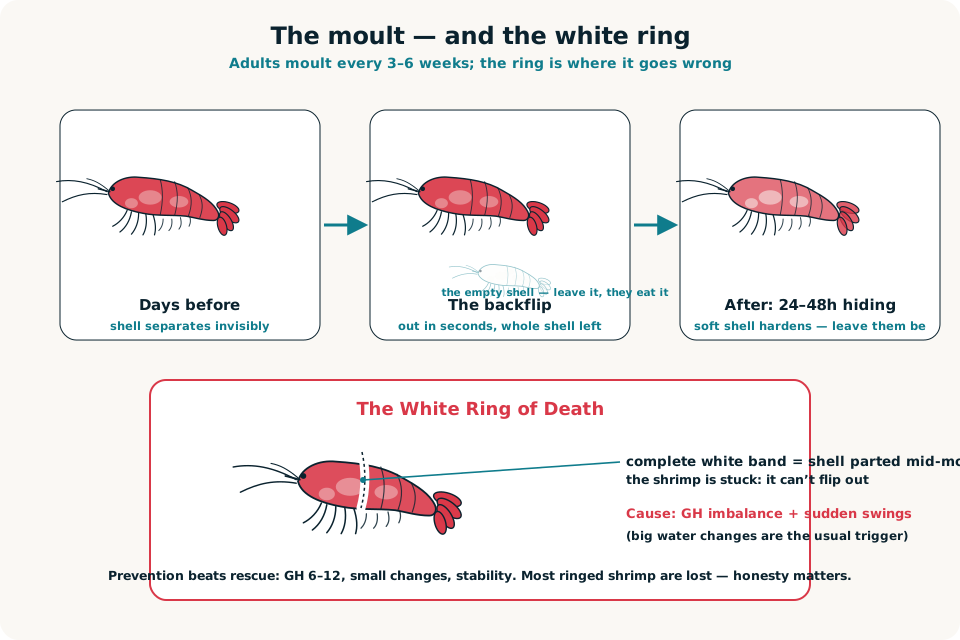
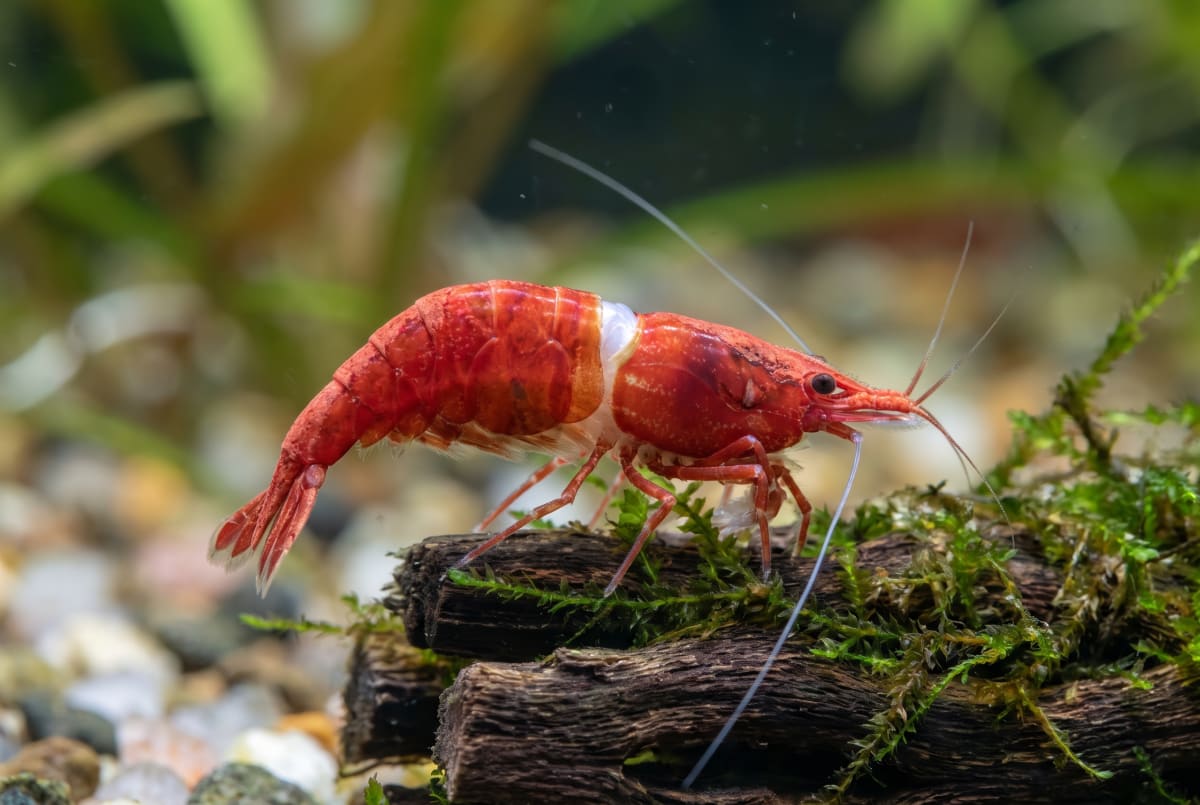
You'll see it described as a white band, a white ring, or a shrimp stuck mid-moult, and they're all the same event. The shrimp may struggle, curl and flick without success, then tire. Because it can't complete the moult, it can't free its gills or feed properly, and it rarely recovers — which is why the hobby gave a stuck moult such a bleak name. Spotting one is distressing, but the useful response isn't to fixate on the individual; it's to work out why the moult failed, because the cause is usually sitting in your water for the whole colony.
Why it happens: GH, minerals and sudden swings
Two things cause failed moults, and they often act together. The first is general hardness — GH, the calcium and magnesium dissolved in your water. Those minerals are the raw material for a new shell and for the moulting process itself. When GH sits too low, the shrimp can't build or work a shell properly, the old one won't part cleanly, and you get the white ring. This is the hidden cause behind a run of failed moults in Britain's soft-water regions, where tap GH can sit well under the 6–12 shrimp want. The mineral mechanics get a full treatment in our guide to failed moults and the GH connection.
The second cause is a sudden swing, and this is the one that catches careful keepers out. A large water change with mismatched water — colder, or a very different TDS — can jolt a shrimp into moulting before its new shell is ready, or change the mineral balance mid-moult so the shell hardens wrong. That's why the white ring so often appears in the day after a big or careless water change. Stable water, held inside GH 6–12 with the wider parameters in our Neocaridina water parameters guide, is what a clean moult actually needs. Get both right — enough minerals, no sudden lurches — and failed moults become rare.
Diet, minerals and the moult
GH does the heavy lifting, but diet plays a supporting role worth getting right. The minerals for a new shell come mainly from the water rather than from food, which is why remineralising a soft tank fixes far more failed moults than any supplement you drop in. That said, a varied diet with a modest protein component supports the whole process — a shrimp living on thin biofilm in a sparse, new tank has less to work with than one in a mature, well-fed colony.
Some keepers add a piece of cuttlebone or a mineral-rich botanical as moulting insurance. We've kept colonies moulting cleanly for years on nothing but remineralised water held at GH 6–12, so we treat those as optional extras rather than fixes. If moults are failing, the answer is almost always in the GH reading, not in what you're adding to the food. The quickest way to confirm it is to test: when failed moults track with a soft tap supply, or start up after a batch of remineraliser runs low, minerals are your cause and a reliable GH target is your fix.
Other moulting problems
The white ring is the dramatic failure, but a few quieter moulting problems are worth recognising. An incomplete or partial moult, where a shrimp frees most of itself but can't shed a leg or the tail section, comes from the same root causes and carries the same poor odds. A run of moults across the colony that all stall points squarely at water rather than bad luck — one shrimp is chance, several is a parameter problem you can fix.
At the other end of the scale, a shrimp that moults too rarely is telling you something as well. Moulting slows right down in a cold tank — pushed below the 18–26°C range, a shrimp's whole metabolism drags — and in a chronically underfed one. If a colony grows slowly and you almost never find shed shells, check the temperature is sitting inside the range and that the tank is fed enough to sustain growth, rather than assuming the shrimp are simply being quiet.
There's also one lookalike that isn't a moulting problem at all. Muscular necrosis, a bacterial or stress condition, turns the flesh inside the tail opaque and milky white, and keepers sometimes read that white as the white ring. The difference is where the white sits: the ring is a gap in the shell at the joint, while necrosis is solid tissue going cloudy inside the body. They need different responses, and we've set necrosis out in our guide to bacterial infections and muscular necrosis. If in doubt, ask whether you're looking at a separation in the shell or a change in the meat.
Can you save a shrimp with the white ring?
Honestly, usually not — and we'd rather tell you that plainly than sell false hope. By the time the ring is visible the moult has already failed, and most shrimp that reach this stage die whatever you do. There's no reliable rescue, and interventions that mean netting and handling the shrimp add stress to an animal that's already in trouble.
What some keepers try, and what does no harm, is to leave the shrimp completely undisturbed in stable water and hope it works itself free — a few do. Others gently correct the underlying water in the same moment: nudging a too-soft tank up towards GH 6–12 with a remineraliser, over hours rather than minutes, and adding an Indian almond leaf for the mild benefits its tannins bring. Treat these as long shots for the individual. The real work is protecting the next moult for every other shrimp in the tank, which comes down to prevention.
Preventing it: the whole job in three habits
Prevention is genuinely the whole story here, and it's three habits rather than any product. First, keep GH in range: 6–12, and if your tap water is soft, remineralise up to it rather than hoping — our guide to remineralising RO and rainwater covers how to hit a target reliably. Second, change water gently: small weekly changes of 10–20%, temperature-matched and dechlorinated, so nothing ever lurches. Third, chase stability over perfect numbers, because a rock-steady tank at the high end of the range beats one being pushed around towards textbook figures.
Do those three and you may never see a white ring at all. A well-run cherry colony moults constantly and invisibly — a shell here, a shrimp lying low there — and the failures stay rare. Watch your juveniles especially: they moult most often, so if GH ever drifts too low they tend to be the first to fail, which makes the smallest shrimp in the tank a useful early-warning system. If moults are failing anyway, treat it as the clearest possible signal to test your water, because a stuck moult is usually the tank telling you something the shrimp already knows. It's also the first thing we'd check in any wider die-off, which is why it sits near the top of our diagnostic checklist for dying shrimp. None of this changes the easy, ordinary care in our cherry shrimp care guide; it just explains the one part of it shrimp can't afford you to get wrong.
FAQ
What is the white ring of death in shrimp?
It's a failed moult. A pale, opaque band appears at the joint between a shrimp's head section and abdomen where the shell has split, but the shrimp can't finish climbing out and gets stuck. Unable to complete the moult, feed or free its gills, it rarely survives. The causes are low GH and sudden water changes, and prevention is far more effective than any cure.
Can a shrimp survive the white ring of death?
Usually not. By the time the white band is visible the moult has already gone wrong, and most shrimp at that stage die whatever you try. A few free themselves if left completely undisturbed in stable water, so don't handle or net them. The productive response is to fix the underlying water — GH and stability — to protect every other shrimp's next moult.
Why do my shrimp keep dying when they moult?
Repeated moult deaths almost always mean a water problem, not bad luck. The two causes are GH too low to build a proper shell — common in soft-water areas — and sudden swings from large or mismatched water changes that trigger or disrupt a moult. Test your GH, aim for 6–12, and switch to small, gentle, temperature-matched changes. A colony-wide run of failed moults is a parameter issue you can correct.
How often do cherry shrimp moult?
Adults moult roughly every three to six weeks, and juveniles more often because they're growing faster. For 24 to 48 hours after a moult the new shell is soft, so the shrimp hides while it hardens — which is why a shrimp that's vanished for a day is usually moulting rather than missing. You'll spot the translucent shed shells long before you ever catch a shrimp in the act.
Should I remove shrimp moults from the tank?
No — leave them in. A shed moult is a hollow, translucent shell, not a body, and the colony grazes it back within a day or two, recycling the calcium into new shells. Removing them just throws away minerals the tank wants back. The only white shape worth removing is an opaque, coloured one that's actually a dead shrimp.