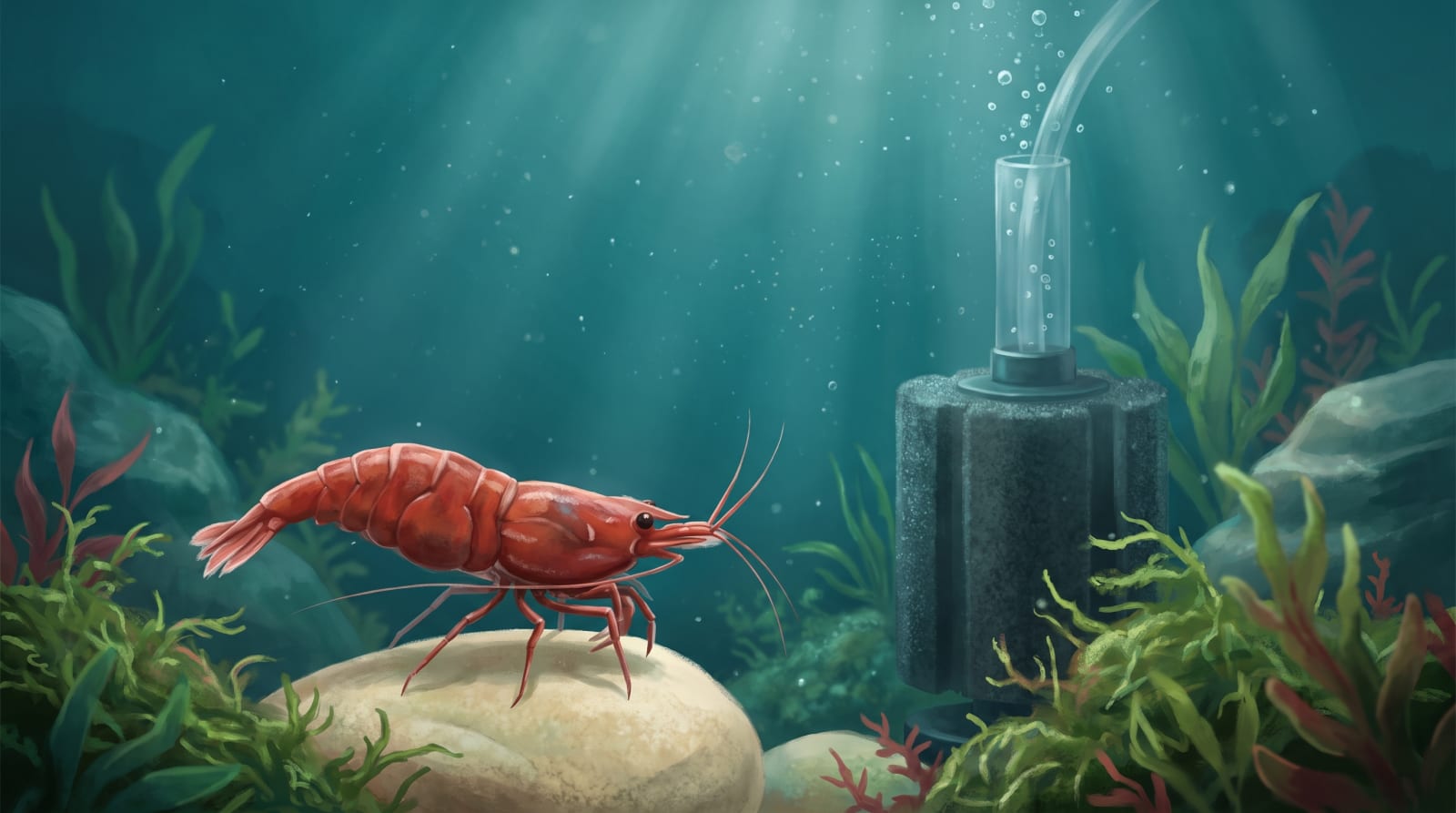
For shrimp, two of these three numbers must read zero, all the time. Ammonia: 0. Nitrite: 0. Nitrate: under 20ppm. There's no safe trace of ammonia or nitrite in a shrimp tank — any measurable reading is an emergency, not a tolerance to fine-tune — and nitrate is the mild one you manage rather than fear. Get these three right and you've removed the most common cause of dead cherry shrimp.
The safe levels at a glance
| Reading | Safe level for shrimp | If it climbs |
|---|---|---|
| Ammonia | 0 | Acute poisoning — usually an uncycled or crashed tank |
| Nitrite | 0 | Acute poisoning — the cycle's unfinished middle stage |
| Nitrate | Under 20ppm | Chronic stress and stalled breeding — manage with water changes |
These aren't targets you aim near. For ammonia and nitrite, zero is the only acceptable reading. Nitrate is different in kind: it's the relatively harmless end product of the same process, and the job there is to keep it low rather than absent. The full context for where these sit among pH, GH, KH and temperature is in our Neocaridina water parameters guide.
Where these three come from: the nitrogen cycle
All three are stages of one process, the nitrogen cycle, and understanding the chain makes the numbers obvious. Shrimp waste, uneaten food and decaying plant matter release ammonia. In an established tank, one group of bacteria converts that ammonia into nitrite, and a second group converts nitrite into nitrate. Ammonia and nitrite are both highly toxic; nitrate, the end of the line, is far milder.
A mature aquarium runs this chain invisibly. The bacteria live in the filter sponge and on every surface, and they process waste about as fast as the tank produces it, which is why a cycled tank reads zero ammonia and zero nitrite day after day. Nitrate is the only one that accumulates, and water changes export it.
The catch is that those bacterial colonies take weeks to build. A brand-new tank has no workforce, so ammonia climbs with nothing to process it — which is why cycling a tank before any shrimp go in isn't optional. We've seen more first-week colonies lost to this than to anything else. If the word is new to you, read cycling a tank for shrimp before you buy livestock.
Why shrimp are more sensitive than fish
Shrimp punish mistakes a hardy fish would shrug off. They're small, they have no protective scales, and their gills sit exposed, so a level of ammonia or nitrite a zebra danio might survive can wipe a shrimp colony. Shrimplets are more fragile still. This is the core reason a tank that "seemed fine for fish" so often fails for shrimp — the bar is simply higher.
It cuts the other way usefully, too. Because shrimp react early, a colony that suddenly goes still and stops grazing is an early-warning system, often the first sign something has shifted in the water well before you'd otherwise think to test. When a tank looks wrong to us, we test before doing anything else. The wider diagnostic runs through why are my cherry shrimp dying, and ammonia or nitrite is the first thing it rules out.
Ammonia and nitrite: the two that kill quickly
These two behave the same way in practice — both acutely toxic, both should read zero, both climbing for the same reasons — so it's worth treating them together.
Ammonia is the first to appear. It floods a tank that was never cycled, and it returns in an established one whenever the bacterial colony is outpaced or damaged: a filter left to dry out or rinsed under the tap, a dead animal breaking down unnoticed, a sudden heavy feed, or too many shrimp added at once. At the pH and temperatures most cherry tanks run, even a fraction of a ppm is dangerous.
Nitrite is the hidden second stage, and it catches keepers who think a new tank has finished cycling. Ammonia falls to zero first, the tank looks safe, and then nitrite spikes as the first bacteria get to work faster than the second group can catch up. A tank mid-cycle can read zero ammonia and dangerous nitrite on the same day, which is why you wait for both to sit at zero before trusting it with shrimp.
The signs of trouble from either are the same, and they're behavioural: shrimp stop grazing, sit motionless in the open rather than tucked under moss, and in a bad spike may swim erratically or gather near the surface where oxygen is highest. By the time you see that, it's already an emergency.
Nitrate: the slow-burn number
Nitrate is the one you'll actually live with, because it's the normal end product of a healthy cycle and it always builds between water changes. Keep it under 20ppm. It won't kill overnight the way ammonia does, but chronically high nitrate quietly suppresses breeding, dulls colour and wears a colony down over months — a common hidden reason a tank that looks fine simply won't produce shrimplets.
Two things push nitrate up: overfeeding and infrequent water changes. Both are easy to fix. Small, regular water changes export nitrate steadily, and feeding only what the colony clears in a couple of hours stops the surplus rotting into more of it. One UK-specific check is worth doing: some tap water carries nitrate straight from the source, so if yours reads high before it even goes in the tank, that caps how low a water change can take you. Your water company publishes the figure, and the regional picture is in our UK tap water guide.
What causes a spike
When ammonia or nitrite appears in a tank that was previously stable, it's nearly always one of a short list:
- The tank was never fully cycled — the commonest cause, and the one that kills new colonies.
- Overfeeding. Uneaten food rots into ammonia and is the single most avoidable trigger; it's the number-one killer in this hobby for exactly this reason. The full case is in overfeeding shrimp.
- A dead animal breaking down. A shrimp, snail or fish that dies out of sight can spike a small tank quickly — check the count if something seems off.
- A damaged filter. Rinsing the sponge under the tap, letting it dry out, or a power cut that stalls the flow can kill enough bacteria to interrupt the cycle.
- Adding too much at once. A big batch of new shrimp, or a sudden heavy feed, can briefly outpace the bacteria — a "mini-cycle" while the colony catches up.
- Disturbing the substrate, which can release trapped waste in an older tank.
Read that list and the pattern is clear: ammonia and nitrite problems are almost always about the cycle being missing, overloaded or broken. Fix the cause, not just the reading.
How to respond to a spike
If a test shows ammonia or nitrite above zero with shrimp in the tank, act the same day.
First, a water change — the fastest way to dilute the toxin. Make it bigger than your routine weekly one, added slowly with dechlorinated, temperature-matched water so the fix doesn't become a swing of its own, and repeat over the following days until readings return to zero. Steady dilution beats one dramatic change, and the how of doing it safely is in water changes for shrimp.
Then stop the source. Cut feeding right back — an established colony loses nothing by not eating for several days — and remove any uneaten food, dead animals or decaying leaves you can find. If the filter was recently rinsed or disturbed, leave it well alone to recover. A dechlorinator that also detoxifies ammonia can buy time in an emergency by locking it into a less harmful form while the bacteria catch up, though it's a stopgap, not a substitute for water changes and finding the cause.
What not to do: don't tear the tank down, don't scrub the filter clean, and don't reach for an armful of additives. Those usually make the swing worse. Dilute, cut the input, remove the source, and let the cycle rebuild — that sequence settles almost every spike a shrimp keeper meets.
Testing without a laboratory
You can't manage what you can't see, and these three readings are invisible until they've done damage, so a test kit isn't optional for a shrimp keeper. A liquid test kit for ammonia, nitrite and nitrate is the one to own — liquid drops read more accurately than paper strips, which tend to be vague at exactly the low end that matters for shrimp.
Test often while a tank is young or after any change — during cycling, when you add shrimp, after a death, or if the colony goes quiet — then settle into an occasional check once things are stable and reading zero week after week. The habit we drum into every new keeper is catching a problem while it's still a number on a test, not a pile of bodies. That, more than any single parameter, separates a colony that lasts from one that crashes, and it runs right through our cherry shrimp care guide.
FAQ
What are safe ammonia, nitrite and nitrate levels for shrimp?
Ammonia and nitrite must both read zero — there's no safe trace of either for shrimp — and nitrate should stay under 20ppm. Ammonia and nitrite are acutely toxic and mean something is wrong with your cycle; nitrate is the mild end product you keep low with regular water changes. Shrimp are more sensitive than most fish, so treat any ammonia or nitrite reading as an emergency.
Can an ammonia spike kill shrimp?
Yes, and quickly. Ammonia is acutely toxic to shrimp, and because they're smaller and more sensitive than fish, even a fraction of a ppm can be fatal, shrimplets first. A spike usually means an uncycled tank, overfeeding, a dead animal breaking down, or a damaged filter. Respond the same day with a temperature-matched water change, cut feeding hard, and remove the source.
Is nitrite or nitrate more dangerous for shrimp?
Nitrite is far more dangerous. It's acutely toxic and must read zero, like ammonia — it's the unfinished middle stage of the nitrogen cycle, and a tank can spike nitrite even after ammonia has dropped away. Nitrate is the mild end product; under 20ppm it's tolerated, though chronically high nitrate quietly suppresses breeding. In short: nitrite kills fast, nitrate wears a colony down slowly.
How do I lower nitrate in a shrimp tank?
Small, regular water changes are the main tool — they export nitrate steadily without shocking the colony. Feed less, since uneaten food rots into more nitrate, and don't overstock. Check your tap water too: some UK supplies carry nitrate before it reaches the tank, which caps how low changes can take you. Aim to hold nitrate under 20ppm rather than chasing an unrealistic zero.