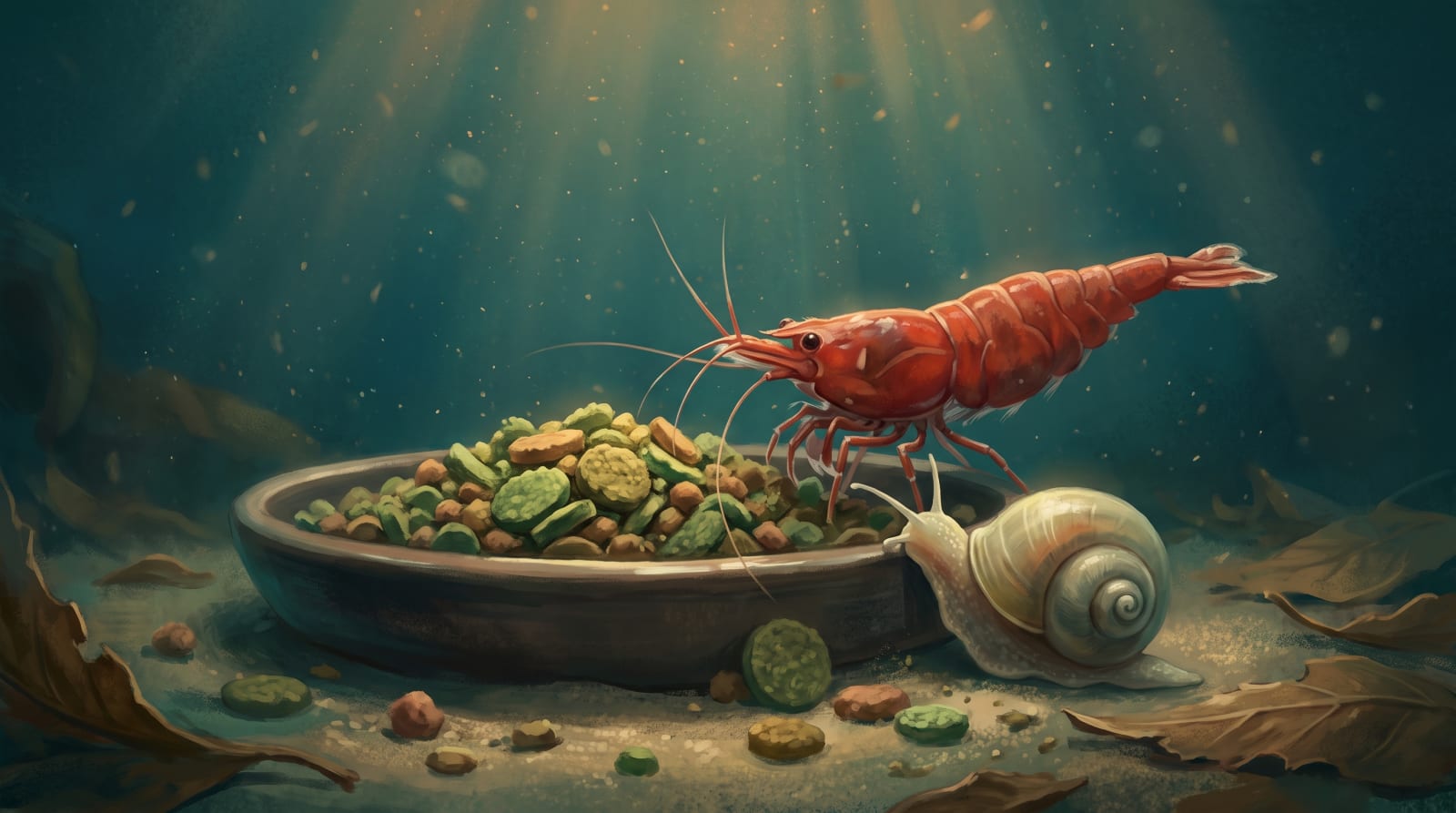
Ask a room full of shrimp keepers what kills the most cherry shrimp, and the honest ones all say the same thing: too much food. Overfeeding is the number one killer in this hobby, and it rarely looks like the culprit, because it does its damage slowly and at second hand. Nobody watches a shrimp die of a pellet — they watch the water go wrong, the worms arrive and the colony quietly fade, weeks after the habit that caused it. This guide is the full case against overfeeding: what it actually does, how to catch it early, and how to pull a tank back once it has already tipped over.
The overfeeding chain: what surplus food does
The thing to understand is that overfeeding never harms shrimp directly. A cherry shrimp couldn't eat itself into trouble if it tried; it grazes, wanders off, comes back. The harm is entirely in what happens to the food the colony doesn't eat. Every pellet, wafer or scrap of veg left sitting in the tank is a lump of decaying protein, and decay is where the trouble starts.
Uneaten food breaks down through the same nitrogen cycle your filter runs on — first to ammonia, then nitrite, then nitrate. In a fully cycled tank the bacteria usually keep pace, so you don't see an ammonia reading; what you see instead is nitrate climbing and TDS creeping upward as the tank slowly loads with waste. Cherry shrimp want ammonia and nitrite at zero and nitrate under 20ppm, and they feel the drift long before a test kit alarms you. In a newer or badly overfed tank the bacteria can't keep up, and then you get an actual ammonia or nitrite spike, which is an emergency rather than a nuisance.
That is only half of it. Surplus food is also free energy for everything you didn't mean to feed. A tank with more food going in than the colony can clear will grow booms of planaria, hydra and pest snails, because you have handed them a buffet. The chain looks like this:
| Surplus food becomes | Which shows up as | Why it harms the colony |
|---|---|---|
| Ammonia, nitrite, nitrate | Rising test readings, then TDS creep | Direct toxicity, then chronic stress and moulting trouble |
| Rotting organic matter | Cloudy water, bacterial bloom, low oxygen | Stress, fouled water, shrimp off their food |
| Free protein for pests | Planaria and hydra blooms | Competition; hydra can catch and kill shrimplets |
| Free protein for snails | A snail population explosion | Not harmful in itself, but a loud overfeeding alarm |
None of those individually screams "you fed too much". That's exactly why overfeeding is so good at killing shrimp — the keeper sees worms, or a snail boom, or shrimp going downhill, and treats the symptom while the cause carries on going in twice a day.
The signs you're overfeeding
Overfeeding announces itself in a fairly reliable order, and once you know the tells you'll never misread them. Run through this checklist whenever a tank feels off:
- Food is still there hours later. The single clearest sign. If a portion isn't gone within two to three hours, the colony didn't want it and the surplus is now rotting. Leftover food in the tank the next morning is overfeeding, full stop.
- A snail population explosion. Ramshorns and bladder snails breed to match the food supply, so a tank suddenly heaving with snails is a living readout of how much surplus there is. We treat a snail boom as the friendliest early warning the tank gives.
- Planaria or hydra appear. Little flatworms gliding on the glass, or tiny tentacled polyps on the surfaces, mean there's spare protein feeding them. Most "planaria" panics are actually harmless detritus worms, but either way a bloom points at the same cause — planaria and hydra are a feeding signal before they're a pest problem.
- The water clouds or a film forms. A milky haze is a bacterial bloom digesting the excess; an oily film on the surface is the same story at the top of the tank.
- TDS is creeping up. Waste dissolves into the water, so an overfed tank's TDS drifts upward between water changes rather than holding steady. A slow climb is the number telling on you.
- Mulm is piling up fast. Some detritus is healthy, but sludge visibly gathering in corners and under décor within a week means more is going in than the system can process.
- The shrimp stop mobbing food. A hungry colony piles onto a new portion within seconds. If yours drift over half-heartedly, or ignore it, they're already well fed and you're topping up a tank that doesn't need it.
One or two of these can have other causes. Three or four together are overfeeding until proven otherwise, and the fix is the same whichever combination you're seeing.
So how much food is too much?
The honest answer is: far less than most people think. A mature, planted tank feeds its shrimp most of the time on its own, through the biofilm and algae growing on every surface — that grazing is the primary diet, and everything you add is a supplement on top. Our established colonies eat added food two or three times a week, in portions a modest colony clears inside a couple of hours.
The rule that keeps you honest is simple: put in only what the colony strips in two to three hours, and if anything is left, the next feed is smaller. It self-corrects for any colony size without weighing a thing — the full method, including portioning and skip days, is in how often and how much to feed shrimp. Fresh foods run to a tighter clock still: blanched vegetables want pulling out within a few hours, twelve at the absolute outside, or they foul the water overnight.
The trap that catches experienced keepers is the growing colony. It feels wrong to feed a tank of two hundred shrimp the same few times a week you fed the starting ten, so people start feeding daily "because there are so many of them now". But the biofilm grew with the colony, and a bigger group simply clears a slightly larger portion at the same frequency. Feeding daily because the numbers went up is one of the surest ways to tip a thriving tank into the mess this guide is about.
The recovery week
If you've read this far with a sinking feeling, here's the good news: an overfed tank almost always recovers, and it recovers by you doing less, not more. The instinct is to strip and scrub everything, but a big deep clean is its own emergency — sudden swings kill cherry shrimp, and a panic overhaul strips the biofilm they live on. Go gentle and go slow. Here's the week we'd run.
Stop feeding entirely. For the first several days, nothing goes in. This alarms new keepers, but a mature tank carries healthy adults for a week or more on biofilm alone, and the shrimplets never notice. Starving the problem of fuel is the single most effective thing you can do, and it costs nothing.
Test the water. Check ammonia, nitrite and nitrate straight away. Zero ammonia and nitrite with high nitrate means a loaded but functioning tank — water changes fix it. Any ammonia or nitrite reading is the acute version, and the response is more urgent: get it down now.
Physically remove the leftovers. Siphon out visible uneaten food, decaying leaves and the worst of the mulm, gently, with a thin tube so no shrimplets go up it. You're removing the fuel source by hand rather than waiting for it to rot. Squeeze a gunged-up sponge filter out in a bucket of old tank water while you're at it — never under the tap, which kills the bacteria.
Change water small and often. Bring nitrate down with modest, frequent water changes — think 10–20% every day or two rather than one huge change. Every drop temperature-matched and dechlorinated, added slowly. Small and repeated lowers the waste without the TDS and temperature shock that a single 50% change would inflict.
Leave the pests to starve. Don't reach for treatments first. Cut the food and the planaria, hydra and snail booms lose their supply and recede on their own over a couple of weeks. If a hydra population is genuinely threatening a big brood of shrimplets, treat it deliberately — but fix the feeding, or the pests simply come back.
Resume feeding only when it's clean. Once the water tests come back in range and stay there, reintroduce food at half what you were giving, and hold to the two-to-three-hour rule from the first portion. The colony will have thinned any weak individuals, but a stable tank rebuilds numbers fast.
Habits that stop it happening again
Recovery is a one-off; prevention is a handful of habits that make overfeeding almost impossible to do by accident. We build them into every tank in the breeding room.
Feed to one spot. A shallow feeding dish or even a clean jar lid keeps every portion in one visible place, so leftovers are obvious and easy to lift out. Scattering food across the substrate just hides the evidence where it rots unseen.
Watch the first two minutes. A hungry colony swarms food instantly; a slow response means the tank is already fed. Let the shrimp's reaction size the next portion for you.
Read the snails. A steady snail population is a healthy tank; a booming one is the tank asking you to feed less. Snails are the cheapest overfeeding meter you'll ever own, which is one more reason shrimp and snails belong together.
Default to less. You can always add food tomorrow; you can't take it back out once it's dissolved into the water. When you're unsure, feed less and feed again the next day. A missed feed in an established tank costs the colony nothing, and the odd fasting day does a shrimp tank good.
Get those four right and overfeeding stops being the number one killer in your tanks and becomes a mistake you simply don't make. The colony does the rest.
FAQ
What are the signs of overfeeding shrimp?
The clearest sign is food still sitting in the tank two to three hours after feeding. After that, watch for a snail population explosion, planaria or hydra appearing, cloudy water or a surface film, TDS creeping up between water changes, and mulm piling up fast. Shrimp that drift over to food half-heartedly rather than mobbing it are also telling you they're already well fed.
Can you overfeed cherry shrimp?
Not directly — a shrimp won't eat itself sick — but overfeeding the tank is the most common way keepers kill their colonies. Uneaten food decays into ammonia, nitrite and nitrate, pushes TDS up, and fuels planaria, hydra and pest snail blooms. The shrimp are harmed by the fouled water and the knock-on problems, not by the food itself, which is exactly why it's so easy to miss.
Does overfeeding cause planaria?
Effectively, yes. Planaria and hydra don't appear from nowhere — they bloom when there's surplus protein to feed them, and that surplus is nearly always uneaten food. Most worms keepers panic about are actually harmless detritus worms, but either population signals the same thing. Cut the feeding and they lose their food supply and fade; treat them without fixing the feeding and they'll simply return.
How much food is too much for shrimp?
Anything the colony can't clear in two to three hours is too much. A mature tank feeds its shrimp mostly on biofilm, so added food is a supplement given two or three times a week, in small portions. Start with less than you think — a single small pellet for a modest colony — and let what disappears inside that window set the amount. Leftovers are the definition of overfeeding.
How do I fix an overfed shrimp tank?
Stop feeding for several days, test ammonia, nitrite and nitrate, and physically siphon out leftover food and the worst of the mulm. Bring nitrate down with small, frequent, temperature-matched water changes rather than one big one, which would shock the shrimp. Let pest blooms starve out rather than dosing first. Resume feeding at half the old amount only once the water tests clean and stays there.