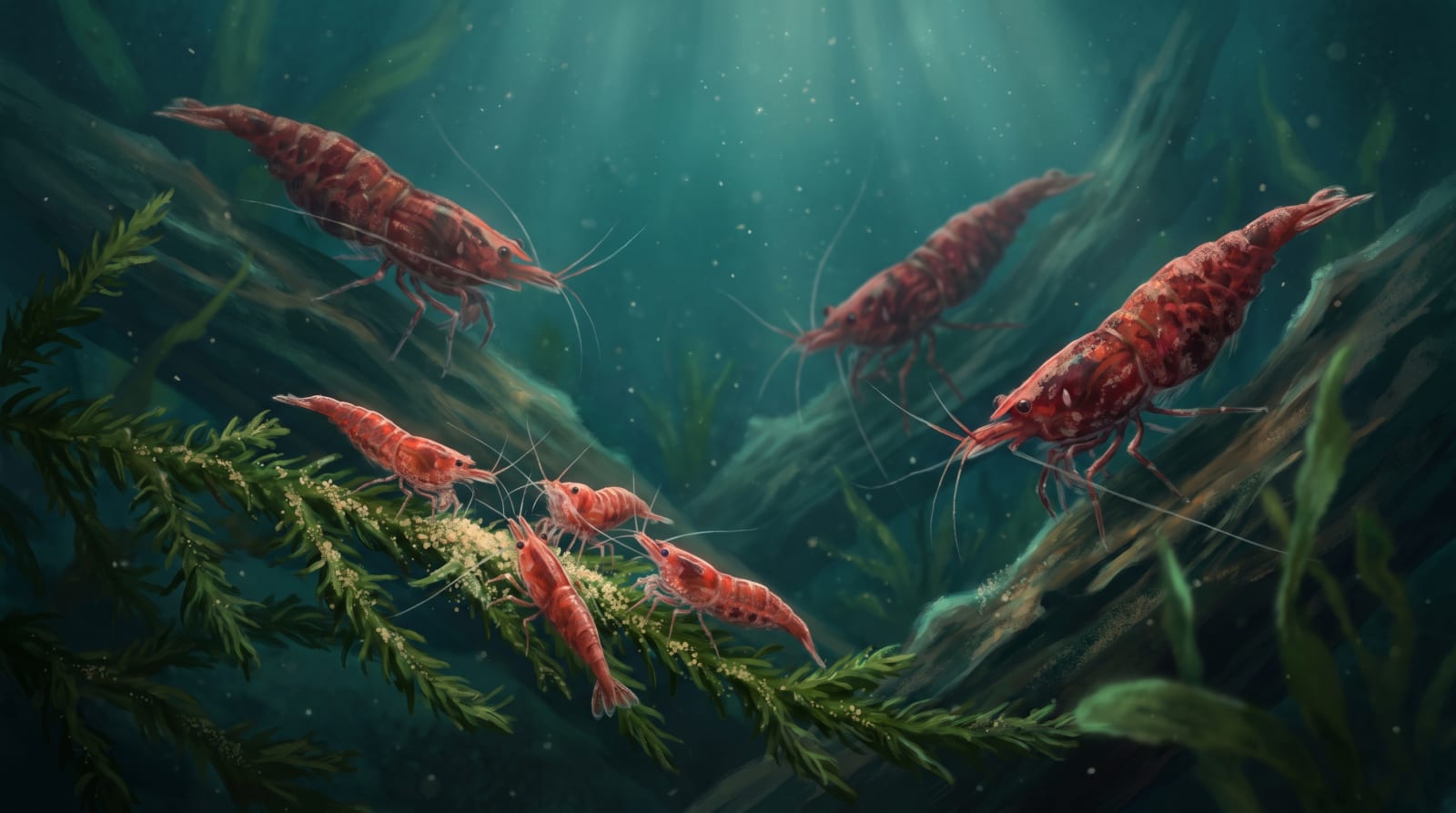
Feeding shrimplets is mostly a matter of not getting in the way. Baby cherry shrimp hatch fully formed and already know what to do — they graze biofilm from their first hour, with no larval stage to nurse through and no special diet to prepare. In a mature, planted tank the food is already there, everywhere they need it. Your job is to keep that food supply going and, above all, to resist feeding them too much. Here is what actually goes into our shrimplet tanks, and what we deliberately leave out.
Shrimplets feed themselves from day one
Cherry shrimp have no larval stage. A berried female carries 20–30 eggs for a couple of weeks and then releases 1–2mm miniatures of the adult — tiny, translucent, and grazing within the hour. What they graze is biofilm: the living film of bacteria, algae and micro-organisms coating every surface in an established tank. It's a complete first food, it's already everywhere, and it restocks itself.
This is why the single most important thing you can do for a brood has nothing to do with feeding at all — it's giving them a mature tank to hatch into. Food is only one lever among several, and the whole survival picture is in raising shrimplets. But of the feeding side specifically, this is the headline: in the right tank, the babies are already fed.
The mature-tank advantage
A tank that's been running for a few months grows biofilm on the glass, the leaves, the wood and the sponge filter — a self-serving nursery where shrimplets can't help but find food. A spotless tank cycled last week can pass every water test and still starve a brood, because there is simply nothing on the surfaces to graze.
So if you're setting up specifically to breed, plant the tank and let it ripen for a month or two before the shrimp go in. Age is an ingredient here, not a sign of neglect. The grubbier, more established tank raises far more babies than the pristine new one, every time — a fact that offends tidy-minded keepers and quietly rewards patient ones. When people ask why their water is perfect but their shrimplets keep vanishing, a too-clean, too-new tank is one of the first things we check.
They don't travel to food
Here's the concept that changes how you feed babies: shrimplets don't cross the tank to a feeding dish. Adults will march over to a pellet the moment it lands; a 2mm shrimplet stays where it is, grazing whatever surface it's already on. Food has to come to them, which means it has to be spread across surfaces rather than piled in one spot.
That single fact explains everything about first foods. It's why powders suit shrimplets and pellets don't, why a mossy tank raises more babies than a bare one, and why "more cover" and "more food" turn out to be the same instruction. A dense clump of moss is a three-dimensional grazing surface with food growing on every strand, exactly where the babies already are. Cover and diet, in shrimplet terms, are the same thing seen from two angles.
First foods, used sparingly
In a mature, mossy tank the biofilm does most of the feeding, but a little extra helps once shrimplets are loose — with the emphasis firmly on little. These are the foods that suit them, and how we use each.
Powdered and dust foods. Micron-fine particles that drift and settle across every surface, putting food exactly where shrimplets live. They're the classic first food, and they earn their place in a young tank that hasn't built much biofilm yet. The danger is that powder is invisible once it's in and impossible to remove, so it's the easiest food in the hobby to overdo. A pinch means a pinch. More on the powdered types is in best shrimp food UK.
Snowflake food. Soya-husk snowflake is close to ideal for a nursery because it's safe to leave in the tank. Rather than a portion that fouls the water, it sits as a slow grazing station, growing a white mycelium fuzz that tiny mouths work on for days. Food that farms more food, with nothing to take back out.
Botanicals. A catappa (Indian almond) leaf or a couple of alder cones do the same job biologically — they soften, grow biofilm, and become grazing stations that keep producing for weeks. There's a leaf in every shrimplet tank we run.
Crushed staple. A normal algae-based staple, crushed to crumbs, works fine at a push. Just keep the portion tiny and treat it like powder: spread thin, offered rarely.
One thing you can skip entirely is the fish-fry playbook. Advice about culturing infusoria or dosing liquid fry food is aimed at newly hatched fish, which are helpless filter-feeders for their first days. Shrimplets aren't — they're competent grazers from hour one, working the same surfaces the adults do, so none of that microscopic live-food effort is needed or useful in a shrimp tank.
The overfeeding trap is worst in a nursery
The rule that governs the adult tank governs the nursery harder: overfeeding is the number-one killer of shrimp, and it does its worst damage among babies. Uneaten food rots into ammonia and drives water quality down, and shrimplets are the least able of anyone in the tank to cope with that. A generous hand that an adult colony might shrug off can quietly clear a brood.
So feed less than feels right, watch the food get grazed, and let the biofilm carry the rest. If you can still see food an hour or two later, you've fed too much — scale the next feed down. The full case against overfeeding, and how to recover a tank that's tipped over, is in overfeeding: signs, dangers and recovery.
What we actually feed our shrimplet tanks
The honest version, because it's less than you'd think. Our nursery tanks are mature and heavily mossed, with a catappa leaf always present and a little of that leave-in food as a permanent grazing station. In a well-established tank that's genuinely all it takes — the biofilm, the leaf and the fuzz do the feeding, and we add almost nothing on top.
The one time we reach for powder is a younger tank raising babies before it has fully ripened, where a light dusting a few times a week papers over the thin biofilm. Everywhere else, the tank feeds the babies and we stay out of it. When in doubt, do less: a slightly underfed shrimplet in clean water beats a well-fed one in fouled water every time.
Growing on: when shrimplets become juveniles
Shrimplets grow gradually and spend their first weeks tucked in cover, so you'll notice them as grazing specks long before they look like proper shrimp. As they put on size they graze more like adults, ranging further and taking the same foods, and by the time they're recognisable juveniles they've simply joined the colony's normal routine.
At that point there's nothing separate to do. They eat what the adults eat, from the same supplement rota, on the same twice- or three-times-a-week schedule. They reach breeding age at roughly 3–5 months, and then they start producing shrimplets of their own — and the whole feed-them-by-barely-feeding-them cycle begins again.
FAQ
Do baby shrimp need special food?
Not usually. Shrimplets graze biofilm from day one, and in a mature, planted tank that living film is a complete first food already spread across every surface. In a newer tank with less biofilm, a light dusting of powdered or finely crushed food helps — but it's a top-up, not a necessity. The mistake to avoid is treating babies as if they need heavy, special feeding; they need a mature tank far more than they need a product.
What do you feed baby cherry shrimp?
In our tanks, mostly the tank itself — biofilm, a permanent catappa leaf, and a little leave-in soya-husk food as a grazing station. In a younger setup we add a light dusting of powdered food a few times a week to cover thin biofilm. What matters more than the specific food is how it's delivered: spread thinly across surfaces, because shrimplets don't travel to a feeding spot the way adults do. Little and everywhere beats a lot in one place.
Do I need to feed shrimplets separately from adults?
No. Shrimplets are raised right alongside their parents in the same tank and graze the same surfaces, so there's no separate feeding to organise. Cherry shrimp don't eat their own young, so the babies are safe among the colony. The only real adjustment is delivery — favour foods that spread across surfaces, like powders, botanicals and leave-in soya-husk foods, over pellets that sit in one place a baby won't reach.
Can you overfeed baby shrimp?
Very easily, and it's the most common way a brood is lost. Uneaten food rots into ammonia, and shrimplets are the least tolerant animals in the tank of the water-quality drop that follows. Powder is especially risky because it's invisible once dosed and impossible to remove. Feed a pinch, watch it get grazed, and if food's still there an hour or two later, cut the next feed right back.
How often should I feed shrimplets?
In a mature tank, less often than you'd expect — the biofilm feeds them continuously, so a light dusting a few times a week is plenty, and a well-established mossy tank often needs nothing added at all. Newer tanks lean on the higher end while their biofilm builds. Let the tank's grazing set the pace: if the babies are on well-covered mature surfaces, your job is mostly to stay out of the way.