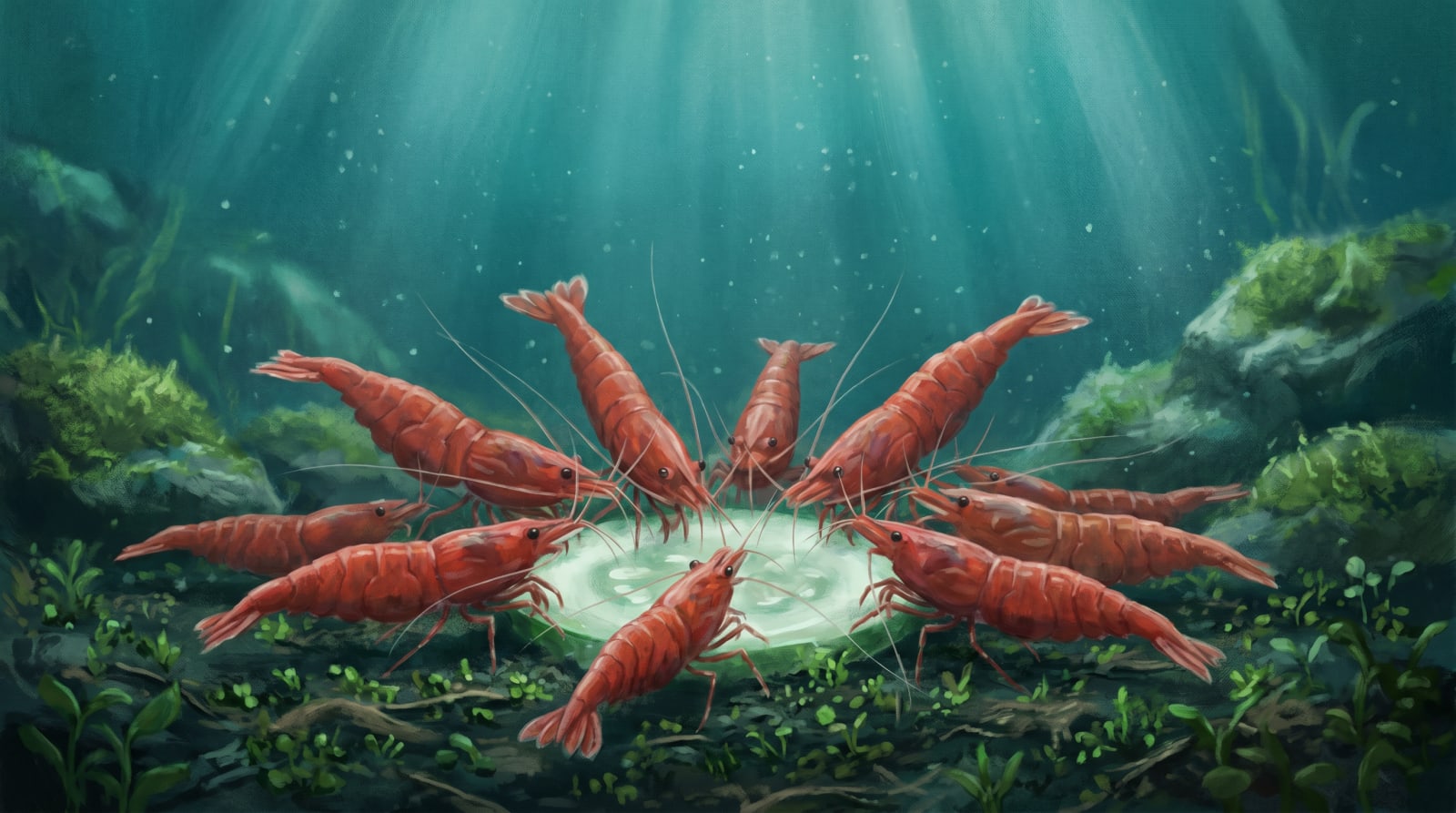
A slice of blanched courgette is the closest thing to a party a shrimp colony throws. Drop one in and within an hour it's carpeted in shrimp, mouthparts working, and it's genuinely one of the nicest things to watch in the hobby. Blanched veg isn't a staple — biofilm and a good shrimp food do the heavy lifting — but as a weekly treat it earns its place, and getting it right takes about two minutes and one pan of water. Here's exactly how we do it.
Why bother blanching at all
Blanching is a quick dip in boiling water, and it does three jobs that raw veg can't.
First, it makes the veg sink. Raw courgette and cucumber float, and shrimp won't chase food up into the water column — they graze what's on the floor. A blanched slice waterlogs and stays put where the colony can find it.
Second, it softens the cell walls. Raw plant tissue is tough for a 3cm grazer to break into, so a raw slice mostly sits there ignored while a blanched one gets stripped to a translucent skeleton. Softening turns "food they can nibble" into "food they can actually eat."
Third, it cleans the surface. A brief boil kills off much of the surface bacteria and any hitchhikers riding on shop veg, and it helps break down surface residues before the piece goes near your shrimp. It doesn't make dirty veg safe — that's what rinsing is for, below — but it's a sensible extra step.
How to blanch veg for shrimp, step by step
The whole routine, start to finish:
- Rinse it hard. Hold the veg under a running cold tap and rub it, whatever it is. This is the step that matters most and the one people skip. Pesticide residue is the real danger with fresh veg, so give it a proper wash before anything else.
- Slice thin. A few millimetres thick. Thin slices blanch evenly, sink readily and give the colony more surface to swarm. A coin of courgette or a stubby chip is ideal.
- Boil for 30–60 seconds. Drop the slices into already-boiling water for 30 to 60 seconds — long enough to soften and sink, not so long they turn to mush. Dense veg like carrot is the exception and needs a couple of minutes; leafy spinach needs barely 20–30 seconds.
- Cool it completely. Lift the veg straight into cold water and let it come right down to room temperature. Nothing warm goes into a shrimp tank — a hot slice is a little temperature spike where the shrimp are feeding.
- Weigh it down. Even blanched veg can lift off the substrate. Use a stainless veg clip or wedge the piece under a stone or a bit of wood. Nothing else metallic goes in a shrimp tank, and skip anything with a suction cup that traps shrimplets.
- Remove it in time. Take out whatever's left within a few hours; twelve hours is the absolute outside limit. Veg left to rot fouls the water and feeds pest outbreaks, which undoes the whole point of a healthy treat.
That's it. No blanching agent, no salt, no oil — plain water and a timer.
The vegetables, ranked
Not all veg is equal, and after years of trying most of the fridge, these are the ones we come back to. The three regulars first, then the two that are fine but rarely worth it.
| Vegetable | Blanch time | Verdict for shrimp |
|---|---|---|
| Courgette | 30–60s | The standard. Cheap, mild, always a hit |
| Spinach | 20–30s | Nutritious, calcium and iron; blanch briefly |
| Nettle | 30–60s | Free and excellent — unsprayed sources only |
| Cucumber | 30–60s | Watery and less nutritious, but harmless |
| Carrot | 2–3 min | Dense and slow; needs the longest blanch |
Courgette is the one we reach for by default. It's cheap, it's mild, it softens beautifully and shrimp adore it. If you only ever offer one vegetable, make it courgette and you'll not go far wrong.
Spinach brings more to the table nutritionally — it's a decent source of calcium and iron — and shrimp strip it fast. It's delicate, so it needs only a very brief dip or it disintegrates. A single small leaf is plenty for a nano colony.
Nettle is the free UK option and a genuinely good one. Pick from ground you're certain has never been sprayed — nowhere near a treated verge, path edge or field margin — because pesticides and shrimp end very badly together. The blanch deals with the sting, and the softened leaf gets grazed like any other green.
Cucumber is the one people default to and we rarely use. It's mostly water, so it offers little beyond the graze itself, and it goes slimy quickly. Harmless and fine in a pinch, just not worth choosing over courgette.
Carrot is the odd one out. It's dense and hard, so it needs the longest blanch by far — a couple of minutes, sometimes three — to soften enough to be grazeable. Slice it thin, be patient with the pan, and it's a fine occasional change. Other shrimp-safe options worth a try include blanched kale, green beans, shelled peas (squeezed out of their skins) and sweet potato; all follow the same rinse-blanch-cool-weight-remove routine.
A note on what to skip: anything oily, salted, seasoned or cooked in a dish is out, and so is anything you can't vouch for the growing history of. Keep it plain and keep it clean.
How much, and how often
Blanched veg is a supplement, not a diet. In a mature tank, biofilm and algae are the primary food and everything you add is a top-up, so one veg session a week as part of a varied rota is plenty. We slot it alongside an algae-based staple and a small weekly protein feed; how those pieces fit together is the subject of our protein, plants and the moulting diet guide, and the wider schedule is in how often to feed shrimp.
Portion size is easy to judge: offer a small piece, and if the colony swarms it and strips it clean, that's about right. A slice they half-ignore is a slice they didn't need — scale down next time. Uneaten veg is the trap here. Leftovers breaking down in the substrate are exactly the kind of surplus that drives ammonia up and sets off pest blooms, which is why overfeeding is the number one killer of shrimp tanks. Feed small, watch them clear it, and take out the remains.
One happy bonus: a slice of veg doesn't only feed the adults. As it softens it grows its own film, and shrimplets graze that fuzz right alongside the grown-ups. It's a small version of the same thing that makes biofilm the invisible buffet underneath everything shrimp eat.
Pesticides: the caution that actually matters
Everything else on this page is about doing veg well. This part is about not killing your colony, so read it twice.
Shrimp are extraordinarily sensitive to pesticide residue. Trace amounts that wouldn't trouble a fish can wipe out an invertebrate colony, and the deaths often come a day or two later with no obvious cause, so you end up blaming your water. Fresh produce carries these residues routinely, which is why the rinse in step one is non-negotiable — a hard wash under the tap before every blanch, every time.
Wild-picked greens like nettle are the sharpest version of this risk. Roadside verges, park edges, allotment paths and field margins are all sprayed far more often than people assume. Pick only from ground you personally know to be clean, and if you're not certain, don't use it. "Organic" shop veg is lower risk but not a guarantee, so it gets the same rinse as anything else. This is the same chemistry that makes new aquarium plants dangerous, and it's covered from the plant side in our preparing new plants guide — the lesson is identical: anything green with an unknown history is guilty until proven clean.
Get that one thing right and blanched veg is pure upside — a cheap, natural, genuinely enjoyable treat that your colony will pile onto every single time.
FAQ
What vegetables can shrimp eat?
Courgette, spinach and nettle are the three we use most, with cucumber and carrot as occasional changes. Blanched kale, green beans, shelled peas and sweet potato all work too. The rule is plain, unsalted, unseasoned veg with a known growing history, always rinsed hard and blanched before it goes in. Avoid anything oily, cooked in a dish or picked from ground that might have been sprayed.
How long do you blanch vegetables for shrimp?
Thirty to sixty seconds in boiling water for most veg — courgette, cucumber, nettle. Leafy spinach needs only 20–30 seconds or it falls apart. Dense veg like carrot is the exception and needs two to three minutes to soften enough to graze. You want it soft enough to sink and be eaten, not boiled to mush.
Can shrimp eat raw courgette or cucumber?
Better not. Raw slices float, so shrimp won't chase them, and the tough cell walls are hard for a small grazer to break into, so raw veg mostly gets ignored and left to foul the water. A 30–60 second blanch makes it sink and softens it enough to eat. It's two minutes of effort for food the colony will actually swarm.
How long can vegetables stay in a shrimp tank?
Take out whatever's left within a few hours; twelve hours is the absolute maximum. Rotting veg drives ammonia up and feeds planaria, hydra and snail blooms — the classic overfeeding spiral. If a piece is regularly still there at the twelve-hour mark, you're offering too much, so cut the portion down until the colony clears it well inside the window.
Do you have to blanch vegetables for shrimp?
You don't strictly have to, but it's worth it. Blanching makes veg sink, softens it so shrimp can eat it, and cleans the surface. Raw veg floats and largely gets ignored. Since it takes under two minutes with a pan of boiling water, there's little reason to skip it — the rinse beforehand matters far more for shrimp safety than the blanch itself.