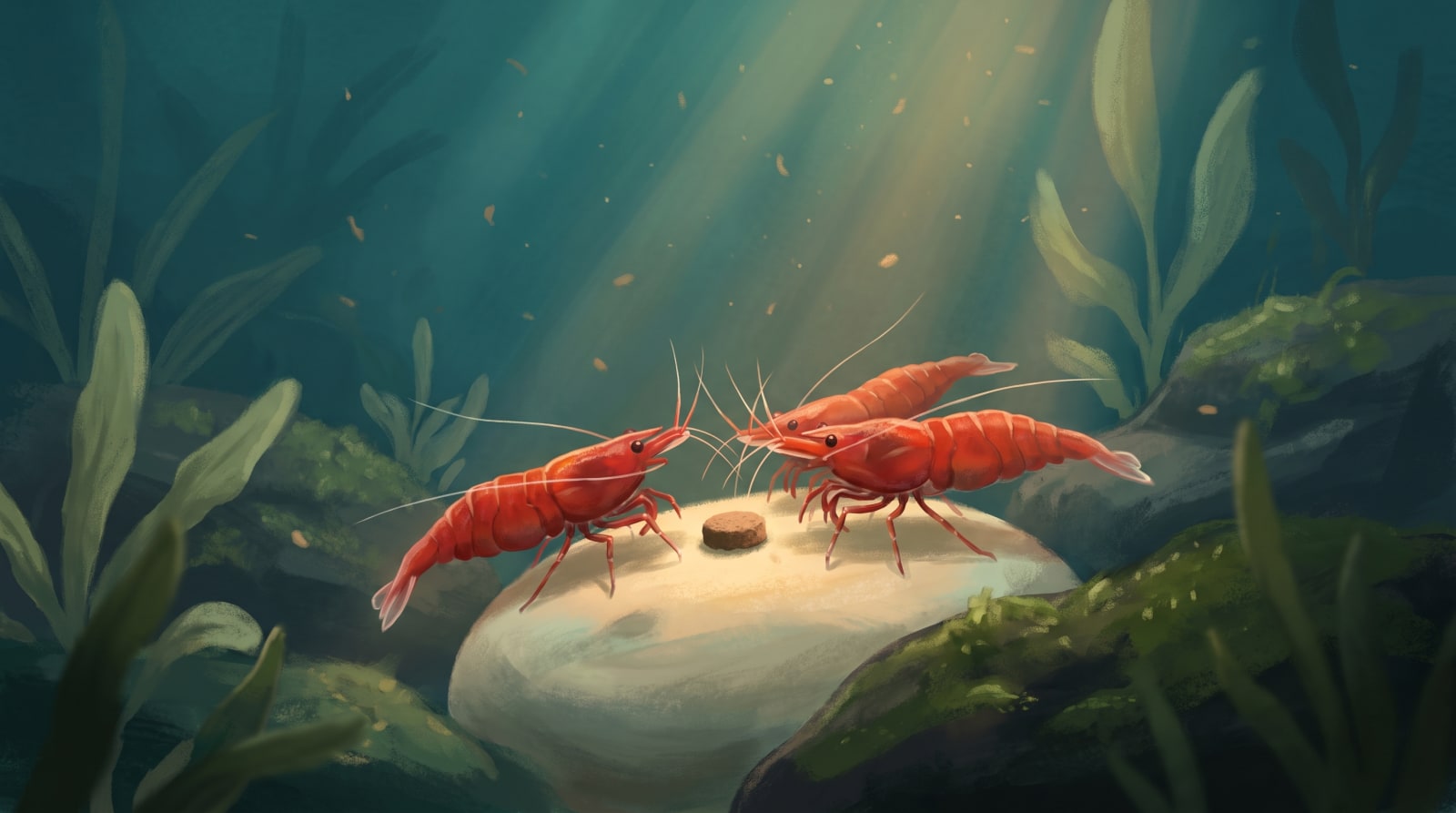
Feeding is the part of shrimp keeping people most often get wrong, and almost always in the same direction: too much. A mature cherry shrimp tank feeds its colony most of the time on its own, through the biofilm and algae growing on every surface, so the food you add is a supplement, not a meal service. We feed our established colonies two to three times a week, and the tank is healthier for it. Here's how to judge how often, and how much.
How often to feed cherry shrimp
In an established, cycled tank, two to three feeds a week is plenty. The shrimp graze biofilm around the clock, so your job is to top their diet up with something richer a few times a week, not to keep them fed like fish. On the days you don't feed, they aren't going hungry. They're doing exactly what they evolved to do, working over every leaf and stone for the film you can't see.
New and lightly stocked tanks are the exception. A tank that's only just cycled hasn't built much biofilm yet, and a small young colony puts little grazing pressure on what there is, so early on you may feed a bit more often while the surfaces mature. As the tank ages and the colony grows, you'll drift naturally back towards two or three times a week. Let the tank tell you: if food vanishes fast and the shrimp still swarm the spot, you can feed a touch more; if it's lingering, ease off.
Skipping days isn't neglect, it's good practice. We routinely leave colonies unfed for a day or two, and go away for a long weekend without a second thought. A mature tank will carry healthy adult shrimp for a week or more with no added food at all, because the biofilm doesn't stop growing just because you're not home. If anything, the occasional fast does a tank good, giving the shrimp a reason to clear up whatever they've missed. The whole diet, and why grazing does so much of the work, is covered in what cherry shrimp eat.
How much: the two-to-three-hour rule
The single most useful feeding rule we know is this: put in only as much as the colony clears in two to three hours. If food is still sitting there after that, you gave too much, so scale the next feed down. It's a self-correcting system that works for any colony size without weighing a thing.
Start with less than you think. A single small sinking pellet, or a pinch of a crushed or powdered food, is enough for a modest colony, and you can always add more next time. Then watch. Within minutes the shrimp should find it and pile on, and a well-fed colony will strip a small portion to nothing in an hour or two. That's your calibration — the right amount is simply whatever disappears inside that window.
Fresh foods run to a tighter clock. Blanched vegetables like courgette and spinach — dipped in boiling water for thirty to sixty seconds to soften them and make them sink — should come out within a few hours, and never be left overnight; twelve hours is the absolute outside limit before they start fouling the water. We tend to drop veg in during the day and pull the remains out the same evening. The method is in our guide to blanched vegetables for shrimp, and the staple foods we rotate through are in our shrimp food roundup.
The sliding scale: colony size and tank age
There's no single feeding schedule because no two tanks are at the same stage. The two things that matter are how mature the tank is — how much biofilm it grows — and how big the colony is — how fast they graze it down. Treat them as a sliding scale rather than a fixed timetable:
| Tank stage | Biofilm available | Feed roughly |
|---|---|---|
| New, just cycled | Low | Small amounts, checking each clears; more often as it matures |
| Establishing (a few months) | Building | 2–3× a week |
| Mature, growing colony | High | 2–3× a week, small portions |
| Mature, large colony | High but grazed hard | 2–3× a week, slightly larger portions |
The pattern to notice is that the frequency barely changes once a tank is established. It's the portion that flexes with colony size. A big colony in a mature tank still only wants feeding a few times a week; it just clears a larger portion each time. Feeding daily "because there are so many of them now" is one of the surest ways to tip a thriving tank into trouble.
Why overfeeding is the number one killer
Overfeeding kills more cherry shrimp than any disease, and it does it indirectly, which is exactly why it catches people out. Uneaten food breaks down into ammonia and then nitrate, dragging your water quality the wrong way in a tank whose inhabitants are acutely sensitive to both. It sends TDS creeping upward. And it fuels population explosions of planaria, hydra and pest snails, which arrive precisely because there's surplus food to support them.
None of that looks like "too much food" at first glance. You see worms appearing, or a snail boom, or shrimp going quietly downhill, and reach for a treatment — when the real fix is to feed less. If you spot flatworms or a sudden snail population, read it as a feeding signal first: our guide to planaria and hydra covers the clean-up, but the cause is nearly always the same. The full argument, and how to recover a tank that's already been overfed, is in our guide to overfeeding shrimp.
Small habits that stop overfeeding
A few habits make the two-to-three-hour rule easy to hold. We feed to one spot rather than scattering food across the tank, so leftovers are simple to see and remove — a shallow feeding dish, even a clean jar lid, does the job and stops pellets vanishing into the substrate to rot unseen. We feed in the evening, when shrimp tend to be most active and any tank mates are winding down, so the shrimp get first claim on the food. And we watch the first few minutes: a hungry colony mobs food within seconds, while a slow, half-hearted response usually means the tank is already well fed and doesn't need much.
Keep half an eye on the snails and pest life while you're at it. A booming snail population, or the first flatworms appearing, is the tank telling you there's more food going in than the colony can use. If in doubt, feed less and feed again tomorrow — you can always add food, but you can't easily take it back out once it's broken down into the water.
Our feeding week
For a typical mature colony, our week looks like this. Two or three times, we drop in a staple — a quality shrimp pellet or an algae-based food — in a portion we know clears in a couple of hours. Once a week or so, that's swapped for a small piece of blanched veg, pulled out the same day. Roughly weekly, a little protein food goes in, because moulting and egg production genuinely need it, but sparingly, since protein is the fastest way to foul water and feed pests. The rest of the days, nothing goes in at all.
Shrimplets need no separate feeding schedule in a mature tank. They eat the same biofilm the adults do, from the day they're born, which is the whole reason an established, slightly grubby tank raises far more young than a spotless new one. If you're raising a big brood and want to push survival, a light dusting of powdered food helps, but it's an addition to the biofilm, not a replacement — there's more on that in feeding shrimplets.
FAQ
How often should I feed cherry shrimp?
In an established tank, two to three times a week is plenty. The shrimp graze biofilm and algae constantly, so added food is a supplement rather than their main diet. New or lightly stocked tanks may need feeding a little more often while biofilm builds, and skipping the odd day — or a long weekend — does no harm at all. Let the tank guide you: if food lingers between feeds, feed less often.
How much food do cherry shrimp need?
Only as much as the colony clears in two to three hours. Start with a single small pellet or a pinch of food for a modest colony and watch: if it's gone quickly and the shrimp still forage, add a little more next time; if it lingers, you overfed. This self-correcting rule works for any colony size without weighing anything, and it keeps uneaten food from fouling the water.
Can I leave cherry shrimp without food?
Yes. A mature, established tank will sustain healthy adult shrimp for a week or more with no added food, because the biofilm they live on keeps growing whether you're home or not. A day or two between feeds is normal in our tanks, and a long weekend away needs no special arrangement. Only very new tanks, with little biofilm built up, need feeding more consistently.
Do baby shrimp need feeding separately?
Not in a mature tank. Shrimplets eat biofilm from the day they hatch — the same film the adults graze — so a well-established tank feeds them automatically, which is why grubby, mature tanks raise more young than pristine new ones. If you're raising a large brood and want to maximise survival, a light dusting of powdered food helps, but treat it as a top-up to the biofilm rather than a replacement.