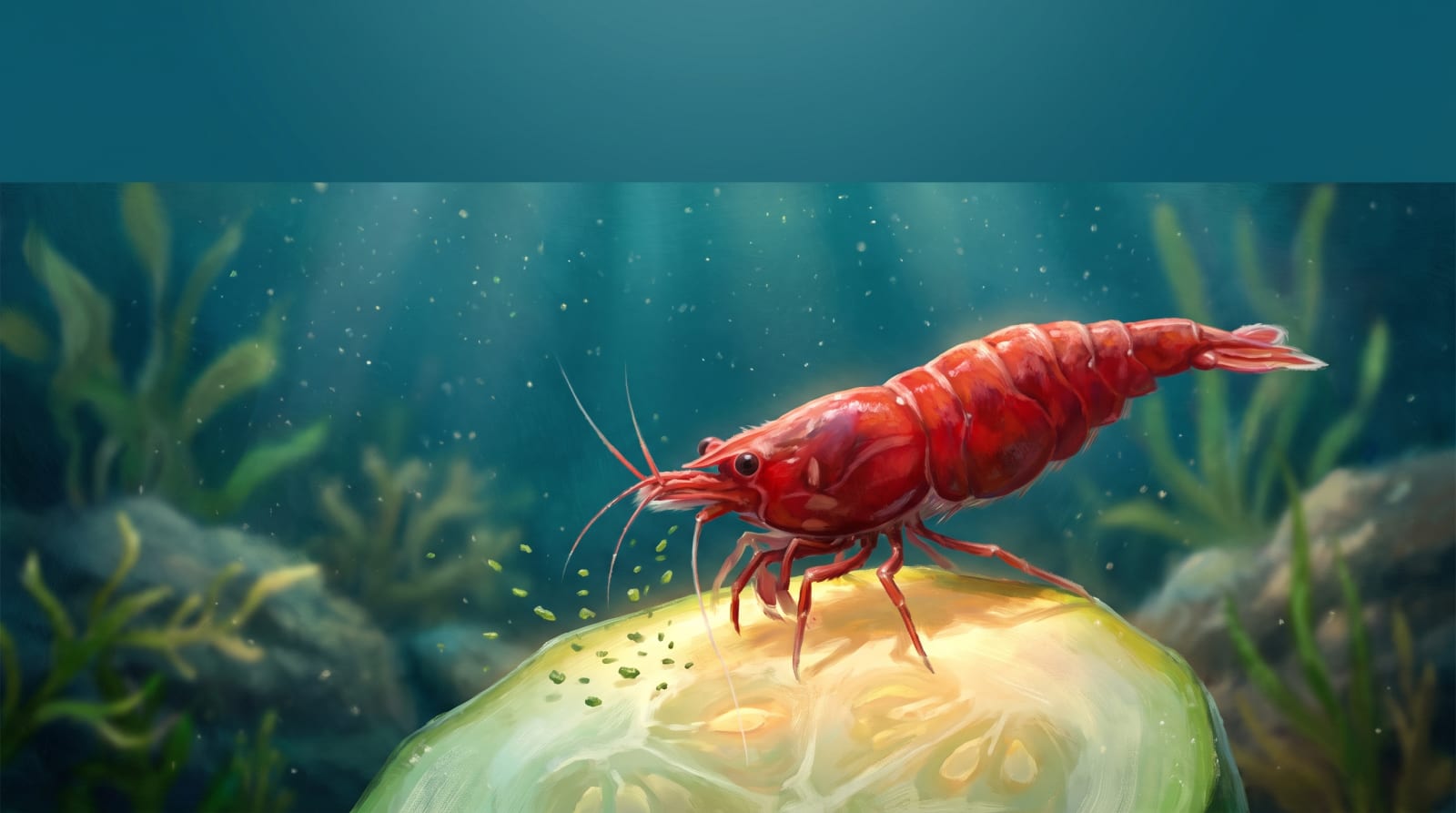
Stand in front of a mature shrimp tank and the colony is eating all day long, even when nobody has fed it for two days. That is the honest answer in one line: cherry shrimp eat the tank. Everything you sprinkle in afterwards is a supplement, and feeding cherry shrimp well is mostly about knowing the difference.
The honest answer: your tank feeds them
Cherry shrimp are omnivorous grazers. Their primary food is the biofilm, algae and aufwuchs growing on every surface in the aquarium, not the contents of any packet. Most shrimp nutrition happens on surfaces you never look at twice.
Biofilm deserves a proper explanation, because it is the nearest thing to a complete shrimp diet that exists. It is the thin, slightly slippery living layer that forms on everything submerged: bacteria, fungi and micro-algae, plus the fine particles trapped among them. Aufwuchs is the wider community that builds on top of it, the fuzz of film, soft algae and micro-organisms coating wood, rock and leaves.
To you it is barely visible. To a shrimp it is a buffet that restocks itself, which is why a mature, planted tank feeds a small colony most of the time with no help from you. The constant picking you see, front legs working every surface, is them eating, and it never really stops. Soft algae is part of the same meal; how far that goes is covered in do shrimp eat algae?.
Growing more shrimp food (without feeding more)
Since biofilm is the main course, the most effective feeding upgrade is not a better packet. It is more surfaces growing food.
Wood is the easy win, and cholla wood is the best of it: shrimplets shelter inside while the outside grows film faster than anything else we have used. Botanicals do the same job on the floor; a catappa leaf or a few alder cones are food that keeps producing food as they break down. Plants finish the picture, because moss packs enormous grazing surface into a small footprint and floating plant roots host biofilm right at the surface.
Then leave it all alone. A scrubbed, spotless tank is a hungry tank, so clean the front glass for viewing and let every other surface work. This is also why new setups need more supplement than old ones: a tank cycled for four to six weeks is safe, but it is not yet rich, and the biofilm keeps building long after the cycle finishes.
What cherry shrimp eat in the wild vs your tank
Wild Neocaridina davidi come from the streams and ponds of Taiwan and eastern China, and they eat there exactly what they eat in glass: biofilm, algae and aufwuchs grazed off rock, wood and sunken leaf litter. Nobody out there is feeding them. Every part of that wild diet has a direct tank equivalent:
| In the wild | In your tank |
|---|---|
| Biofilm and aufwuchs on rock and wood | The same film on glass, hardscape and the filter sponge |
| Soft algae on sunlit surfaces | Algae on plants and the back glass |
| Sunken leaf litter | Catappa leaves and alder cones |
A tank changes two things. The water is far more stable than any wild stream, which suits them. But a breeding colony in a closed box will eventually out-graze its own biofilm supply, and that is the entire reason supplementary feeding exists. You are topping up a wild diet, not replacing it.
The supplement rota
We supplement two to three times a week, and variety matters more than any single product. A grazer's natural diet is a little of everything rather than a lot of one thing, so the rota is built to copy that. Each food type below has a different job.
| Food type | What we use | The job it does | How often |
|---|---|---|---|
| Staple | An algae or spirulina-based shrimp food | Balanced baseline when biofilm runs short | Most feeds, 2–3 a week in total |
| Blanched veg | Courgette, spinach, nettle | Plant matter and a long graze | About one feed a week |
| Protein | A small piece of bloodworm | Egg production in females | Roughly weekly, kept small |
| Botanicals | Catappa leaves, alder cones | Grow biofilm; mild antimicrobial tannins | One in the tank at all times |
| Snowflake | Soya husk food | Safe to leave in; shrimplet grazing | Whenever, as it does not foul water |
A working week in our breeding room looks like this:
- Tuesday: a pinch of algae-based staple, gone within two to three hours
- Friday: a slice of blanched courgette in the evening, out by morning
- Sunday: a small piece of bloodworm
- Always: a catappa leaf quietly growing biofilm in a corner
That is three feeds. In our most mature tanks we drop to two and nobody notices. How we choose the staples themselves is a separate argument, and we make it in best shrimp food UK.
Blanched veg: the two-minute how-to
Courgette, spinach and nettle are our three regulars. The routine:
- Slice thin and drop into boiling water for 30–60 seconds.
- Cool completely in cold water so nothing warm goes in the tank.
- Weigh the piece down, because blanched veg floats and shrimp will not chase it.
- Remove whatever is left within 12 hours at the outside. A few hours is better.
Use a plant weight or wedge the piece under a stone; anything metallic stays out of a shrimp tank. And expect the colony to pile onto a good slice — one they ignore is one they did not need.
Nettle is the free UK option. Pick from somewhere you are certain has never been sprayed, because pesticides and shrimp end very badly together, and the blanch deals with the sting.
Protein and egg production
Roughly once a week, our colonies get a small piece of bloodworm. Protein supports egg production, which is why breeding females get it regularly, and we time it around conditioning females for the next round of berries. The full routine is in how to breed cherry shrimp.
Why not more often? Because shrimp are grazers, not carnivores, and protein-rich leftovers foul water faster than anything else you can offer. Uneaten meaty food sitting in the substrate is precisely the sort of overfeeding that sets off pest outbreaks. Weekly and small is the whole trick.
Snowflake: the food you can leave in
Snowflake-style food is made from soya husks, and it breaks the normal feeding rules in a useful way: it does not foul the water, so it can stay in the tank until it is gone. As it sits, a white mycelium grows over it and shrimplets graze that fuzz. Food that grows more food.
It is our holiday cover and our shrimplet-tank standby in one.
Feeding shrimplets
Shrimplets eat biofilm from day one. In a mature tank with moss, botanicals and a little snowflake about, they need nothing extra from you at all.
Newer tanks are thinner on biofilm, and that is where powdered and dust foods earn their keep: the particles settle across surfaces and into the crevices where shrimplets actually live. The full routine, including how we handle brand-new setups, is in feeding shrimplets.
How much and how often
How often to feed shrimp is the question we get asked most, and the honest answer is: less often than you want to. Two to three supplement feeds a week is the ceiling in most tanks, not the floor.
The portion rule is simple. Feed what the colony clears in two to three hours; blanched veg is the exception, with its 12-hour window. If food is still sitting there the next morning, you fed too much.
The most useful signal in all of shrimp feeding: a colony that ignores food is telling you it is not hungry. Skip the next feed. Nothing bad happens, the tank keeps feeding them, and the renewed grazing keeps every surface in better shape.
Scale by response, not by headcount. A large established colony clears food fast, a starter group of ten wants a fraction as much, and the two-to-three-hour rule handles both without any arithmetic. New tanks lean towards three feeds plus a little powder; mature planted tanks often do well on two or fewer.
Overfeeding: the number one shrimp killer
Nothing kills more shrimp tanks than generosity. Overfeeding hurts in three ways at once. Rotting food spikes ammonia, and shrimp need ammonia and nitrite at zero with nitrate under 20ppm. A constant surplus is exactly what planaria and hydra outbreaks are built on. And a hand-fed colony turns lazy on biofilm, the diet it is actually built for.
The fixes are already in this guide: the two-to-three-hour rule, fresh food out within a few hours and veg within 12, and the willingness to skip a feed. When we are asked to diagnose a crashed tank, the food tin is the first place we look.
Two safety notes: pesticides and copper
Shrimp forgive a lot, but not chemistry. Anything green going into the tank needs a clean history: nettle from an unsprayed patch, shop veg rinsed well before blanching, and new aquarium plants treated with real suspicion, because pesticide residue on plants is a major cause of mystery colony wipeouts. Tissue-culture plants are the safe option when you are buying anyway.
Copper is the other trap. Copper-based medications have no place near a shrimp tank, and it is worth knowing that before a fish disease forces a quick decision. The trace copper in a quality aquarium fertiliser at normal dose is fine; it is meds and overdoses that do the damage.
Moulting and minerals: water builds the shell, not food
Every moult means rebuilding a shell, and the raw material comes mainly from the water rather than the food dish. That is why we keep GH between 6 and 12 in every tank we run. A balanced diet supports the process, but no calcium-enriched food will fix soft water.
For much of the hard-water south east, UK tap is fine once dechlorinated. Soft-water regions need a GH+ remineraliser to bring minerals up into that 6–12 band. Where your tap sits is covered in UK tap water for shrimp, and the full target ranges live in our Neocaridina water parameters guide.
FAQ
How often should I feed cherry shrimp?
Two to three times a week in most tanks, in small amounts, with variety across the week. A mature planted tank feeds the colony between times. Skip a feed whenever food gets ignored; that is the shrimp telling you the biofilm is keeping up.
What vegetables can cherry shrimp eat?
Courgette, spinach and nettle are the three we use. Blanch for 30–60 seconds, cool completely, weigh the piece down and remove the leftovers within 12 hours. One veg session a week is plenty as part of the wider rota.
Do cherry shrimp eat algae?
Constantly. Soft algae and the biofilm tangled through it are the core of their natural diet, and a colony grazes both all day. What they will not do is strip an established algae problem for you; they are a grazing crew, not a cleanup service, and serious algae needs its cause fixed.
Can you overfeed shrimp?
Easily, and it is the most common way shrimp tanks fail. Excess food drives ammonia spikes, feeds planaria and hydra, and trains the colony off its biofilm. Feed what disappears in two to three hours and skip a feed at the first sign of indifference.
Why are my shrimp not eating?
Usually because they are full. A tank with healthy biofilm does most of the feeding, and a colony that ignores food is not hungry, so skip a feed and offer again in a couple of days. If they are also lethargic, hiding or dying, treat it as a water problem first — ammonia and nitrite must read zero — and work through why are my shrimp dying.
Do cherry shrimp eat fish poop?
No. You will see shrimp picking through fish waste, but they are sorting it for undigested food particles rather than eating the waste itself. They get no nutrition from it and will not clean it up; removing waste is what your water changes are for.