Nine times out of ten, the "planaria" someone has just spotted in their shrimp tank are detritus worms — harmless, and no reason to reach for anything. The whole job here is knowing which of the two you're actually looking at, because real planaria and their stinging cousin hydra are worth clearing out of a breeding tank, and the sloppy way to do it takes your snails and stresses your shrimp along with the pests. So we'll sort the identification first, then cover the shrimp-safe way to deal with the real thing, and the feeding habit that started all of it.
Detritus worms vs planaria: the ID that saves a panic
Get this right before you do anything else, because the two get confused constantly and only one is a problem.
Detritus worms are thin, round-bodied and off-white to pinkish, and they live down in the substrate and filter eating waste. When they come out into open water they thrash and wriggle in a loose S-shape, whipping about in the current. They're segmented worms, the aquarium's version of an earthworm, and a few live in every mature tank. A sudden bloom of them — dozens waving out of the substrate at feeding time — isn't a disease. It's a gauge, and what it's measuring is how much uneaten food is going spare. They don't touch a healthy shrimp.
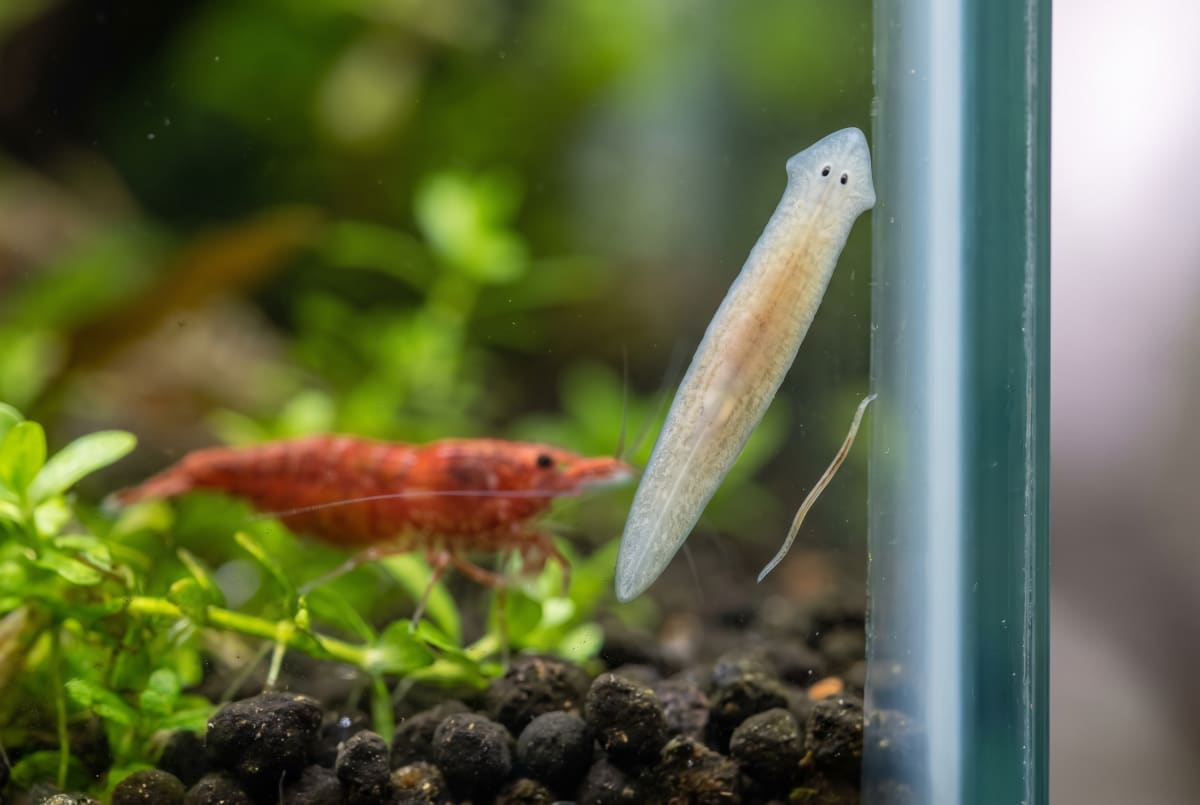
Planaria move completely differently. A planarian glides — smooth and unhurried, as if it's on rails — across the glass or hardscape, because it travels on a film of mucus and cilia rather than wriggling. Look at the head: it's flat and triangular, an arrow or spade shape, usually with two dark eye-spots that give it a faintly cross-eyed look. That arrowhead and the smooth glide are the two tells you need. They're flatworms, ribbon-like rather than round, and normally white, cream or pale brown.
| Feature | Detritus worm (harmless) | Planaria (worth clearing) |
|---|---|---|
| Body | Thin, round, segmented | Flat, ribbon-like |
| Head | No distinct head | Triangular arrowhead, two eye-spots |
| Movement | Thrashes and wriggles in an S | Glides smoothly along the glass |
| Where you see it | Substrate, filter, in the mulm | Cruising the glass and hardscape |
| Risk to shrimp | None | Preys on eggs, shrimplets and weak or moulting shrimp |
Why the mix-up matters: almost every treatment on the shelf is aimed at planaria, and almost every one of those will also flatten your snails. Reaching for a chemical because a detritus-worm bloom made you squeamish is all cost and no benefit. Fix the feeding and detritus worms fade back to the handful that belong there.
What hydra are, and when they matter
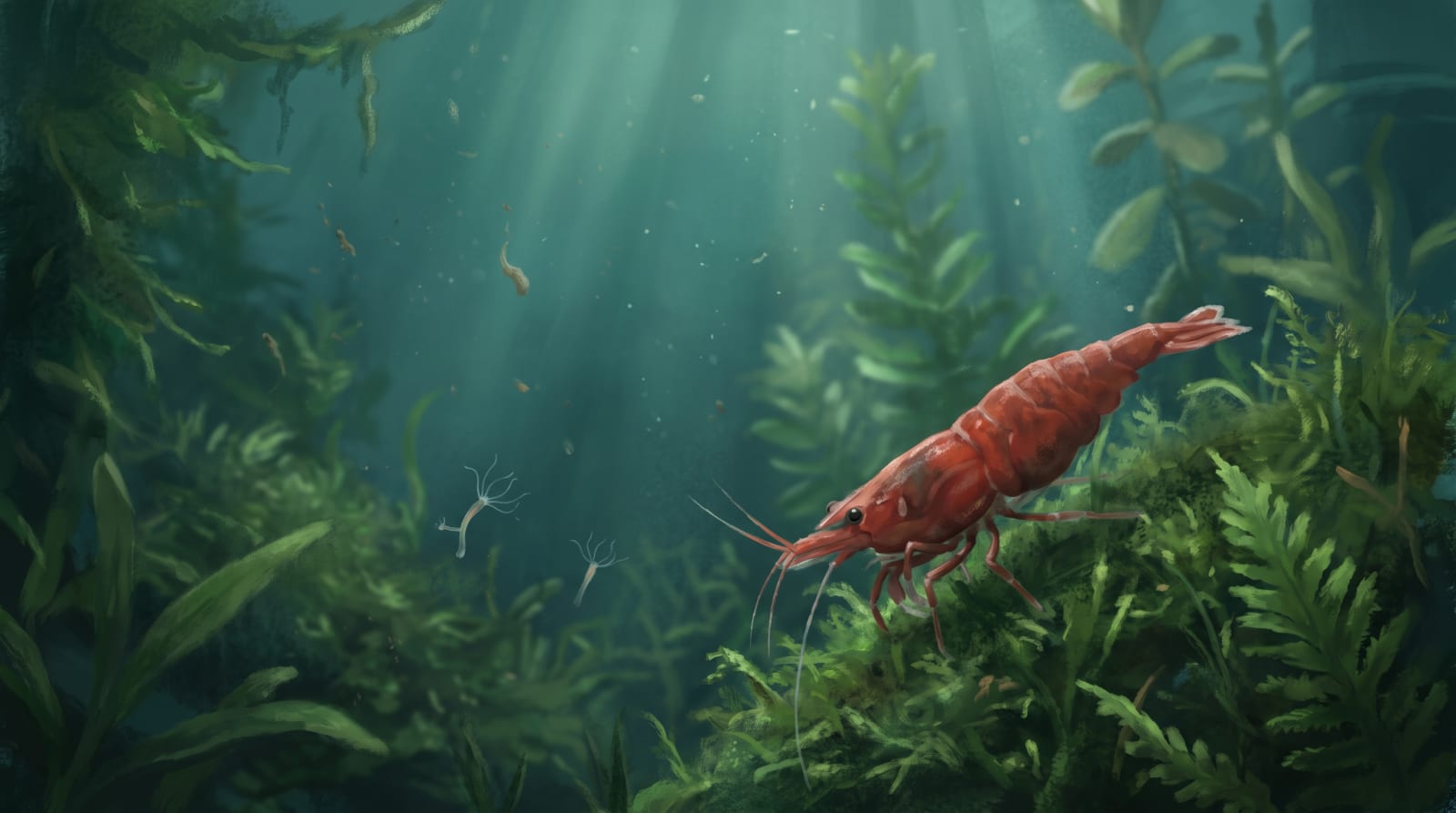
Hydra are tiny freshwater polyps, a few millimetres tall, that anchor by a stalk to glass, plants or hardscape and hold up a crown of fine tentacles. They look like a little tuft or a translucent palm tree, and they don't move around much once settled. They're relatives of jellyfish, and like jellyfish they sting: they fire stinging cells to catch passing microfauna.
For an adult cherry shrimp, hydra are a non-event — the shrimp is far too big to be caught, and it'll happily graze right past them. The problem is a breeding tank. Newly hatched shrimplets are 1–2mm and drift wherever the water carries them, and a dense hydra population can catch and kill the smallest of them. In a colony you're working to grow, that's a genuine dent in shrimplet survival. Hydra almost always arrive as hitch-hikers on new plants, and, exactly like planaria, they bloom when there's surplus food and infusoria in the water for them to eat.
Why they turned up: overfeeding, nearly always
The honest root cause of a planaria, hydra or detritus-worm bloom is the same, and it isn't bad luck. It's food. Uneaten food, and the cloud of microfauna that uneaten food feeds, are what let these populations explode in the first place. Each of them is effectively a needle on the same dial, reading out how much surplus is sitting in your tank — which is the same thing an explosion in the snail population tells you.
So the first and most important move isn't a treatment at all. It's to cut right back on feeding. An established tank feeds its shrimp on biofilm most of the time, and dropping supplementary food hard for a week or two starves the pests without touching the shrimp. If you clear planaria or hydra with a chemical but carry on overfeeding, they simply come back — you've treated the symptom and left the cause running. Getting portions right, covered in how often to feed shrimp, is what actually keeps them gone.
Clearing planaria and hydra without harming your shrimp
Work through this in order. The free steps fix most cases on their own, and the chemical option is a last resort with a serious catch attached.
- Stop the cause. Cut feeding to almost nothing for one to two weeks. Both pests shrink as the surplus food dries up, and for a mild case this is often the whole treatment. It costs nothing and risks nothing.
- Remove what you can by hand. Siphon planaria and hydra out during water changes, and scrape visible hydra off the glass. A simple bottle trap baited with a little protein food will pull planaria in overnight — sink it, leave it, lift it out in the morning with the arrowheads inside.
- Only then, an active. If the infestation is heavy and shrimplets are being lost, the consensus hobby treatment for both planaria and hydra is a fenbendazole-based wormer — the same active found in dog and livestock wormers — or a betel-nut (areca) extract product sold specifically for planaria. Both are effective, and both are generally considered safe for shrimp at the stated dose.
The warning that matters most: both of these kill snails. Fenbendazole and betel-nut extract are lethal to every snail in the tank — nerites, ramshorns, mystery snails, the lot — and this isn't a maybe. Dose the water and the snails die. If you keep snails, move them to another tank or a bucket of the same water before you treat, and be aware that fenbendazole in particular can linger in substrate and filter media for a long time, so snails put back too soon can still be killed. Because of that lingering, some keepers prefer to treat the shrimp in a separate quarantine tank rather than dose the display at all. Our guide to shrimp-safe medications sets out the wider "what to keep well away from an invert tank" picture, copper included.
Whichever active you use, dose strictly per the product's instructions. We deliberately don't hand out a homebrew dose here, because concentration differs between products and more is never better with any of them.
After treatment, do a couple of decent water changes and run fresh activated carbon to strip the medication back out. Siphon out the dead planaria and hydra as they appear, too — a large die-off of anything adds to the bioload, and the last thing a stressed tank needs is an ammonia bump on top. Test your water for a few days afterwards, and keep snails out until you're confident the residue has cleared.
Plenty of keepers, us included, never dose at all and simply starve the tank down over a few weeks. It works for the great majority of planaria and hydra problems and carries zero risk to shrimp or snails, so it's always our first move — we keep the wormer in reserve for a heavy outbreak in a breeding colony where shrimplets are visibly being taken.
Keeping them out for good
Prevention is the same short list every time, and it's mostly about food and plants.
Feed less, and feed to the tank you have — a mature colony grazing biofilm needs far less than beginners give it. Quarantine or dip new plants before they go in, since hydra and planaria are classic plant hitch-hikers; the proper routine is in our guide to preparing new plants. Keep a snail or two as a living overfeeding gauge, siphon the odd patch of mulm at water-change time, and accept that a few detritus worms in the substrate are normal and even useful — they're part of the cleanup crew, not a problem to be solved. Do that and the blooms that send people rushing to the shrimp health guides mostly never start.
FAQ
Are planaria harmful to cherry shrimp?
Adult cherry shrimp are rarely bothered — planaria are far too slow to catch a healthy one. The risk is to eggs, newly hatched shrimplets, and shrimp that are weak or mid-moult, which planaria will scavenge or prey on. In a breeding tank that adds up over time. In a colony of hardy adults, a planaria bloom is mostly just a sign you're overfeeding. Clear them if you're raising young, and fix the feeding either way.
How do I get rid of planaria without harming my shrimp?
Start by cutting feeding hard for a week or two — planaria bloom on surplus food and shrink fast without it — and siphon out what you can or trap them with a baited bottle overnight. If that isn't enough, a fenbendazole-based wormer clears them and is generally shrimp-safe at the labelled dose. The catch is that it kills every snail in the tank, so move your snails out first and dose strictly per the product's instructions.
What are the tiny white worms in my shrimp tank?
Almost certainly detritus worms rather than planaria. Detritus worms are thin, round-bodied and wriggle or thrash in an S-shape; they live in the substrate and filter and eat waste, and they're harmless and normal in a mature tank. Planaria, by contrast, are flat, glide smoothly along the glass, and have a triangular arrow-shaped head with two eye-spots. A sudden bloom of either usually just means you're feeding too much.
Does fenbendazole kill shrimp?
At the doses used to treat planaria and hydra, fenbendazole is generally considered safe for shrimp, and it's the hobby's standard active for both pests. It is lethal to snails, though, and it can persist in substrate and filter media, so remove snails before treating and don't rush them back afterwards. Follow the product's own instructions rather than guessing a dose, and run activated carbon once you're done to clear the residue.
How do I get rid of hydra in a shrimp tank?
Hydra starve without a steady supply of tiny food, so the reliable first step is to stop overfeeding — cut portions right back and they shrink over a couple of weeks — while scraping visible ones off the glass as you go. For a heavy outbreak that's threatening shrimplets, a fenbendazole-based wormer clears hydra as well as planaria, with the same snail warning attached: move every snail out first, and dose per the product's instructions.