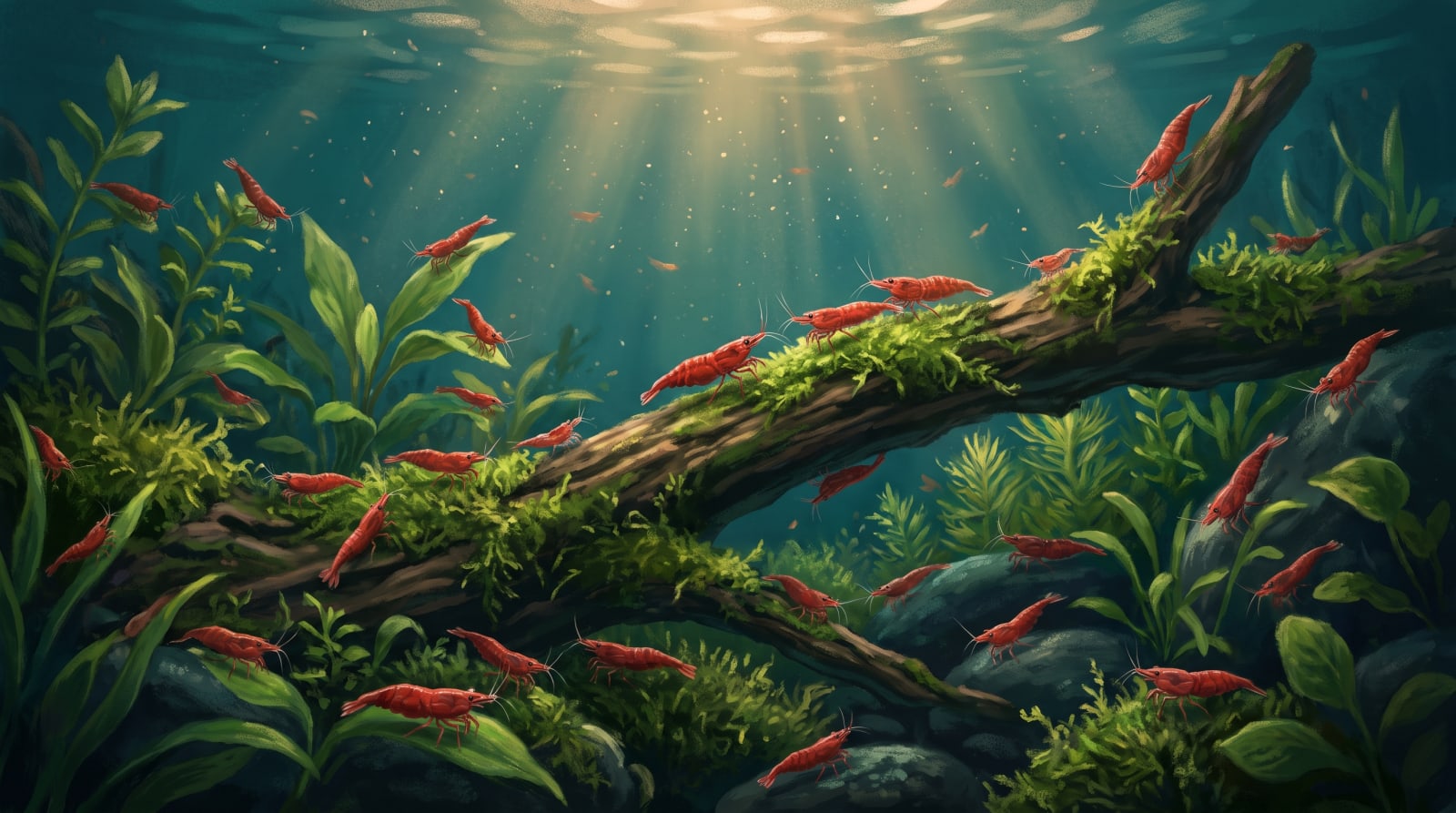
Forty of the questions we get asked most about cherry shrimp, answered fast. It's grouped by theme — water, feeding, breeding, health, tank mates and buying — so you can skim to what you need, and the full care guide covers anything here in more depth. Every number is what we actually run in our own tanks.
Water and parameters
Do cherry shrimp need a filter?
Yes. A filter keeps the water oxygenated and houses the bacteria that process ammonia, and shrimp are too sensitive to go without. An air-driven sponge filter is the standard choice — cheap, gentle, and safe for shrimplets because there's no intake to trap them. It doubles as a grazing surface, so you'll often see shrimp picking over it all day long.
Can cherry shrimp live in tap water?
In most of the UK, yes — dechlorinated tap water is exactly what our colonies live in. Hard-water regions like London and the South East are usually fine straight from the tap. Soft-water areas such as Wales, Cornwall, Scotland and the North West need a GH+ remineraliser to lift minerals into range. Always use a dechlorinator rated for chloramine. See our UK tap water guide.
What water parameters do cherry shrimp need?
Aim for 18–26°C, pH 6.8–7.6, GH 6–12, KH 2–8 and TDS 150–250, with ammonia and nitrite at zero and nitrate under 20ppm. The single most important rule is that stability beats perfect numbers — a steady tank slightly outside a range beats one chased around inside it. The full breakdown is in our water parameters guide.
Do cherry shrimp need a heater?
Usually not, in a centrally heated UK home. Cherries are happy from 18–26°C, and a normal room sits comfortably inside that. The risk isn't cold so much as swings — a windowsill tank or a big night-time drop is worse than a steady cool. If your room falls below 18°C in winter, add a small preset heater. Breeding slows below about 21°C.
What's the ideal temperature for cherry shrimp?
Anywhere from 18–26°C keeps them healthy, but for breeding we run our tanks at 22–23°C, within the 21–24°C sweet spot. Warmer water speeds growth and breeding but holds less oxygen and can shorten lives; cooler water slows everything down. Whatever you settle on, hold it steady — a stable 20°C beats a temperature that bounces between 19 and 25.
How do I lower or raise TDS in a shrimp tank?
To lower TDS, do small water changes with lower-TDS water — remineralised RO, or softer tap. To raise it, add a GH+ remineraliser a little at a time. The key is to move slowly: TDS is a trend line, and a sudden jump stresses shrimp more than the actual reading. A TDS pen is the cheapest early-warning tool you can own.
Is my tap water too hard for cherry shrimp?
Probably not. Neocaridina handle hard water well — London tap at around 260ppm is on the high side of ideal but fine straight from the tap once dechlorinated, and hard water builds good shells. Very soft water is the trickier case, needing remineralising up to GH 6–12. Check your water company's postcode report for your exact hardness before deciding anything.
Feeding
What do cherry shrimp eat?
Mostly biofilm and algae, which they graze off every surface all day — that's their staple, not the food you add. On top of that we feed a quality shrimp food two to three times a week, rotated with algae or spirulina, blanched vegetables and the occasional protein treat. A mature tank does most of the feeding for you. More in what cherry shrimp eat.
How often should I feed cherry shrimp?
Two to three times a week in an established tank, and even less if it's mature and heavily grazed. Offer only what's cleared within a couple of hours and take out any uneaten fresh food. Skip days are healthy — a colony grazing biofilm is never truly hungry. New, bare tanks need slightly more supplementary feeding until the biofilm builds up.
Can cherry shrimp be overfed?
Very easily, and overfeeding is the number-one killer in the hobby. The shrimp themselves don't overeat to harm — the damage is the uneaten food rotting, spiking ammonia and nitrate, and triggering planaria, hydra and snail booms. If in doubt, feed less. A missed meal costs a healthy colony nothing; a fortnight of overfeeding can cost you the tank.
Do cherry shrimp eat algae?
Some of it. They happily graze soft film and dust algae and pick at young hair algae, which makes them a genuine cleanup crew. They won't touch tougher black beard or staghorn algae, and they can't fix green water. Treat them as janitors, not a cure — a real algae problem is a light and nutrient problem, and that's what you fix.
What vegetables can I feed cherry shrimp?
Blanched courgette and spinach are the reliable favourites, with cucumber, blanched carrot and unsprayed nettle also taken well. Blanch for 30 to 60 seconds so the veg sinks and softens, let it cool, then remove leftovers within a few hours before they foul the water. Rinse everything well — pesticide residue on fresh veg is a real risk to shrimp.
Do I need to feed baby shrimp separately?
No. Shrimplets eat the same biofilm the adults do, from their first day, which is why a mature, well-grazed tank raises far more young than a spotless new one. You don't need special baby food — just don't strip the tank clean. A dusting of powdered food can help in a newer setup, but biofilm on every surface is what really carries them.
Breeding and babies
How do cherry shrimp breed?
Readily, and with no help from you if the water's right. A mature female develops a "saddle" of eggs behind her head, then becomes "berried", carrying 20 to 30 eggs under her tail within days of a moult. She fans them for two to three weeks until they hatch. There's no larval stage. Our breeding guide covers the whole process.
How long are cherry shrimp pregnant for?
A berried female carries her eggs for 14 to 21 days, faster at the warm end of the range and slower when it's cool. She fans them constantly with her swimmerets to keep them oxygenated and clean, and toward the end you can often see dark eye spots developing inside each egg. Then they hatch as fully formed miniature shrimp.
How many babies do cherry shrimp have?
A single female carries 20 to 30 eggs per brood, and can produce a new brood roughly every five to six weeks once she's mature. Not all survive, but in a safe, well-covered tank plenty do. It adds up fast: a colony in good conditions can roughly double every two to three months, which is why ten starters soon become a crowd.
How can you tell if a cherry shrimp is pregnant?
Look for the eggs. A "berried" female carries a visible clutch of 20 to 30 eggs under her tail, between her swimmerets, and fans them constantly. Before that, a "saddle" — a patch of developing eggs in the ovaries, behind the head and over the back — shows she's maturing. Males never carry either; they stay small, slim and pale throughout.
At what age do cherry shrimp breed?
Females reach breeding age at around three to five months, which is also roughly when they hit full adult size. Before that they're juveniles and can't be reliably sexed. Once mature, a female may berry within days of a moult and keep breeding across the rest of her one-to-two-year life. Warmth toward 21–24°C brings that first brood on sooner.
Will cherry shrimp breed in a community tank?
They'll try, but the shrimplets rarely survive. Adult cherries breed regardless, yet newborn 1–2mm shrimplets are food for almost any fish, so a community tank tends to hold a stable adult group rather than a growing colony. If you want numbers to build, a species-only tank with dense moss cover is the answer. Heavy planting improves the odds either way.
Why won't my cherry shrimp breed?
Usual suspects: they're too young, all one sex, or the tank's too cold — below about 21°C slows things right down. Instability, wrong GH, chronic underfeeding of protein, or a low-level toxin can all stall breeding too. Most often it's patience: give a healthy, stable, well-fed colony a few warm months and berried females tend to appear on their own.
Health and problems
Why are my cherry shrimp dying?
Almost always water before disease. Check, in order: an uncycled tank leaking ammonia or nitrite, chlorine or chloramine in untreated water, copper from a medication, a sudden temperature or TDS swing, and pesticide on new plants. One loss in a busy colony is normal for a one-to-two-year animal; several in a week is a pattern worth diagnosing. Work through our checklist.
What is the white ring of death?
It's a failed moult. A pale band appears where the shell has split behind the head, but the shrimp can't back out of the old shell and gets stuck halfway — usually fatally. It's linked to GH being too low or swinging suddenly, often after a big mismatched water change. Keep GH at 6–12 and steady and you may never see one.
Why is my cherry shrimp losing colour?
Usually stress, not disease. New arrivals, transport, a house move or predators all wash colour out temporarily, and it returns as the shrimp settles. Other causes are a pale substrate (shrimp show deeper colour over dark gravel), poor diet, age, or mixed-line genetics reverting toward wild-type. If colour fades alongside other symptoms or deaths, test the water — otherwise it's rarely an emergency.
Is my shrimp dead or moulting?
Check what you're looking at. A clear, complete, empty shell is a moult — the shrimp has climbed out and is hiding while its new shell hardens over a day or two. A body is opaque and often pinkish, and won't recover. Leave the cast moult in the tank; the colony grazes it back for the minerals it contains.
My shrimp isn't moving — is it dying?
Not necessarily. Shrimp sit still while digesting, at night, and especially for 24 to 48 hours after a moult while the new shell hardens — all normal. The warning sign is several shrimp motionless and not grazing at once, which points to a water problem. If one shrimp is tucked away and the rest are busy, it's almost certainly just moulting.
Do cherry shrimp carry diseases?
They can, but genuine disease is far less common than water problems. Watch for white fuzz (vorticella), tiny worms on the head (scutariella), or milky, opaque tissue inside the body (bacterial or muscular necrosis). Most clear up or are contained by improving water quality and, for external pests, a careful salt dip. Whatever you read online, never treat shrimp with copper.
Tank setup and tank mates
What size tank do cherry shrimp need?
Ten litres is the absolute minimum; 19 litres or more is what we'd actually recommend. Bigger volumes hold their temperature and chemistry far more steadily, and shrimp hate sudden change, so a larger tank is more forgiving, not less. More surface area also means more biofilm to graze. Footprint matters more than height — shrimp use the floor and walls.
How many cherry shrimp can I keep?
Start with at least ten, and stock loosely — around two to five shrimp per litre is a comfortable long-term density, though colonies self-regulate around the food supply and rarely overpopulate a well-run tank. Ten starters in a 19-litre tank will happily grow into a colony of dozens. Overfeeding, not overcrowding, is what causes trouble at higher numbers.
What fish can live with cherry shrimp?
The safest tank mate is no fish at all, then snails, which are completely compatible. Small, peaceful nano fish like ember tetras or pygmy corydoras mostly leave adult shrimp alone but will eat shrimplets. Anything with a mouth big enough for a shrimp eventually uses it. For a breeding colony, go species-only. Our tank mates guide grades the options honestly.
Can cherry shrimp live with bettas?
Sometimes, never guaranteed. It depends entirely on the individual betta — some ignore adult shrimp, others hunt them relentlessly, and shrimplets are always eaten, so the colony won't grow. Dense moss cover improves the odds for the adults. Don't put expensive high-grade shrimp in with a betta; if you try it, use cheap standard-grade cherries and accept the risk.
Do cherry shrimp need live plants?
Not strictly, but they make everything easier. Plants grow the biofilm shrimp graze, give shrimplets cover, take up nitrate and add stability. Mosses, anubias and java fern are the classic shrimp-safe, low-tech trio. A bare tank can work with more feeding and hides, but a well-planted one raises more young and swings less — it's the closest thing to an easy button.
Buying and cost
How much do cherry shrimp cost in the UK?
Standard-grade cherries run about £2–4 each, with high-grade groups typically £30–50 per 10, the rarer lines topping that range. Postage adds a few pounds and overnight services cost more. Very cheap shrimp are often mixed culls or poorly kept stock, so factor quality into the price rather than chasing the lowest number you can find.
Where can I buy cherry shrimp in the UK?
Specialist online breeders tend to have the best stock and ship well; local fish shops let you see before buying but vary in quality; the big chains are convenient but often weakest on genetics. eBay and Facebook turn up hobbyist bargains and real risks in equal measure. Our honest buying guide weighs each up. We're not selling shrimp ourselves right now; join the waitlist if you'd like an email should that change.
How do I introduce new cherry shrimp to my tank?
Slowly. Drip acclimate them over one to two hours so the water they're in gradually becomes yours — a sudden jump in temperature or TDS is what kills new shrimp in the first week. Float the closed bag briefly to match temperature, drip tank water in until the volume roughly triples, then net the shrimp across and bin the transport water.
FAQ
Are cherry shrimp easy to keep?
Yes — the easiest dwarf shrimp in the hobby and one of the more forgiving aquarium animals full stop. The two things that catch beginners out are uncycled tanks and unstable water. Cycle the tank properly, dechlorinate every water change, keep parameters steady rather than perfect, and don't overfeed, and cherry shrimp largely look after themselves.
How long do cherry shrimp live?
One to two years, with genetics, temperature and stability deciding where an individual lands. That sounds short, but in a breeding colony the generations overlap so completely that the tank never really ages — you stop tracking single shrimp and start thinking about the colony, which renews itself faster than its members grow old.
Can you keep just one cherry shrimp?
You can, but you shouldn't. A single shrimp won't pine the way a fish might, but you lose everything that makes cherries rewarding — no breeding, no colony, no self-sustaining group. They're cheap and social grazers, so always start with at least ten. One shrimp is also far harder to spot problems in than a busy, active group.
Do cherry shrimp clean your tank?
Partly. They graze algae and biofilm off every surface and clear leftover food, and a big colony makes a visible difference. What they won't do is fix the cause of an algae bloom — that's light and nutrients — or process waste like a filter. Think of them as maintenance staff that also happen to be the main attraction.
How fast do cherry shrimp multiply?
Fast, once they start. Females mature at three to five months, carry 20 to 30 eggs for two to three weeks, and can berry again within days of a moult. In good conditions a colony roughly doubles every two to three months, so ten shrimp bought in spring are often a self-sustaining colony by the autumn.
Do cherry shrimp need an air pump?
If you run a sponge filter, you already have one — it's air-driven, so the pump doing that job aerates the tank too. A separate air stone only really helps in warm weather, when rising temperature drops the oxygen, or in heavily stocked tanks. Surface movement is the goal: it's how oxygen gets into the water.