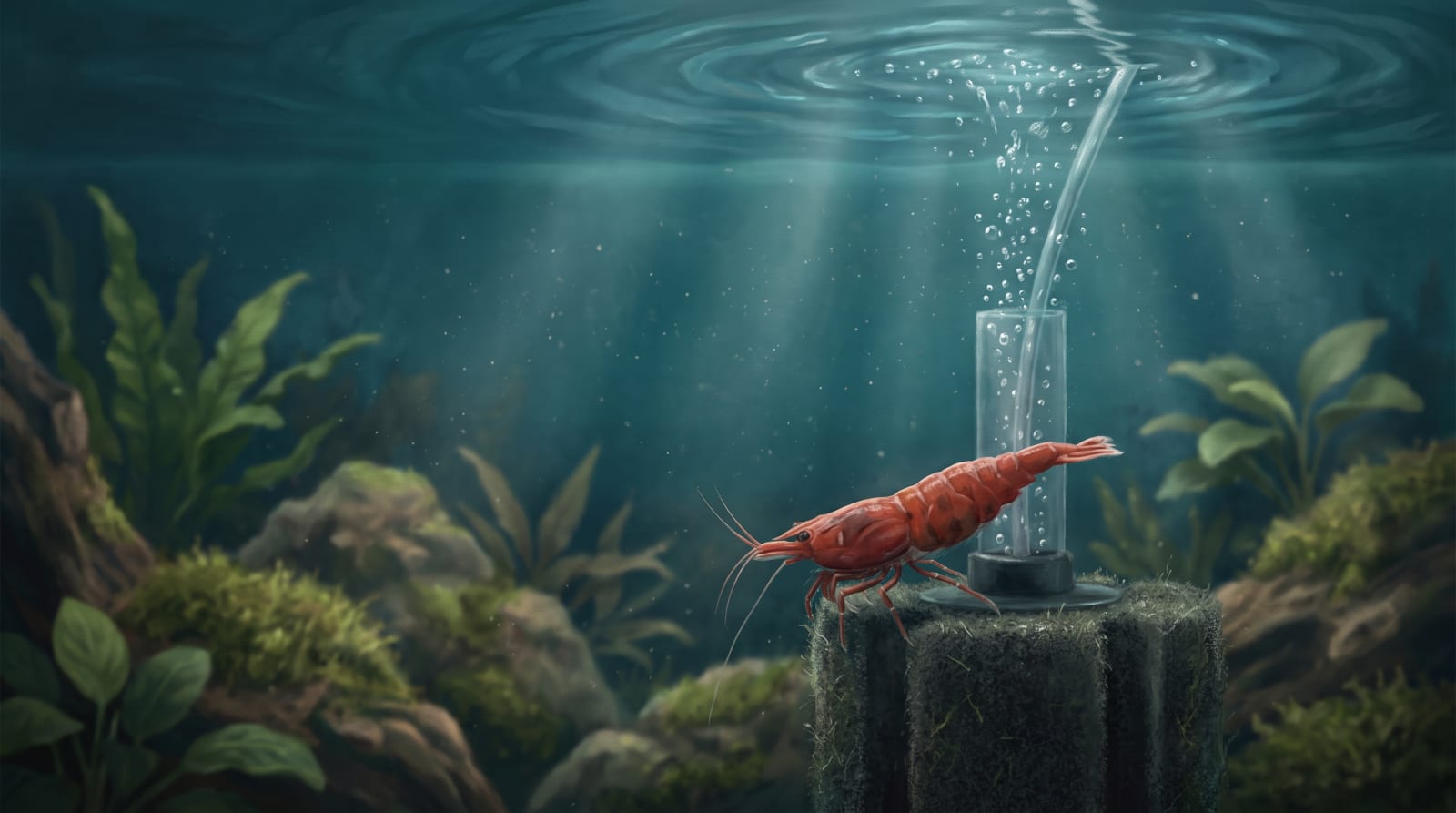
The short answer is that if you run a sponge filter — and for a shrimp tank you almost certainly should — then the air pump question is already settled, because a sponge filter is air-driven and the pump is what powers it. What people usually mean when they ask is whether they need a separate air stone on top of that, and for most tanks, most of the year, the honest answer is no. Here is when that changes.
What shrimp actually need from the water
Shrimp breathe dissolved oxygen out of the water through their gills, and they're more sensitive to a shortage of it than most fish. They also need the water's carbon dioxide kept from building up. Both of those come down to gas exchange at the surface: oxygen dissolving in, CO2 gassing off, across the boundary where water meets air. A tank with a still, undisturbed surface exchanges gas slowly; a tank with a gently broken, moving surface exchanges it briskly. Aeration, in other words, isn't really about pushing bubbles into the water — it's about keeping that surface alive.
Warm water also holds less oxygen than cool water, which is the single fact that decides most of the rest of this guide. The warmer a tank runs, the less oxygen the water can carry and the more the animals in it want — a squeeze from both ends.
The sponge filter already answers the question
A sponge filter runs on air. A small pump on the shelf pushes air down a line to the filter, the bubbles rise up through a lift tube, and as they rise they drag water through the sponge and spill it out at the top. That does three jobs at once. It pulls tank water through a big sponge that grows biofilm and can't suck in a shrimplet, which is why the sponge filter is the shrimp-keeping standard in the first place — the full case is in our sponge filter guide. It circulates the tank. And every one of those bubbles breaking at the surface is doing your gas exchange for you.
So if you've built the tank the way we would build it — and our setup guide does exactly that — you already own an air pump, it's already running, and it's already aerating the tank as a side effect of filtering it. You don't need to add a separate air stone to a healthy, sponge-filtered tank running at normal temperatures. The pump you have got is the answer.
It is the surface, not the bubbles
This is worth getting right, because it explains everything that follows. The bubbles from a sponge filter or an air stone don't add much oxygen directly — they're too big and rise too fast to dissolve meaningfully on the way up. What they do is disturb the surface when they burst, and it's that agitation that drives the gas exchange. The bubbles are just a way of moving the surface.
That means two things. First, you don't need violent bubbling — a gentle, steady stream that keeps the surface rippling is doing the whole job, and that's ideal for shrimp, who dislike being knocked about by strong flow and whose shrimplets get thrown around in a torrent. Turn the pump down, or fit an adjustable valve, until the surface moves without the tank looking like it's boiling. Second, anything that keeps the surface moving counts: a sponge filter, an air stone, or the outflow of a hang-on filter rippling the top all reach the same end.
It's worth knowing the flip side, too. Anything that seals the surface off works against you — a tight glass lid with no gap, or a thick mat of floating plants grown corner to corner, both quiet the exchange down. Neither is a problem while the sponge filter keeps a patch of surface broken and moving, but it's the reason a still, fully covered tank can go short of oxygen where an open, gently bubbled one never does.
When you do need extra aeration
There are a handful of situations where the sponge filter alone isn't enough and a bit more surface movement — usually a separate air stone, or simply turning the existing pump up — earns its place.
Warm weather. This is the big one in the UK, ironically, because our tanks are most at risk in the rare heatwave. As the water warms towards the top of the 18–26°C range and beyond, it holds less and less oxygen just as the shrimp's demand rises. A summer hot spell is exactly when a well-stocked tank can run short, and extra aeration is the cheapest insurance going. It pairs with the other hot-weather moves — floating the lid off, a fan across the surface — covered alongside the temperature question in do cherry shrimp need a heater in the UK.
A heavily stocked colony. A thriving cherry colony doesn't stay ten shrimp for long, and a densely populated tank has a much higher oxygen demand — not just the shrimp, but all the biofilm and bacteria respiring too, especially overnight. If your colony has boomed, adding aeration keeps the margin comfortable. How far stocking can sensibly go is the subject of how many shrimp per litre.
A medicated tank. Some treatments lower the dissolved oxygen in the water while they work, so the standing advice during most medications is to increase aeration for the duration. If you're ever treating a tank — and the list of what's safe to use around shrimp is short, see shrimp-safe medications — run extra surface movement while the treatment is in.
A heavily planted tank at night. Plants produce oxygen under light but consume it in the dark, so a jungle of a tank can dip in the small hours. It's rarely a problem with the modest planting most shrimp tanks run, but if yours is packed and you ever see the signs below in the morning, an air stone on overnight fixes it.
Reading the tank
Shrimp will tell you when the oxygen is low, if you know the tell. They climb. A colony that's gathered high up — clustered around the sponge outflow, up on the glass near the surface, hanging in the top of the water rather than grazing across the bottom — is a colony reaching for the most oxygenated water in the tank, and it's your cue to get more surface movement going now. It's the same lethargy-and-clustering picture that has other causes too, sorted through in our guide to shrimp that have stopped moving.
Two practical notes while you're at it. Keep the air pump above the tank's water line, or fit a check valve in the airline — otherwise a power cut can back-siphon tank water down the tube and onto your floor. And if you lose power often, a battery air pump sitting in a drawer is a cheap bit of peace of mind, since a sponge filter stops aerating the moment the power does. A timer, a valve and spare airline all live on the shrimp tank kit list if you're stocking up.
FAQ
Do cherry shrimp need an air pump?
In practice, yes — but not as a separate gadget. The standard shrimp filter is an air-driven sponge filter, which runs off an air pump, so keeping shrimp the usual way means you have one anyway. It aerates the tank as it filters. What you rarely need is an extra air stone on top of a working sponge filter, unless the tank is warm, crowded or being medicated.
Can shrimp live without an air pump?
They can, if something else keeps the surface moving and oxygenated — a hang-on or canister filter whose outflow ripples the top, for instance. What shrimp can't tolerate is a still, stagnant tank with no gas exchange. Since the shrimp-safe filter of choice is an air-driven sponge, though, most shrimp keepers run an air pump regardless, and it's the simplest way to be sure.
Do I need an air stone if I already have a sponge filter?
Usually not. A sponge filter already breaks the surface and does your aeration, so a second air stone is redundant on a normal tank at normal temperatures. Add one when the water's warm in summer, when a big colony has raised the oxygen demand, or when you're running a medication that depletes oxygen. The rest of the time the sponge alone is plenty.
How much surface agitation do shrimp need?
Enough to keep the surface gently rippling, no more. The gas exchange happens at a moving surface, so a steady ripple does the whole job, while a violent churn just stresses shrimp and tosses shrimplets about. Turn the pump down or fit a valve until the top of the water is clearly moving but the tank isn't turbulent. Gentle and constant beats strong.
Do shrimp need an air pump running at night?
If the pump runs your sponge filter, leave it on around the clock — filtration and aeration shouldn't stop. Night is actually when oxygen is lowest, because plants and bacteria consume it in the dark rather than producing it, so overnight is the worst time to switch off aeration. Run it continuously; there's no benefit to giving the tank a rest from it.