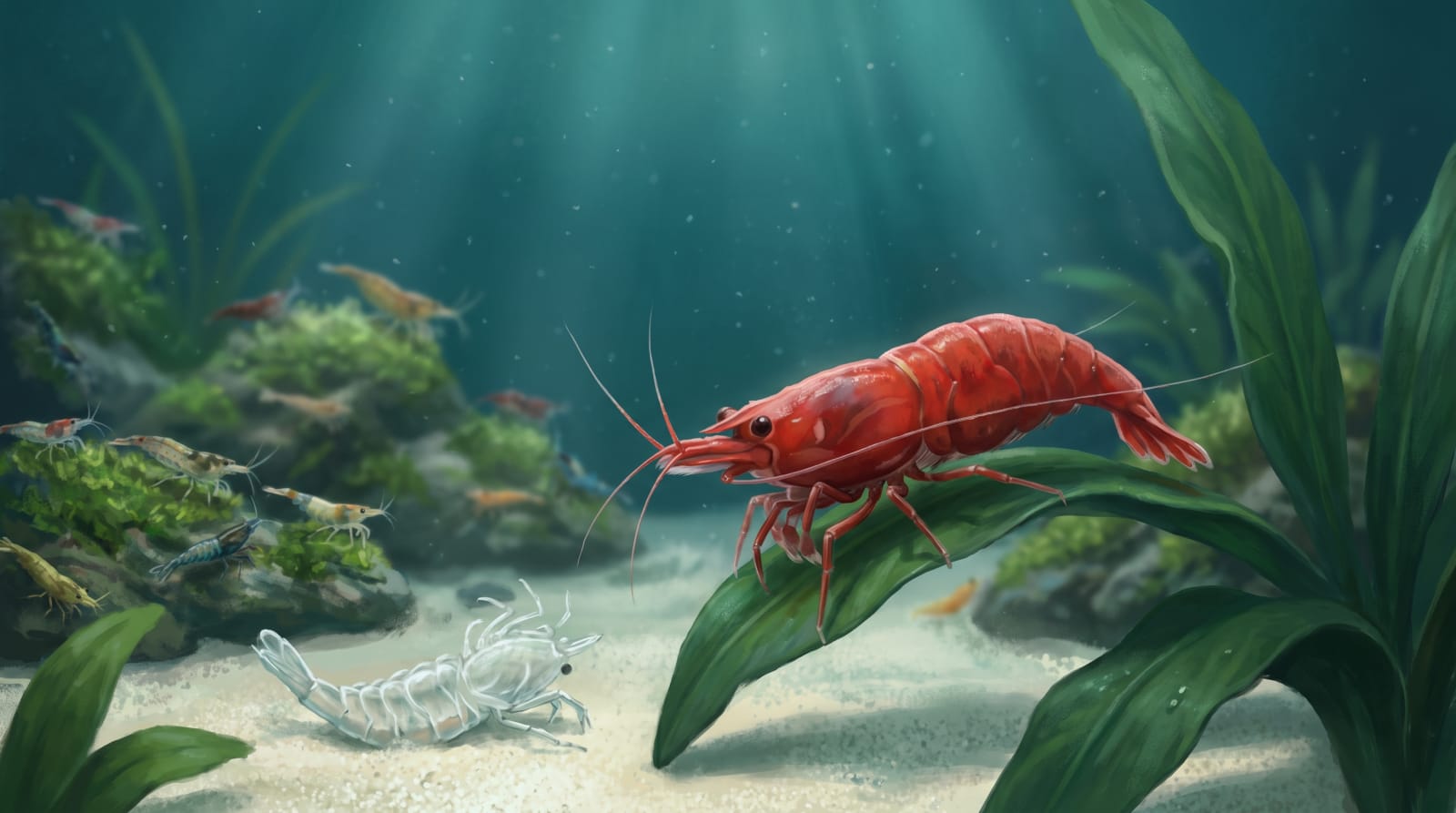
A shrimp sitting dead still is the single most common thing that sends new keepers into a panic, and nine times out of ten it's nothing. Shrimp aren't in constant motion the way the shop tank made them look; they park up, they hide, they moult, and a healthy colony always has a few members doing exactly that. The trick is knowing the difference between one shrimp having a quiet afternoon and a whole tank telling you something is wrong. This is the triage we run in our own breeding room.
Start with one question: is it one shrimp, or the tank?
This is the fork everything hangs on. A single shrimp sat still while the rest of the colony grazes, forages and mooches about is almost never a problem — that individual is moulting, resting or berried, and the busy tank around it is your reassurance. What should get your attention is several shrimp going still at once, especially if they're sitting out in the open and not grazing. One quiet shrimp is biology. A quiet tank is a water test waiting to happen.
So before you do anything, stand and watch for a minute. Count how many shrimp are active. If it's most of them, relax and read the next section. If the tank has gone eerily still, skip ahead to the warning signs.
The normal reasons a shrimp sits still
It has just moulted. This is the big one. Adults moult every 3–6 weeks, and for 24–48 hours afterwards the new shell is soft and vulnerable, so a sensible shrimp tucks itself under moss or behind wood and stays put while it hardens. A shrimp you haven't seen all day is usually doing this, not dying. Juveniles moult more often because they grow faster, so young tanks have more of these quiet spells, not fewer.
It is resting after a feed. Shrimp graze more or less constantly, but drop a fresh food in and you'll often see one gorge, then sit heavy and still on the spot for a while afterwards. It moves off when it's ready. A shrimp parked on a wafer isn't lethargic; it's having lunch.
It is a quiet part of the day. Shrimp don't sleep the way we do, but they do have slower spells, and the moments right after the light comes on or goes off are often the stillest. A tank that looks sluggish for the first ten minutes under fresh light frequently wakes up as the shrimp get going.
She is berried. A female carrying eggs will tuck herself into cover and stay there, fanning the clutch under her tail with her swimmerets. She can look motionless from the front of the tank while her pleopods work non-stop underneath. This is exactly what you want to see; berried females and their care are covered in our guide to protecting the brood.
They are new. Shrimp that arrived in the post this week are allowed to look miserable. Newly added shrimp often sit pale and still for a day or two while they adjust, and colour and confidence return as the stress drops. If you've just drip-acclimatised a batch, give them time before you worry.
The tank is a little cold. Cherries are comfortable across 18–26°C, but at the cold end of that band, or below it, everything slows down — including them. A tank sitting in the mid-teens in an unheated winter room will have sluggish, low-activity shrimp that are otherwise perfectly healthy. They pick up as it warms. Whether you need to do anything about that is the subject of do cherry shrimp need a heater in the UK.
Dead or just moulted?
The empty shell is what fools everyone, and it fools everyone at least once. Here is how we tell a body from a cast-off.
A moult is translucent and complete — a clear, hollow, shrimp-shaped ghost, often split across the back where the shrimp backflipped out of it. Hold a torch behind it and light passes straight through; there's nothing inside. Leave it in the tank. The colony grazes the minerals back out of it within a day or two, and that isn't morbid, it's how they recycle the calcium for the next shell.
A dead shrimp is opaque. The body tissue is still there, and the giveaway is colour: a shrimp that has been dead a while turns pink or orange all over, a cooked-looking flush that a living red cherry never has and a moult never shows. If it's pink and solid, it's gone. Reading the body in more detail — what the colour and timing tell you about the cause — is the whole subject of our shrimp post-mortem guide.
One caution: don't be too quick to fish out a still shrimp you think is dead. If it's translucent and hollow, it's a moult and you're about to bin a perfectly good shrimp that's hiding nearby. If it's opaque and pink, then yes, remove it — but a colony will usually deal with a body itself, and one dead shrimp in a busy tank is normal attrition for an animal that lives 1–2 years.
When stillness is the warning
Now the version that matters. If a lot of your shrimp go still at the same time — sitting out in the open, on the glass or the substrate rather than tucked in cover, and crucially not grazing — treat it as a water problem until proven otherwise. Grazing is the vital sign. A shrimp that's picking at surfaces is a shrimp that's fine, whatever else it's doing. A shrimp sitting motionless with its mouthparts idle, out where it would never normally loiter, is a shrimp under stress.
The most common cause is something wrong in the water, and the response is to test before you touch anything. Reach for the ammonia and nitrite tests first: both should read zero, and any reading at all is an emergency, because shrimp are more sensitive to both than fish are. Our ammonia, nitrite and nitrate guide covers safe levels and what to do about a spike. If those are clear, run the rest of the parameters against the Neocaridina water parameter targets — a swing in TDS or temperature does this too.
Timing is a huge clue. If the tank went still within hours of a water change, the change itself is the prime suspect: mismatched temperature, mismatched TDS, or unconditioned water carrying chlorine or chloramine. A sudden swing is exactly the kind of shock that flattens a colony, which is why we change little and often rather than big and occasional. If the stillness crept in over days or weeks instead, you're looking at something chronic, and the ordered checklist in why are my cherry shrimp dying is the place to work through it.
Two more specific pictures are worth naming. A shrimp stuck half out of its shell and unable to move, often with a pale band showing behind the head, is a failed moult — the white ring of death, which is a GH and stability problem rather than anything catching. And a shrimp lying on its side, twitching or flicking on the spot, is generally a shrimp in serious trouble rather than one at rest; there is no gentle version of that posture.
What to actually do
Don't poke it. Prodding a moulting or resting shrimp stresses it for no gain, and a soft-shelled shrimp is at its most fragile in exactly the window it's hiding. Watch instead.
Run this quick sequence. Count how many shrimp are active versus still — that tells you which half of this guide you're in. Look for grazing, because idle mouthparts across several shrimp is the real red flag, not stillness by itself. Check for a fresh moult on the substrate, since one clear shell explains one missing shrimp. Glance at the thermometer for an overnight cold snap or a heatwave spike. And only if several shrimp are affected, test the water — ammonia and nitrite first.
What you do not do is dose anything blind. Tipping a treatment in for a problem you haven't identified is how a slow week becomes a dead tank, and most of the time the honest answer is that one shrimp is moulting and the tank is fine. If it turns out the whole colony is off, water is the cause far more often than disease, and the routine that keeps it steady is laid out in the full cherry shrimp care guide.
FAQ
Is my shrimp dead or moulting?
Look at the shell. A moult is translucent and complete — a clear, hollow, shrimp-shaped cast, usually split across the back, with nothing inside when you shine a light through it. A dead shrimp is opaque, with the body still present, and after a while turns an all-over pink or orange that a living shrimp never shows. Translucent and hollow means leave it; solid and pink means remove it.
Why is my cherry shrimp not moving?
Usually because it has just moulted and is hiding while its soft new shell hardens, which takes 24–48 hours. Resting after a big feed, a berried female fanning her eggs, brand-new shrimp still settling in, and a cold tank all produce the same stillness harmlessly. It only becomes a worry when several shrimp go still at once and stop grazing, which points at the water.
Do cherry shrimp sleep?
Not in the way we do. Shrimp have no proper sleep, but they do have quieter, lower-activity spells through the day and night, and they're often stillest right after the light changes. A shrimp that's parked up for a while but still flicks its antennae and moves off when it's ready is resting, not ill.
My shrimp stopped moving after a water change — what do I do?
Treat the water change as the cause until you have ruled it out. A mismatch in temperature or TDS, or water that wasn't properly dechlorinated, can shock a colony within hours. Test ammonia and nitrite, check the new water was temperature-matched and conditioned, and next time change less at once — small, regular changes avoid the swing that caused this.
How long do shrimp hide after moulting?
About 24–48 hours, occasionally a little longer for a big adult. The new shell comes out soft and takes a day or two to harden, and a sensible shrimp spends that window tucked under moss or wood out of sight. If it's grazing again and back in the open after that, everything went as it should.