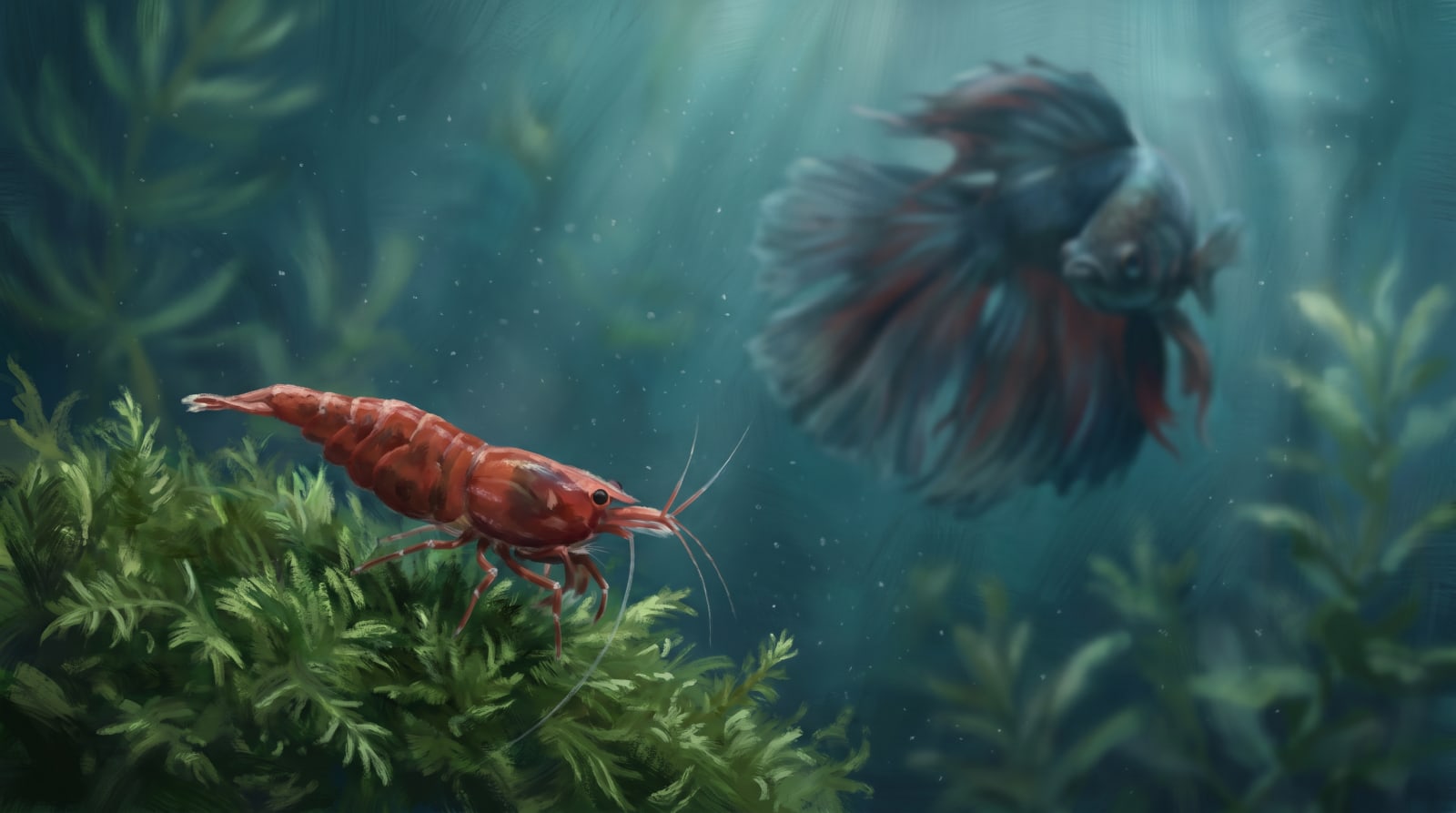
Keeping cherry shrimp with a betta is the single most-asked question in this hobby, and it deserves a straight answer rather than a hopeful one. They can share a tank — sometimes. Whether it works comes down almost entirely to the individual betta, and nobody, including the person who sold you the fish, can tell you in advance which betta you've got. Here are the honest odds, and how to load them in your favour.
It depends on the individual betta
A betta is a small, curious carnivore that hunts insects and larvae in the wild, and a cherry shrimp fits that description closely enough to be worth investigating. Some bettas take one look, decide a 3cm armoured adult is too much bother, and never think about it again. Others treat the same shrimp as a snack that happens to move, and clear a colony methodically over a few weeks. Most sit somewhere in the middle: they tolerate the adults and eat anything small enough to swallow whole.
You cannot read this off the fish in the shop. Temperament doesn't track with fin type, colour or price, and a placid-looking betta in a bare display tank can become an efficient ambush hunter the moment it has planting to work from. We've kept bettas that ignored a busy colony for their whole lives, and bettas that had to come out within a fortnight. The trait is fixed in the fish, not in anything you do — which is why every honest answer to "will a betta eat cherry shrimp?" has to begin with "it depends".
What you can say for certain is that the house always has an edge. A betta that mostly ignores shrimp is one bad day — a missed feed, a territorial mood, a shrimp caught in the open — away from a kill. Plan for the fish you might have, not the placid one you're hoping for. It's exactly why bettas land in the "risky" tier of our cherry shrimp tank mates guide rather than the safe one.
Adults might make it; shrimplets never do
Cherry shrimp come in two very different sizes, and a betta treats them as two separate things. Adults reach 2.5–3cm and carry enough shell that a betta often can't do much with one even when it tries; a fixated fish will still harass and eventually kill them, but a relaxed one leaves them alone. Shrimplets hatch at 1–2mm. They are live food, plain and simple, and no betta on earth walks past them.
That second fact quietly decides the whole outcome. Even the calmest, most shrimp-blind betta hoovers up every shrimplet it happens across, which means recruitment into the colony drops to zero. You won't notice at first — the adults you bought are still there, grazing away, and the tank looks a success. Then, over a year or two, those adults reach the end of their 1–2 year lives with nothing grown up behind them, and the colony simply fades out. A betta tank is a display with some shrimp in it, never a breeding colony. The full picture of why survival collapses without cover is in raising shrimplets.
| Shrimp at this stage | Typical outcome with a betta |
|---|---|
| Hard-shelled adult, 2.5–3cm | Often left alone by a calm betta; picked off by a keen one |
| Freshly moulted adult, soft 24–48h | Vulnerable to almost any betta — the classic loss |
| Shrimplet, 1–2mm | Eaten on sight, every time |
Read that table as the honest summary of the article. The middle row is the one people forget.
The moult is the dangerous hour
Adult cherry shrimp grow by moulting out of their old shell, and they do it every 3–6 weeks. For 24–48 hours afterwards the new shell is soft and the shrimp is close to defenceless, which is exactly why they hide under moss and wood while it hardens. A betta that can't make any impression on a hard adult will happily take a freshly moulted one, and this is how a fish that "ignores the shrimp" still whittles the colony down over months.
It's also why cover isn't optional in a betta tank. A shrimp needs somewhere to spend its soft day where a patrolling fish can't reach it, and a bare, open tank offers nowhere. Get the water wrong on top of that — a big, mismatched water change stressing moults into failure — and you stack a health problem onto a predation one. Keeping parameters steady, GH in the 6–12 range, matters as much here as in any cherry shrimp care routine.
How to stack the odds
If you've set your heart on the combination, you can shift the odds a long way in the shrimp's favour without ever making them certain.
Cover, then more cover. This is the single biggest lever. Dense moss thickets, floating plants trailing roots, cholla wood, botanical leaf litter and tangled hardscape all break a betta's sightlines and give shrimp and shrimplets places the fish physically cannot follow. A well-mossed tank absorbs losses a bare one never could; the moss guide covers the best species for the job, and there's more on hides and grazing cover in our breeding décor guide.
Establish the shrimp first. A colony that has been breeding for a few months before the betta arrives has population momentum and a settled network of hides. Shrimp dropped into a betta's established territory, by contrast, get inspected by an interested resident on day one.
Feed the betta properly. A well-fed betta hunts less than a hungry one. It's not a guarantee — a full betta will still take an easy shrimplet — but a betta that's never sharp-set is a calmer tank mate.
Give them room. A bigger, well-planted tank means more territory, more sightline breaks and more distance between a resting shrimp and a bored fish. Cramped quarters force encounters; space dilutes them.
Never put expensive shrimp in with a betta
Here's the rule we'd tattoo on anyone about to try this: the shrimp you put in a betta tank are shrimp you've accepted you might lose. That single sentence sorts out which shrimp to buy.
Use standard-grade cherries at £2–4 each. A small group of ordinary red cherry shrimp — even your own culls, if you already breed — is exactly the right stock for a gamble like this. What you never do is put high-grade shrimp at £30–50 per 10 in front of a betta. Those shrimp earn their price through selective breeding, and their value only comes back if their offspring survive to carry the line on. In a betta tank the offspring don't survive, so you're feeding a premium animal to a fish for no return. Spend accordingly, and keep the good stock in a colony where it can do its job.
Keeping a betta anyway: have an exit plan
Even with every odd stacked right, some bettas simply cannot be housed with shrimp, and you only find out which by trying. So don't try without a way out. A cheap tub and a spare cycled sponge filter mean that the day you catch your betta systematically working the moss line, you can move the fish the same afternoon rather than three weeks and half a colony later.
Watch the first few weeks closely. A betta that patrols the planting with intent, that you keep finding nose-down in the moss, or that visibly reduces your shrimp count, has told you what it is. Believe it. There's no husbandry trick that rewrites a hunter, and no shame in deciding the fish gets its own tank.
For most people who ask us, the honest recommendation lands in the same place: if you want a growing shrimp colony, keep the betta separately and run the shrimp species-only with a few snails. If you want a planted betta tank and you'd enjoy some shrimp in it as a bonus you're prepared to lose, go in with cheap stock, heavy cover and open eyes. Our species-only vs community guide is the fuller version of that decision — you genuinely can't optimise a tank for both at once.
FAQ
Will a betta eat cherry shrimp?
Maybe — it depends entirely on the individual betta. Some ignore adult shrimp for their whole lives, others hunt them relentlessly, and you can't tell which you have until you try. What's consistent is that nearly every betta eats shrimplets and freshly moulted adults, which are soft and defenceless for a day or two. Dense cover improves the odds for hard-shelled adults but never makes them certain.
Can you keep cherry shrimp with a betta?
You can, but treat it as a display rather than a breeding project. Adults often coexist with a calm betta in a heavily planted tank; the colony won't grow, because shrimplets are always eaten. Load the odds with dense moss, floating plants and leaf litter, establish the shrimp before the fish arrives, and only use cheap standard-grade shrimp you can afford to lose.
Do bettas eat baby shrimp?
Yes, always. Baby shrimp hatch at 1–2mm and are ideal live food, and no betta ignores them regardless of temperament. This is why a betta tank never becomes a self-sustaining colony: the adults you buy may survive, but every generation of shrimplets is eaten before it grows up. If you want babies to make it, the shrimp need a tank with no fish in it.
How many cherry shrimp should I keep with a betta?
Start with a group of ten or more standard-grade shrimp, the same as any colony, so the survivors have enough numbers to settle and breed. Expect to lose some early while the betta works out what it thinks of them. Buy cheap, plant heavily, and judge the pairing over the first month before adding any more — there's no point restocking into a fish that's shown itself to be a keen hunter.