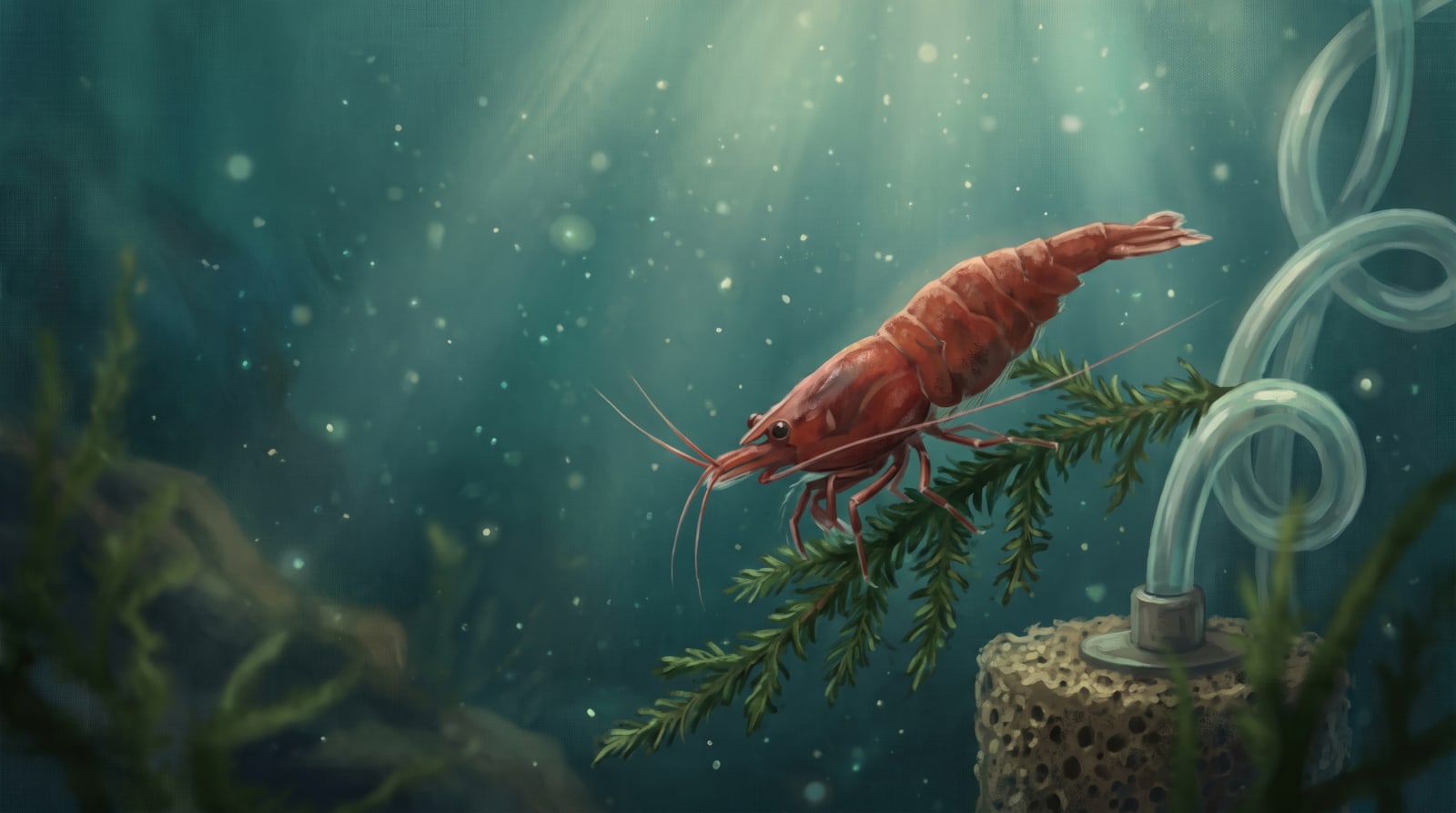
A shrimp tank needs less kit than almost any other aquarium, and most of what it does need is cheap and interchangeable. The trouble with a plain shopping list is that it treats a chloramine-rated dechlorinator and a decorative cave as if they matter equally, and they don't — one keeps the colony alive and the other is a nice-to-have. So this list is sorted by exactly that: what your shrimp can't live without, what genuinely earns its place, what's optional, and what you can skip with our blessing. We buy by category rather than by brand, because a sponge filter is a sponge filter.
How to read this list
Everything here falls into one of four tiers. Essentials are the kit a healthy colony genuinely depends on; skimp here and you'll lose shrimp. Strongly recommended is the stuff that isn't strictly life-or-death but that we wouldn't run a tank without, because it prevents problems rather than fixing them. Nice to have improves the tank or your life without changing whether the shrimp thrive. Skip it is the kit the hobby will happily sell you that a cherry shrimp tank simply doesn't need.
We've deliberately kept prices off this page, because they move about and because a shopping list padded with figures dates the moment a shop changes a label. For an honest, costed version of the essentials — where we'd spend and where we'd go cheap — our £60 budget build prices the whole starter kit up in one place. Treat this list as the what and that guide as the how much.
The essentials
This is the kit that decides whether your shrimp live. None of it is exotic and none of it is dear, but every line matters.
| Kit | What it's for | What to look for |
|---|---|---|
| Aquarium, 19L+ with a lid | The home; bigger holds steadier | Glass, more footprint than height, a lid to slow evaporation |
| Air-driven sponge filter | Filtration plus a biofilm grazing surface | Rated for your volume or the size up; no open intake |
| Air pump, airline, non-return valve | Runs the sponge filter | A quiet pump; the valve stops back-siphoning in a power cut |
| Inert substrate | The tank floor | Plain sand or fine gravel, dark if you have the choice |
| Dechlorinator | Makes tap water safe | Must state it treats chloramine, not just chlorine |
| Liquid test kit | Reading ammonia, nitrite, nitrate, pH | Liquid, not strips — strips are vague where you need precision |
| GH/KH test kit | Knowing what your tap water actually is | A drop-count kit; tells you if you must remineralise |
| Thermometer | Confirming temperature and catching swings | Any cheap glass or stick-on one |
| A few easy live plants | Biofilm surface, cover, water stability | Moss, anubias, java fern — low-light, no CO2 |
| Jug and bucket, shrimp-only | Water changes and acclimatisation | Never a bucket that's held soap or cleaner |
A few of those deserve a word. The tank is the single decision that matters most: 10L is the absolute floor and 19L or more is what we'd actually buy, because a bigger body of water holds its temperature and chemistry steadier, and steadiness is the whole game with shrimp. We compare the common sizes in best nano tanks for shrimp UK.
The sponge filter is non-negotiable and, happily, the cheapest option going. There's no intake to hoover up shrimplets, the sponge itself grows into a grazing lawn, and the flow is gentle. The full case against canisters and internals for a shrimp tank is in our sponge filter guide.
The dechlorinator is a few pounds and one of the two things we'd never cut. Many UK supplies use chloramine, which — unlike chlorine — doesn't gas off if you stand a bucket overnight, so the bottle must say it handles chloramine; what to look for is in our shrimp-safe dechlorinators guide. And the test kit isn't optional despite what a "starter set" implies: you cannot tell by eye whether a tank has cycled, and ammonia or nitrite at any level is lethal to shrimp. Our guide to safe ammonia, nitrite and nitrate levels explains what each reading means.
Strongly recommended
Not strictly essential, but this is the kit that stops trouble before it starts. We run all of it.
| Kit | What it's for | Why it earns its place |
|---|---|---|
| TDS pen | The early-warning number | Cheapest useful test you own; spots drift before it's a swing |
| Light on a plug-in timer | Grows the plants and biofilm | A timer keeps the photoperiod steady and the algae in check |
| Ammonia source | Fishless cycling | Lets you cycle the tank properly before any shrimp go in |
| Ceramic or botanical cover | Hides and moult shelters | Cheap cover raises shrimplet survival dramatically |
The TDS pen is the one we'd promote to essential if we were being strict. It reads total dissolved solids in seconds, and because you're watching the trend rather than a magic number, it catches the slow creep from evaporation or overfeeding, and the sudden jump that means something's happened, long before a liquid test would. Our target sits at 150–250, and the reasoning is in TDS for shrimp keepers.
A light on a timer matters less for the shrimp — they don't care about light — and more for the plants and the biofilm garden that feeds the colony. A cheap plug-in timer holding a steady 6–8 hour photoperiod does more for algae balance than any expensive fixture; the detail is in our lighting for shrimp tanks guide.
Nice to have
Genuinely optional. These make the tank prettier or the maintenance easier, but no shrimp ever died for want of them.
| Kit | What it's for |
|---|---|
| Hardscape wood and rock | Extra biofilm surface, shade and structure |
| Botanical leaves (catappa and friends) | Slow-release grazing stations and gentle tannins |
| A spare sponge filter | Runs in the tank ready to seed a second setup |
| Turkey baster or pipette | Spot-feeding and lifting debris without a big water change |
| A shallow feeding dish | Keeps food in one spot so leftovers are easy to remove |
| A small algae scraper or pad | For the front glass only — leave the rest for grazing |
None of this changes the biology; it's comfort and convenience. Hardscape is the pick of the bunch if you want to add just one thing — though it pays to choose wood and rock that won't quietly shift your water chemistry, since some rocks raise your hardness as they slowly dissolve. Which stones are inert, and the vinegar test that tells them apart, is a topic worth its own read before you buy.
Skip it
The hobby is very good at selling kit a cherry shrimp tank doesn't need. Here's what we leave on the shelf.
| Kit | Why we skip it |
|---|---|
| Active "shrimp soil" substrate | It's a buffering substrate for soft-water Caridina; on Neos in UK water it drags pH down for no benefit and costs several times more than sand |
| Pressurised CO2 | The low-light plants a shrimp tank uses don't want it, and an unstable CO2 rig swings pH, which is exactly what kills shrimp |
| High-output lighting | Grows algae faster than plants; a modest light is plenty |
| Canister or internal filter | Open intakes are how shrimplets disappear; the sponge does the job better and cheaper |
| Automatic feeder | Overfeeding is the number-one killer; a machine that feeds on a schedule is the opposite of what a shrimp tank wants |
| Gravel vacuum, for deep cleaning | The mulm on the floor is biofilm and food; a hard gravel-vac strips the tank of what feeds it |
| "Premium branded everything" | The dear version of a sponge, an airline or a bag of sand does nothing the basic one doesn't |
The theme running through the skip list is that a shrimp tank thrives on being left alone. It wants stability, a mature grubby-in-a-good-way maturity, and gentle everything — and most of the kit above works against exactly that. Once the tank is built, the ongoing routine is genuinely light; the full order of assembly, from empty glass to stocked colony, is in our step-by-step shrimp tank setup.
The one thing this list doesn't cover: the shrimp
Everything above builds the home. The shrimp are a separate purchase, and deliberately a later one — the tank needs to cycle for 4–6 weeks or more before any livestock arrives. When it's ready, start with ten or more of a single colour line; a group that size all but guarantees both sexes and gives the colony room to grow. We're not selling shrimp ourselves right now, but the waitlist gets an email if we start breeding again.
FAQ
What do you need for a shrimp tank?
The essentials are a glass tank of 19L or more with a lid, an air-driven sponge filter with an air pump and non-return valve, inert sand or fine gravel, a chloramine-rated dechlorinator, a liquid test kit and a GH/KH kit, a thermometer, and a few easy live plants. A TDS pen and a light on a timer are the first additions we'd make. Most UK rooms don't need a heater.
What equipment do I need to keep cherry shrimp?
Less than you'd think. Beyond the tank, filter and substrate, the kit that actually matters is for water: a dechlorinator that handles chloramine, a liquid test kit, a GH/KH kit and ideally a TDS pen. Live plants and a timed light round it off. You can skip active substrate, CO2, high-output lighting and any filter with an open intake — cherry shrimp want simple, stable and cheap, not fancy.
Do you need a test kit for a shrimp tank?
Yes — it's genuinely essential, not optional. You cannot tell by eye whether a tank has finished cycling, and ammonia or nitrite at any measurable level kills shrimp quickly. A liquid test kit for ammonia, nitrite, nitrate and pH, plus a GH/KH kit to check your tap water, is the minimum. A TDS pen is the cheap upgrade that catches drift early. Skipping the test kit is how most first colonies are lost.
What can I skip when setting up a shrimp tank?
Plenty. For cherry shrimp in typical UK water you can skip active "shrimp soil" substrate, pressurised CO2, high-output lighting, automatic feeders and any canister or internal filter with an open intake. A heater is usually unnecessary too, since most UK rooms sit inside the 18–26°C range. Spend the saved money on nothing at all, or on a bigger tank — volume buys you stability, which is the thing shrimp actually reward.
Do cherry shrimp need a heater?
Usually not, in the UK. Cherry shrimp are comfortable from 18–26°C, and a normal heated room sits around 18–21°C, which is fine — the colony just breeds a little more slowly than it would at the 21–24°C sweet spot. The real risk isn't cold so much as swings, so if the tank sits somewhere that drops sharply overnight or in winter, a small preset heater buys you stability rather than warmth.