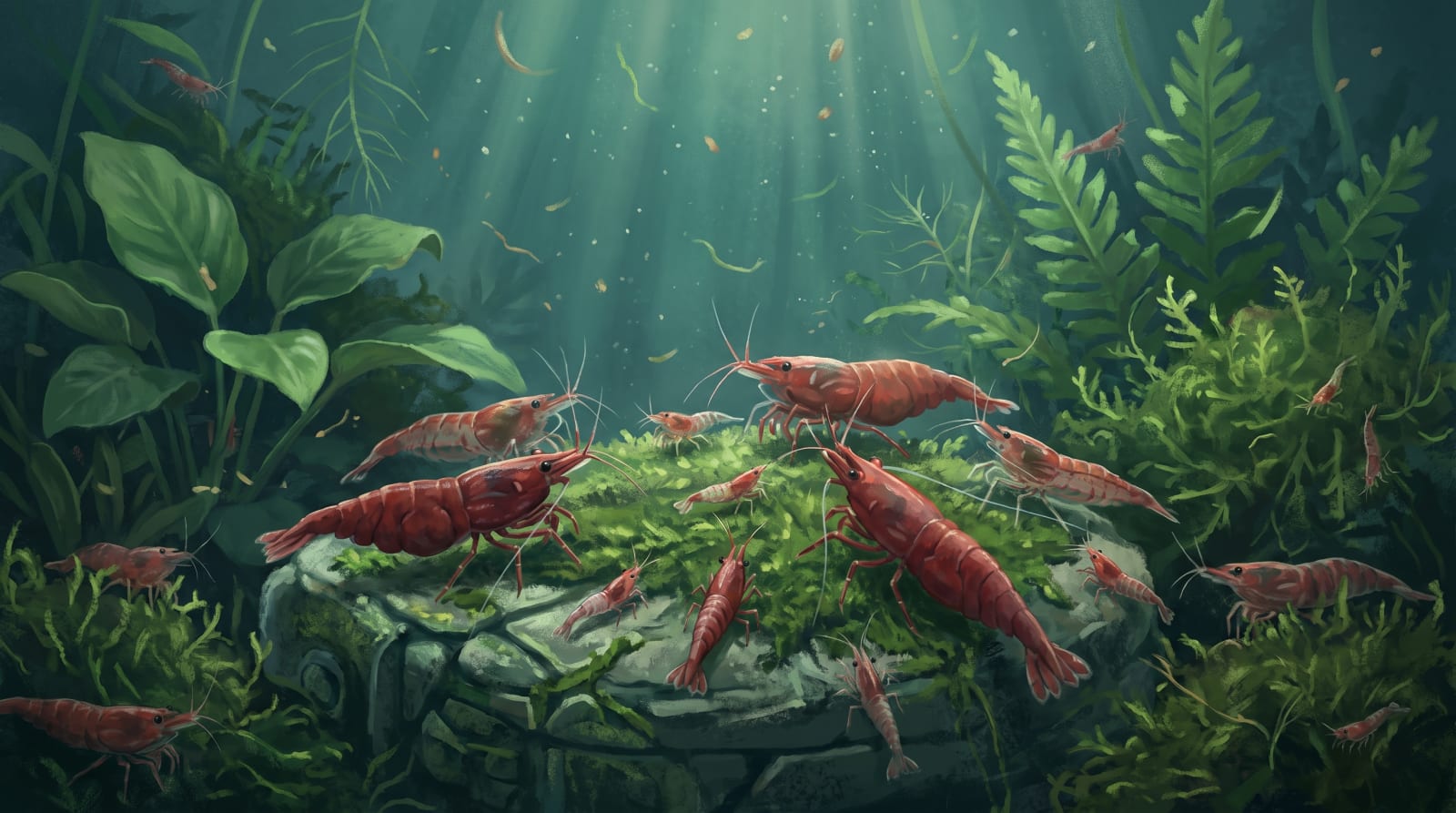
Every new shrimp keeper reaches the same fork: a tank that's only shrimp, or shrimp sharing the water with fish. It looks like a decorating choice and it isn't. It's a decision about what the tank is for — a colony that grows, or a display you sit and watch — and a species-only shrimp tank and a community tank pull towards opposite goals. You can lean one way or the other, but you can't fully have both, so the honest first step is deciding which you're actually after.
The one question that decides it
The whole choice collapses into a single question: do you care more about the colony growing, or about the tank looking busy? Answer that and everything else — stocking, cover, even which grade of shrimp to buy — follows on its own.
Here's why the two goals fight. Cherry shrimp come in two sizes with two different fates. Adults are 2.5–3cm, too big a mouthful for genuinely tiny fish and armoured enough to shrug off casual interest. Shrimplets hatch at 1–2mm and are food to almost anything that swims, picked off in the open even by peaceful nano fish. A colony only persists by replacing itself — cherries live just 1–2 years — so the fate of the shrimplets is the fate of the tank.
That's the trap in a community tank. It looks fine for months, because the adults you bought are still there. What you don't see is the shrimplets vanishing one by one, until the adults age out and nothing has grown up behind them. Take the fish away and the same colony can roughly double every 2–3 months. Predation is the tax that eats colony growth, and species-only sets it to zero. Which specific animals are safe, risky, or a flat no is rated in our cherry shrimp tank mates guide; this one is about the decision sitting above that list.
What a species-only tank actually is
"Species-only" puts people off because it sounds like a bare box with a few shrimp in it. It isn't. It's a fully planted tank running one colour line of shrimp, plus snails — and a colony in full colour is a display in its own right, not a compromise on one.
Snails are the exception that proves the rule: the one addition that costs the colony nothing. They graze film algae and leftovers a shrimp's mouthparts can't lift, they have no ability or appetite to hunt, and they double as an overfeeding gauge. A shrimp-and-snail tank is a complete, near self-cleaning little system, and it's how we run every breeding colony in our room. The pairing gets its own write-up in shrimp and snails, the perfect cleanup crew.
One rule comes with the territory: one colour line per tank. Every Neocaridina colour is the same species and they interbreed freely, so a mixed tank drifts back to wild-type brown within a couple of generations. Pick your line and commit the tank to it.
The case for going species-only
If the plan is a growing colony, this is the setup, and the reasons stack up.
Shrimplet survival goes through the roof. Removing predators is the single biggest lever on how many babies reach adulthood — bigger than food, bigger than parameters. It's the difference between a colony that treads water and one that booms, and it's covered in full in raising shrimplets.
The shrimp are bolder and better coloured. A colony under no threat grazes out in the open at midday instead of skulking in the moss. Stress mutes colour, too: even a deep blue dream line looks grey and washed out when it spends its life hiding from fins. Take the pressure off and the whole tank comes out to feed like it's being paid to.
You can spend up on grade. High-grade shrimp only make sense somewhere their offspring survive to justify the outlay. Put a group at £30–50 per 10 into a tank where every shrimplet lives and you're compounding your investment; put them in with fish and you're feeding it to them.
Management is simpler. No fish means no competing needs — you feed for shrimp, plant for shrimp, and never have to weigh a fish's health against the colony's.
The honest costs? It's shrimp and snails, not a fish display, so if you want darting movement and variety this won't scratch that itch — though a full colony is more mesmerising than most people expect. Snails multiply when you overfeed, which is a signal to read rather than a fault to fix. And plenty of keepers who start species-only end up wanting a second tank for fish anyway.
The case for a community tank
If what you actually want is a planted display with life in it, a community tank is a perfectly good choice — as long as you go in clear-eyed about the trade.
The upside is obvious: movement, variety, a proper scene, with cherry shrimp as living colour and a working cleanup crew grazing algae and biofilm off every surface. A dozen red shrimp threading through a planted tank is a lovely thing, and they earn their keep while they're at it.
The costs are just as real, and honesty matters more here than anywhere.
The colony won't grow. Shrimplets get eaten, so numbers hold at best and usually drift down over a year. Buy standard-grade shrimp at £2–4 each for a community tank and treat them as a population you'll top up, not one that replaces itself.
You lose the freedom to medicate. A shrimp tank already rules out copper-based treatments and most fish medications, which are lethal to invertebrates. Put fish in and the day one of them needs treating you're stuck — you can't dose the tank, so you'll be moving the fish out to a hospital tank instead. The full list of what you can and can't use is in shrimp-safe medications.
Even adults aren't fully safe. Every adult goes soft for 24–48 hours after each moult, every 3–6 weeks, and that's exactly when an otherwise-tolerable fish picks one off. Steady attrition adds up over a year.
You have to build for it. Heavy cover isn't optional in a community tank — it's the only thing keeping any shrimplet alive — and it needs to go in before the fish, along with establishing the shrimp colony first so it has momentum. Dense moss and tangled breeding décor are what let a colony hold its numbers under fish at all.
Choosing in a minute
Lay the two side by side and the decision usually makes itself.
| If you want… | Go… |
|---|---|
| The colony to grow and breed | Species-only |
| High-grade shrimp to pay their way | Species-only |
| Maximum colour and bold behaviour | Species-only |
| A self-cleaning shrimp-and-snail system | Species-only |
| Fish and movement in the tank | Community |
| A display first, shrimp as living detail | Community |
| To accept a stable-or-shrinking shrimp count | Community |
If your answers land in both columns, that's not indecision — it's the honest reason a lot of keepers end up running two tanks.
The middle path, and the two-tank answer
There is a genuine middle ground, and it's worth knowing before you commit. A heavily planted nano with nothing but a small shoal of true nano fish over thick moss can let enough shrimplets survive to hold the colony steady — not grow it, but not lose it either. It works if your expectations are set to "stable" rather than "booming", and it lives or dies on how much cover you build in first.
The answer most breeders drift towards, though, is simpler and better: run two tanks. A species-only colony as the engine and a community tank as the display, with the colony quietly supplying shrimp to the show tank and never missing them. It sounds like twice the work and mostly isn't — a settled shrimp colony is the lowest-maintenance tank in the house — and the numbers behind why a colony can afford to stock a second tank are laid out in how to breed cherry shrimp. You don't have to choose between the two tanks you want. You just have to stop asking one tank to be both.
FAQ
Can you keep cherry shrimp in a community tank?
Yes, with the right neighbours and plenty of cover. Adult cherries at 2.5–3cm are safe from genuinely small, peaceful fish, and they'll graze algae and biofilm while adding colour to a planted display. The catch is the shrimplets, which most fish eat on sight, so the colony won't grow — treat community shrimp as a population you top up rather than one that breeds itself.
Do cherry shrimp breed in a community tank?
They'll breed — that part you can't stop — but the babies rarely survive. Shrimplets hatch at 1–2mm and are food to almost every fish, picked off in the open before they reach a safe size. In a heavily mossed tank a few slip through and the colony holds steady, but for real colony growth you need a species-only tank with no fish at all.
Is a species-only shrimp tank boring?
Not once it fills out. A planted tank running a single colour line at full colour, with the colony out grazing in the open and snails working alongside, is a display in its own right — and far more active than a community tank where nervy shrimp hide all day. Species-only means no fish, not no life; the shrimp and snails are the show.
What can I keep with cherry shrimp in a species-only tank?
Snails, and that's the happy answer. Ramshorns, nerites and Malaysian trumpet snails do a complementary cleanup job, never harm shrimp, and don't touch the colony's growth. They also read your feeding for you — a snail population that's climbing means you're overfeeding. Beyond snails, the whole point of species-only is keeping it to shrimp so the colony can grow undisturbed.
Do cherry shrimp have to be kept alone?
No — they don't need company of other species, but they're equally happy in a species-only tank and in a well-planned community. What they do need is their own kind: keep a group of at least 10 so the colony has both sexes and room to grow. Whether you add fish is a choice about your goals, not about the shrimp's welfare.