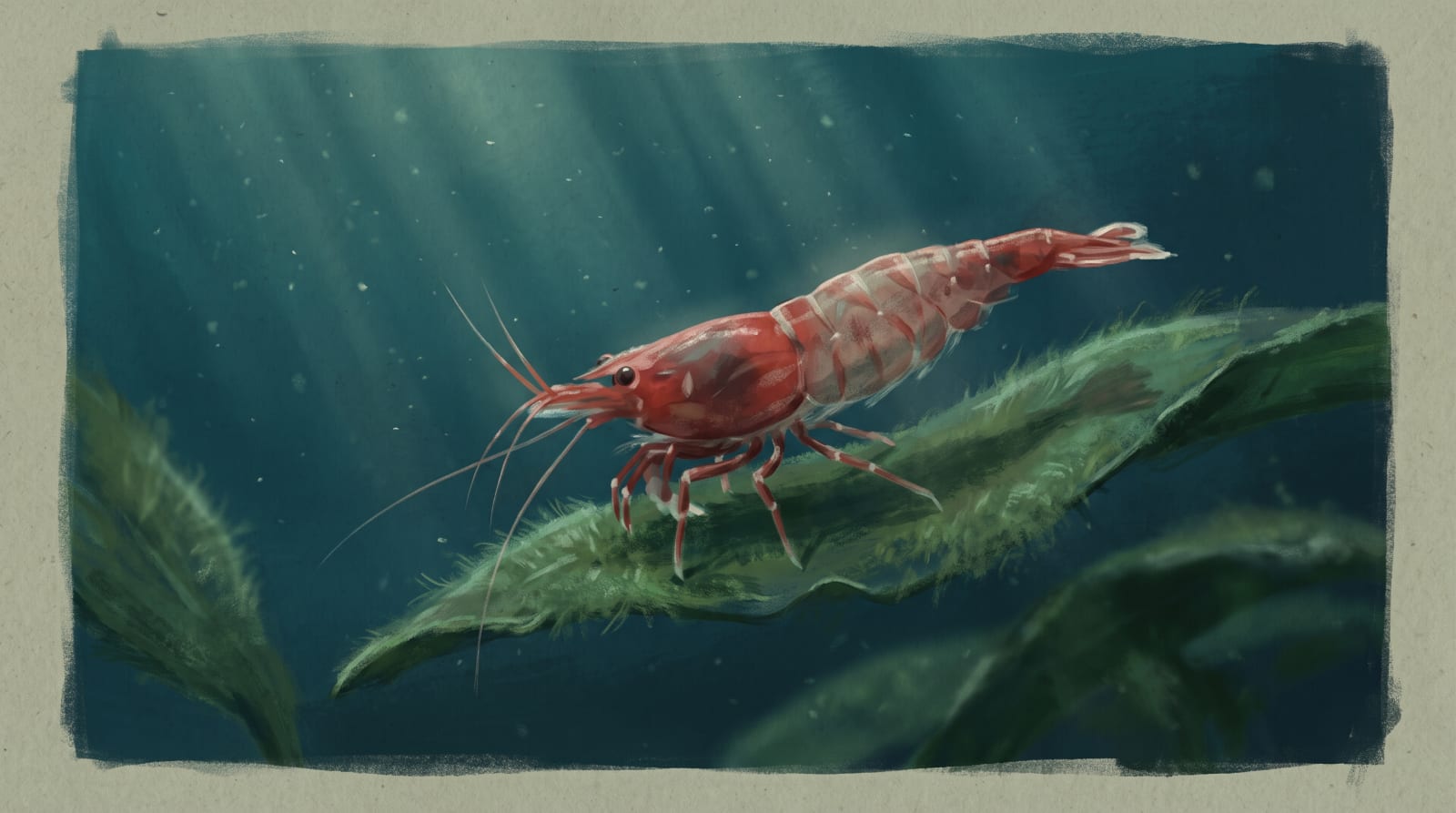
Yes, cherry shrimp eat algae, and it's half the reason people buy them. But "algae eater" is a generous job title for a 2.5cm grazer, and the gap between the sales pitch and the reality is where a lot of keepers end up disappointed. Cherries graze the soft, edible algae and biofilm they'd eat in a wild stream; they ignore the tough, ugly algae you actually want gone, and they can't touch a bloom hanging in the open water. Here is the honest breakdown: which algae they eat, which they don't, and why they were never going to fix an algae problem on their own.
Grazers, not a clean-up crew
Watch a colony for a minute and you'll see the appeal. Every shrimp is working a surface, front legs picking away constantly, and in a decent-sized group that adds up to real grazing pressure on the soft films coating glass, plants and wood. On the algae they can eat, a busy colony genuinely earns its keep.
The catch is in what "the algae they can eat" means. A cherry shrimp's natural diet is biofilm and the soft algae tangled through it, grazed off surfaces all day long. That's the same food they're after in your tank, which is why we treat algae grazing as part of their feeding rather than a cleaning service you've hired. They're topping up their own diet, not clearing your glass to order. The wider picture of how that diet works is in what do cherry shrimp eat.
Which algae cherry shrimp actually eat
The honest menu, from the films they strip in a day to the stuff they won't touch at all.
| Algae type | Do they eat it? | Why |
|---|---|---|
| Soft green film on glass and plants | Yes, readily | Soft and edible, part of the biofilm layer |
| Brown diatom dust (new-tank film) | Yes, eagerly | Soft, common in young tanks, grazed off fast |
| Green dust algae | Yes | Soft enough to graze as it forms |
| Soft, young hair or thread algae | A little | They'll nibble fresh growth, not keep pace with it |
| Established hair and thread algae | No, in practice | Too tough, and grows faster than they graze |
| Green spot algae (hard green discs) | Barely | Too hard — this one needs a scraper |
| Black beard and staghorn algae | Basically no | Almost nothing eats it; it's a tank problem, not a menu item |
| Blue-green "algae" (cyanobacteria) | No | Not a true algae; leave it well alone |
| Green water (free-floating bloom) | No | They graze surfaces, not the open water |
The pattern is simple once you see it: if it's soft and grazeable, cherry shrimp eat it; if it's hard, tough or floating, they don't. Soft films and diatom dust vanish almost before you've noticed them. The tough end of the list — black beard, staghorn, mature hair algae — is exactly the stuff people most want removed, and it's precisely what shrimp can't help with. Green water is its own case: a bloom of single-celled algae suspended in the water column, and since shrimp graze surfaces rather than filter the water, they make no difference to it at all.
The new-tank brown phase: the one they genuinely fix
Most new tanks go through a brown, dusty phase a few weeks in — diatoms coating the glass and leaves in a fine film. It looks alarming and it's completely normal, a passing stage as a young tank settles down. It's also the one algae situation where cherry shrimp come close to an actual solution: diatom film is soft, edible and exactly what they're built to graze, so a colony works it down as fast as it appears and often clears the brown phase noticeably quicker than an empty tank would. It's the exception that proves the rule. Soft film they'll strip for you; anything tougher they won't.
Why shrimp can't fix an algae problem
Here's the part the pet-shop pitch skips. Algae isn't a pest that arrives from nowhere; it's a symptom of two things being out of balance — light and nutrients. Too long a photoperiod, or a tank catching direct sun, gives algae the energy to spread. Surplus nutrients from overfeeding give it the food. Add a shrimp colony and you've added grazers, but you haven't changed either driver, and a colony brings a small bioload of its own on top.
So the shrimp graze the aftermath while the cause keeps producing more. If algae is genuinely taking over, the fix is upstream of the livestock. Shorten the lighting period and keep the tank out of direct sun — our lighting guide covers sensible photoperiods. Cut feeding right back, because uneaten food is fertiliser for algae as surely as it's a route to overfeeding trouble. And in a planted tank, get the plants growing well so they outcompete the algae for nutrients; lean, careful dosing is covered in ferts and CO2 in shrimp tanks. Sort those out and the shrimp handle the soft regrowth from then on.
Getting the most grazing out of your colony
None of this means shrimp are useless against algae. It means you use them for what they're good at. A few pointers from our own tanks.
Colony size is everything. Ten shrimp make almost no visible dent; a hundred grazing all day keep every soft surface visibly cleaner. Cherries breed readily in good water, so this mostly takes patience rather than money — the colony you want is a season away, not a shopping trip.
Feed a little less. A colony that's full of shrimp food ignores the biofilm and soft algae it would otherwise graze. Keep supplement feeds modest and the colony does more of its own foraging, which is better for the tank and the shrimp both.
Bring in snails for the jobs shrimp can't do. Nerite snails in particular rasp harder films — including some green spot — that shrimp leave behind, and they make a genuinely complementary cleanup team with shrimp. It's still no cure for a light-and-nutrient problem, but two grazers cover more of the menu than one.
And ignore colour when you're picking for grazing. Every Neocaridina line grazes identically — a red cherry works no harder or softer than a blue or a yellow. Buy the colour you like the look of; they all eat the same.
The 'algae eater' sales pitch, honestly
Cherry shrimp get sold as algae eaters because it shifts stock, and it sets buyers up to feel cheated. Buy a colony expecting it to strip a green tank clean and you'll be back at the shop within a fortnight, convinced yours are faulty.
Buy them for what they are instead: a hardy, endlessly watchable, freely breeding grazer that helps keep soft algae and biofilm in check as part of a healthy tank. That's a fair deal and a genuinely useful one. Expecting them to solve a black beard outbreak or clear a green-water bloom is asking a snack-sized invertebrate to do a maintenance job, and it's the fastest route to a disappointed keeper — and, worse, to a colony bought for the wrong reason and kept in the wrong conditions.
FAQ
Do cherry shrimp eat hair algae?
A little, and only the soft new growth. Cherry shrimp will pick at young, fine hair or thread algae as it appears, but they can't keep pace with an established mat — it's too tough and grows faster than they graze. If hair algae is spreading, the cause is excess light or nutrients, and that's what needs fixing. The shrimp will only ever nibble the edges of a problem they didn't create.
Do cherry shrimp eat black beard algae?
No, in practice. Black beard and staghorn are among the few algae types almost nothing in the aquarium will eat, cherry shrimp included. If you've got it, treat it as a tank-balance problem — usually unstable CO2, poor flow or excess nutrients — rather than something a clean-up animal can remove. Adding shrimp to a black beard outbreak just gives you shrimp living alongside black beard.
Will cherry shrimp clean my tank?
They'll help, within limits. A good-sized colony keeps soft films, biofilm and diatom dust grazed down and clears leftover food — real, visible maintenance. What they won't do is remove tough algae, scrub green spot off the glass, clear a green-water bloom, or fix whatever is feeding the algae in the first place. Think of them as grazing staff that keep the soft stuff in check, not a reset button for a tank that's out of balance.
Do cherry shrimp eat green water?
No. Green water is a bloom of microscopic algae floating in the water column, and cherry shrimp are surface grazers — they simply can't feed on algae suspended in the open water. Clearing green water means tackling its cause, usually too much light and too many nutrients, or resorting to a UV steriliser or a blackout. The shrimp are bystanders to all of it.
How many cherry shrimp do I need to control algae?
More than most people expect, and even then only for soft algae. Ten shrimp make little visible difference; it's a mature colony of many dozens, grazing all day, that keeps surfaces genuinely clean. Since cherries breed quickly in good water, the realistic route is to start with ten or more and let the colony build. Just keep the target honest — numbers help with soft films, not with tough algae or blooms.