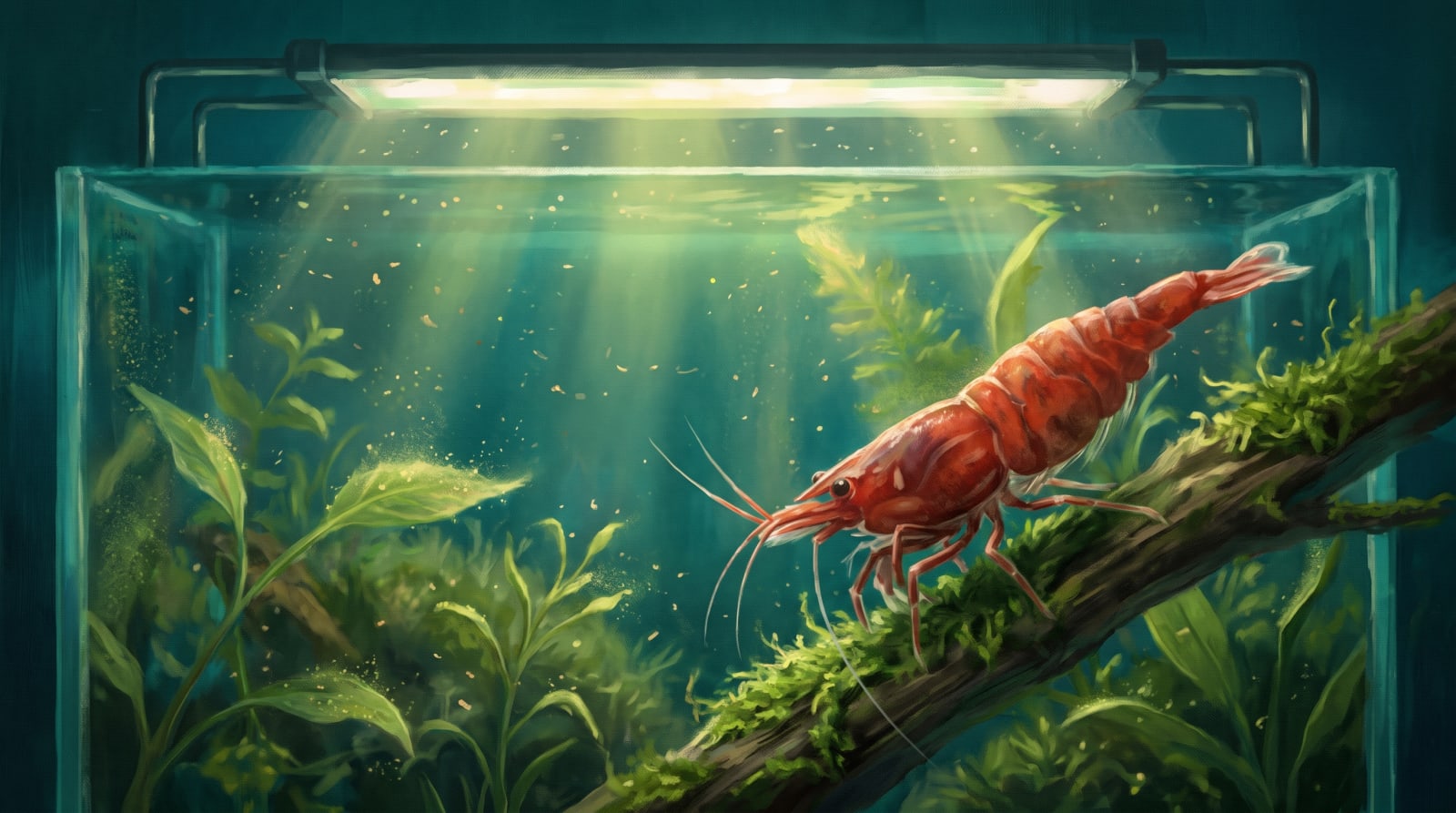
Most lighting advice for shrimp tanks has it backwards: the shrimp don't care. Neocaridina come from shaded, overgrown streams, and they would happily live in a tank you never lit at all. The light is for the plants, for you being able to see your colony, and for the quiet algae-and-biofilm garden that actually feeds them. Get those three straight and lighting a shrimp tank stops being complicated.
Do shrimp need light?
Not for their health, no. Shrimp have no requirement for a bright tank and no daily light "dose" they need to hit; in the wild they spend their days grazing in shade and cover, and a shrimp given the choice will often head for the darkest corner of the tank. You could run a colony in a north-facing room on ambient daylight alone and the shrimp themselves would be perfectly fine.
So why fit a light at all? Three real reasons, none of them about the shrimp directly. Plants need it. You need it, unless you enjoy a tank you can't see into. And light powers the biofilm and algae the colony grazes — the one way lighting does feed your shrimp, just indirectly. Everything that follows is about serving those three without tipping the tank into an algae mess.
Light grows the food
This is the part worth understanding, because it reframes the whole job. A lit tank grows a film of algae and biofilm — aufwuchs, if you want the proper word — across every surface: glass, wood, leaves, the filter sponge. That film is the primary diet of a cherry shrimp colony, and it's what shrimplets graze from the day they're born. Our explainer on biofilm, the invisible buffet goes into how to farm it deliberately.
Light is the engine of that garden. A tank with a sensible photoperiod grows a steady supply of the soft film algae shrimp actually eat, which is why a mature, gently lit, planted tank feeds a colony far better than a spotless new one does. It also sets expectations: some algae is not a failure in a shrimp tank, it's lunch. What shrimp will and won't clear is a longer story in do cherry shrimp eat algae, but the short version is they love the soft stuff and ignore the tough stuff.
Plants are why you're really choosing a light
If your tank is the usual shrimp-keeper's mix of moss, anubias, java fern and a few crypts, you need very little light. These are low-tech, shade-tolerant plants that grow perfectly well under a modest LED and no added CO2, and they're the backbone of most of our tanks precisely because they ask for so little. Our roster of the best plants for shrimp tanks is built around exactly this kind of easy, shrimp-safe planting.
The mistake is buying a powerful light for plants that never asked for one. High-output lighting exists to drive demanding carpet plants and heavily planted, CO2-injected aquascapes — setups most shrimp tanks don't run, and covered in ferts and CO2 in shrimp tanks. Bolt that kind of light onto a low-tech moss tank and you don't get better plants; you get an algae bloom, because there's more light than the plants can use and the surplus feeds algae instead. Match the light to the plants and most algae problems never start. If you're still planning the tank, our step-by-step setup guide covers where lighting sits in the build.
The photoperiod: six to eight hours on a timer
Here is the single most useful thing in this guide. Run your light for six to eight hours a day, and put it on a timer so the schedule fires at the same time whether you're home or not. That's it. Six to eight hours is plenty for low-tech plants and for the biofilm garden, short enough to keep algae in check, and the timer takes the decision out of your hands — which matters, because the thing shrimp value most is consistency.
Longer isn't better. A light left on for ten or twelve hours, or switched on and off by hand at random times, mostly just grows more algae. Some keepers run a "siesta" — a few hours on, a break in the middle, a few hours on again — and swear it helps with algae; we've never found we needed the extra fiddle over a simple single block, but it does no harm if you like the tank lit at both ends of the day. Whatever you pick, a cheap plug-in timer is one of the best few pounds you'll spend on the tank, and it earns a place on the complete kit list.
Keeping algae in balance
Algae is light plus nutrients, and a shrimp tank always has both. A little is the point; a lot means one of the two dials is turned up too far. If green film is climbing the glass faster than the shrimp graze it, the levers are simple: shorten the photoperiod by an hour or two, cut back on feeding so there are fewer spare nutrients, and add or grow more plants to outcompete the algae for what's left. Getting the tank out of any direct sun helps too, which we'll come to.
For a proper outbreak — pea-soup green water especially — a short blackout works as a reset: cover the tank and kill the light for two or three days, and the free-floating algae starves while your plants and shrimp ride it out comfortably. What algae won't do is respond to buying more shrimp. Cherries are grazers, not a cure; they'll keep soft film in trim but they won't fix an underlying light-and-nutrient imbalance, so treat them as the janitors and fix the actual cause yourself.
Direct sunlight: the one thing to avoid
Wherever you put the tank, keep it out of direct sun. A window that lands sunlight on the glass does two things shrimp hate. It drives algae hard — a sunlit tank grows green water and thread algae faster than any aquarium light will — and worse, it swings the temperature, heating the water through the afternoon and letting it fall back at night. Cherries tolerate 18–26°C comfortably, but it's the swing, not the number, that does the damage, and a sunny windowsill is a swing machine. An aquarium light on a timer gives you all the control; the sun gives you none.
Light, colour and actually seeing your shrimp
The last job is the one you'll enjoy most: seeing the colony properly. A daylight-white light — the cool, bright kind rather than a warm yellow — shows reds, blues and greens far better than a dim or yellow-tinted one, and over a dark substrate a well-lit red cherry looks the colour you paid for. There's a real husbandry angle here too, not just vanity. Shrimp adjust to their surroundings, and a tank lit very brightly over a pale, reflective substrate can leave shrimp looking washed out, both because they pale down against a bright background and because they spend more time hiding from it. If your colony looks less colourful than it should, lighting and substrate are on the list of suspects in why is my shrimp losing colour, usually well before anything is actually wrong with the shrimp.
FAQ
Do cherry shrimp need light?
No. Cherry shrimp have no need for light and would live happily in an unlit tank; they're shade animals from overgrown streams. The light in a shrimp tank is for the plants, for you being able to see the colony, and for growing the biofilm and algae the shrimp graze. Serve those and you can run as much or as little light as the plants require.
How many hours of light should a shrimp tank get?
Six to eight hours a day, on a timer. That's enough for low-tech plants and a healthy biofilm garden, while staying short enough to keep algae from taking over. Consistency matters more than duration, so a cheap plug-in timer that fires at the same time every day beats switching the light by hand and is one of the better small buys for the tank.
Can I keep a shrimp tank with no light at all?
The shrimp will be fine, but the tank works better with some light. Without it you can't grow live plants, the biofilm garden runs thinner, and you can't see your colony. If you want a no-light tank, lean on ambient room daylight kept off direct sun, use hardy plants or none, and expect to feed a little more since the grazing surface will be leaner.
Why does my shrimp tank keep getting algae?
Too much light, too many nutrients, or both. The usual culprits are a photoperiod over eight hours, overfeeding, or direct sunlight on the glass. Shorten the light, feed less, add more plants to compete, and get the tank out of any sun. Buying more shrimp won't fix it — they graze soft film but can't cure a light-and-nutrient imbalance.
Does lighting affect shrimp colour?
It affects how they look and, a little, how they behave. A daylight-white light over dark substrate makes colours pop, while a very bright tank over pale substrate can leave shrimp looking washed out and sending them to hide. It doesn't change their genetics, but if a colony looks pale, lighting and substrate are worth checking before you assume something is wrong.