Most of what looks like disease in a cherry shrimp tank turns out to be water quality or a moult gone wrong, not a pathogen — so before you treat anything, it pays to know what you're actually looking at. True shrimp diseases and parasites do exist, and a handful are common enough that every keeper should be able to name them on sight. This is our visual ID guide to the ones you'll genuinely meet, what causes each, and how we handle them. None of it involves copper, and here's why that matters throughout.
First, rule out water and moulting
The single most useful habit before reaching for any treatment is to test the water, because the two conditions most often mistaken for disease aren't diseases at all. When shrimp start looking unwell in numbers, water quality is the cause far more often than any bug, and our diagnostic checklist for dying shrimp is the place to start if you're losing several.
The classic false alarm is the pale white band that appears behind the head when a shrimp can't complete a moult — the white ring of death. It looks alarming and gets called a disease constantly, but it's a moulting failure tied to GH and sudden swings, not an infection, and we've written it up separately in moulting problems and the white ring of death. Rule those two out first; then, if the shrimp genuinely has something growing on it or turning opaque inside it, the sections below tell you what.
The quick ID table
Use this to narrow things down at a glance, then read the matching section for the detail.
| What you see | Likely culprit | Nature |
|---|---|---|
| Fine white fuzzy tufts on the shell, legs or moult sites | Vorticella | External ciliate — see below |
| Tiny white stalks or "worms" on the rostrum and head | Scutariella japonica | External flatworm — see below |
| Opaque, milky or pinkish patch inside an otherwise clear body | Muscular necrosis / bacterial infection | Internal — see below |
| Green or dark cauliflower-like growths on the body | Ellobiopsidae | Parasite — see below |
| Pale white band splitting behind the head, shrimp stuck mid-moult | Failed moult — not a disease | Test water, not treat |
The pattern to notice: the first two live on the outside of the shrimp and are usually survivable, while the internal ones are far more serious. Match your shrimp to a row, then read on.
Vorticella: the white fuzz
Vorticella is the one most people meet first. It's a stalked ciliate — a colony of tiny single-celled organisms — that anchors to a hard surface and waves in the current, so on a shrimp it reads as fine white fuzzy tufts, often at the edges of the shell, the leg joints, the rostrum, or old moult sites. Under good light you can sometimes see the individual stalks. It's frequently confused with a bacterial or fungal fuzz, but vorticella is the far more common find.
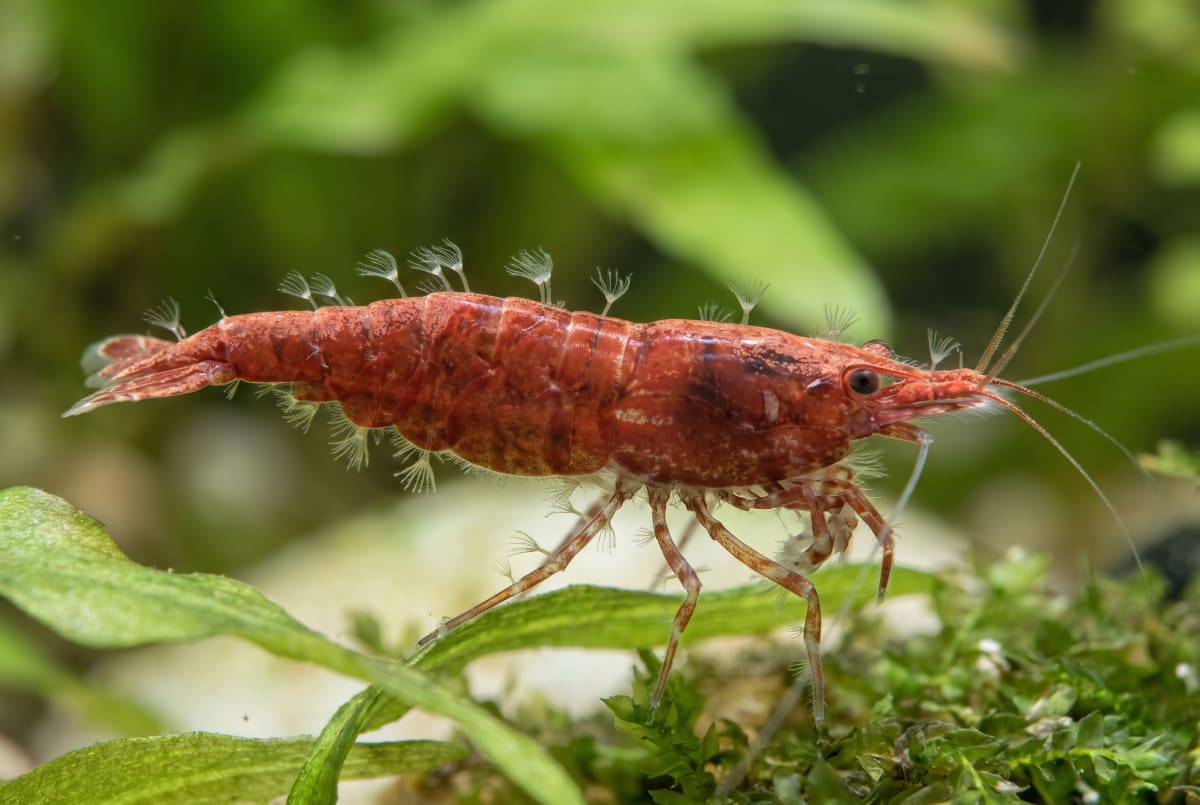
Vorticella is an opportunist that takes hold when water quality slips, so the first response is always to clean up the tank: test, small water changes, cut feeding back. Many light cases clear on their own with the shrimp's next moult, since the ciliate is anchored to a shell the shrimp is about to shed. For stubborn cases the consensus treatment is a salt dip — one level tablespoon of aquarium or rock salt dissolved in 250ml of tank water, dipping the affected shrimp for 30–60 seconds while you watch it, then returning it to the tank. Never add salt at that strength to the main tank; the dip is a spot treatment only. The full method is in our vorticella identification and treatment guide.
Scutariella japonica: the rostrum worms
Scutariella japonica looks like disease but is technically a commensal flatworm, and it has a signature location: tiny white stalks projecting from the rostrum and head, sometimes described as little worms on the shrimp's nose. A mild infestation is often tolerated indefinitely and does little harm; a heavy one irritates the shrimp and is worth clearing, especially on new arrivals that may have brought it in.
The treatment is the same salt dip as for vorticella — one level tablespoon of aquarium or rock salt per 250ml of tank water, a 30–60 second dip with the shrimp watched the whole time. The wrinkle is the eggs, which sit in the shrimp's old shell, so you repeat the dip after the next moult and remove shed moults from the tank during treatment to break the cycle. Because it hitchhikes in, scutariella is a strong argument for quarantining new stock, and the detail lives in our scutariella japonica guide.
Bacterial infection and muscular necrosis: opaque tissue
This is the serious one, and the honesty has to be up front: it's usually fatal for the individual. Muscular necrosis and internal bacterial infections both show as opaque, milky or pinkish tissue inside a body that should be clear — often starting in the tail or abdomen and spreading, a whitening you can see through the shell. It's the condition most often mixed up with the white ring of death, but this is internal muscle turning opaque, not a shell separation.
There's no reliable invert-safe cure, so don't expect a treatment to save the affected shrimp — anyone promising one is guessing. What you can do is contain it and protect the rest: isolate the shrimp, remove any body promptly so the colony doesn't eat it, and fix the underlying stressor, which is nearly always water quality or a swing that knocked the colony back. Get the tank stable and the rest usually stay fine. The background and the containment routine are in our guide to bacterial infections and muscular necrosis.
Ellobiopsidae: the rare green parasite
You're unlikely to meet this one, but it's worth recognising because it's untreatable and easy to panic over. Ellobiopsidae are parasites that appear as green or dark, almost cauliflower-like growths on the body or under the tail, quite unlike the fine white fuzz of vorticella. They draw nutrients from the shrimp, which slowly declines.
There's no reliable cure that a shrimp keeper can safely apply, so the honest handling is containment rather than treatment: isolate any affected shrimp, keep water quality pristine to support the rest of the colony, and accept that a heavily parasitised individual is unlikely to recover. Fortunately it's rare in home tanks, and good quarantine of incoming stock is the best defence against ever seeing it.
What never to reach for: copper
Whatever the diagnosis, one rule overrides all of it — no copper. Copper-based medications kill shrimp, and reaching for a general "anti-parasite" or "fungus" fish treatment without checking the label is how keepers turn a survivable case of vorticella into a dead colony. The trace of chelated copper in a quality shrimp-safe plant fertiliser is fine; a copper medication is a different thing entirely, and the distinction is spelled out in our guide to copper and shrimp.
If fish in a shared tank genuinely need a copper treatment, move the fish out to treat them — never dose "approximately safe" copper around shrimp. More broadly, most shrimp problems are handled with a salt dip, a water-quality fix and patience rather than a bottle, and our guide to shrimp-safe medications and what never to dose is worth reading before you treat anything. Prevention beats all of it: quarantining new shrimp, covered in our quarantine guide, stops most of these arriving in the first place.
FAQ
How do I know if my cherry shrimp is sick?
First check it isn't a water or moulting problem, which account for most "sick shrimp" — test ammonia, nitrite and GH before anything else. Genuine disease shows on the body: white fuzzy tufts (vorticella), tiny stalks on the rostrum (scutariella), opaque milky tissue inside the body (bacterial or muscular necrosis), or dark green growths (ellobiopsidae). A shrimp that grazes normally and holds its colour is usually fine.
What is the white fuzz on my shrimp?
Almost always vorticella — a stalked ciliate that anchors to the shell and waves in the current, appearing as fine white tufts on the shell edges, legs or rostrum. It takes hold when water quality slips, so improving the water is the first step, and many light cases clear with the shrimp's next moult. Stubborn cases respond to a short salt dip. It's rarely a true fungus.
Can you treat shrimp diseases with salt?
For the external parasites, yes. Vorticella and scutariella both respond to a salt dip — one level tablespoon of aquarium or rock salt in 250ml of tank water, dipping the shrimp for 30–60 seconds while you watch it. Never dose salt at that strength into the main tank; it's a spot treatment only. Internal conditions like muscular necrosis don't respond to salt, and no reliable invert-safe cure exists for those.
Why do my shrimp have worms on their heads?
Those are scutariella japonica — small white flatworms that live on the rostrum and head. They're technically commensal rather than a true disease, and mild cases are often tolerated with no real harm. Heavier infestations are worth clearing with the same salt-dip protocol used for vorticella, repeated after the next moult because eggs sit in the shed shell. They usually arrive on new shrimp, so quarantine helps.
Are cherry shrimp diseases contagious to other shrimp?
Some are. The external parasites — vorticella and scutariella — can spread within a tank, which is why you treat affected shrimp and improve conditions for all of them. Internal bacterial infections and muscular necrosis are usually triggered by a shared stressor like poor water rather than passing shrimp to shrimp, so fixing the water protects the colony. Quarantining new arrivals is the most effective way to keep any of them out.