A dead shrimp is evidence, if you know how to read it. The colour of the body, the state of the shell and — above all — the timing of the deaths each point at a different cause, and read together they usually name the culprit before you've run a single test. This is the post-mortem we run on our own losses. It won't bring a shrimp back, but it tells you what to change so the next one lives.
First, make sure it's actually dead
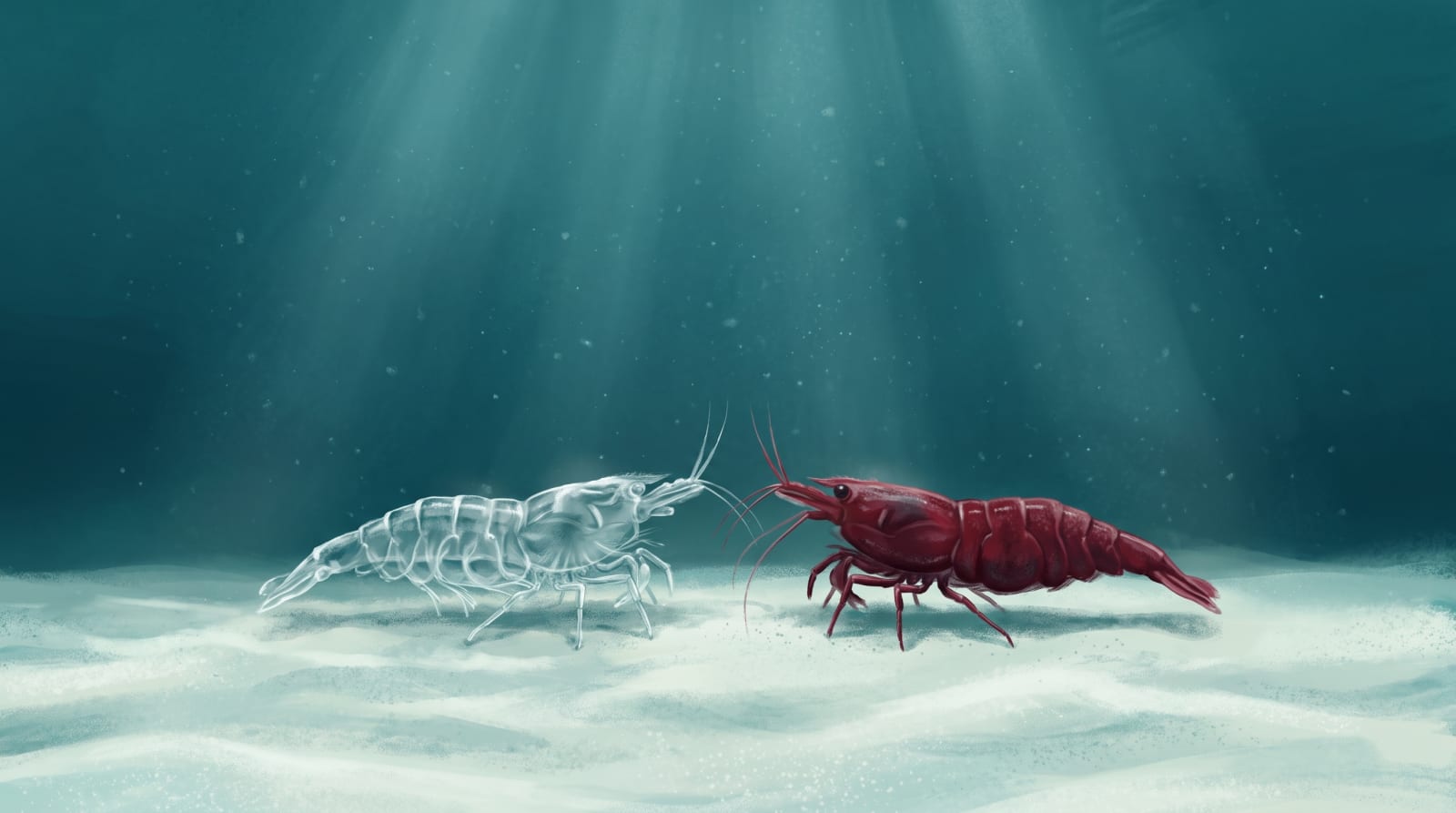
More "deaths" than you'd think are moults. A shed exoskeleton is a complete, shrimp-shaped ghost lying in the open, and it fools almost everyone at least once. The tell is clarity: a moult is translucent and hollow, usually split across the back where the shrimp backflipped out of it, and light passes straight through with nothing inside. Leave it in the tank — the colony grazes the minerals back out of it within a day or two.
A body is opaque and keeps its bulk, and the surest sign is colour, which is where the real post-mortem starts. If you're routinely unsure which one you're holding, the fuller version of dead-versus-moulted is in our guide to a shrimp that isn't moving.
The body: colour and shell
Pink or orange all over. This is the most misread sign in the hobby. A shrimp that has turned an even, cooked-looking pink has been dead a while — hours at least, often longer. The pigment shift is the same chemistry as a prawn changing colour in a pan, and it happens after death, not before. A living red cherry is never this flat, uniform pink, so pink doesn't tell you what killed the shrimp; it tells you the death isn't fresh, which resets any "it happened overnight" assumption. Found it pink first thing in the morning? It may well have died the previous afternoon.
Milky, opaque tissue inside the body. When whole segments of the tail or body go white and cloudy — as if the flesh has been cooked from the inside — you're usually looking at muscular necrosis or an internal bacterial infection rather than anything to do with moulting. It creeps across the body over a day or two and is generally fatal for that individual; the causes and the honest limits of treating it are in our guide to bacterial infection and muscular necrosis.
A pale band behind the head, shrimp half out of its shell. A shrimp that died stuck mid-moult, with a white ring showing where the old shell separated behind the carapace, has hit the white ring of death. This is a moulting failure, not a disease, and it points straight at general hardness and stability rather than anything catching.
Normal colour, intact, simply dead. A shrimp that dies looking more or less its usual self — no ring, no milky muscle, no fresh cast shell nearby — often went from either old age or a clean acute event, a toxin or a temperature swing that killed without a struggle. For that one, the timing does the talking.
The timeline: your single biggest clue
If the body gives you the what, the timing gives you the why. Before anything else, answer one question: did the deaths come all at once, or one at a time over weeks? The two patterns point at completely different causes.
| Pattern | What it usually means | Where to look first |
|---|---|---|
| Several overnight or in a day or two | Acute — something in the water changed | The last 48 hours: what did you add, change or dose? |
| One every few days over weeks | Chronic or age — nothing changed, something was quietly wrong | GH, diet, nitrate, and the age of the group |
All at once is the signature of an acute event. Several shrimp dead overnight, or a colony that was fine yesterday and crashing today, almost always means the water turned on them: an ammonia spike in a tank that wasn't fully cycled, a slug of copper from a medication, unconditioned tap water carrying chlorine or chloramine, a temperature crash or spike, or pesticide off a plant added that week. The question that cracks it is simply what changed in the last day or two. Ammonia and nitrite are the first things to test, because they're the most common acute killers and the fastest to confirm — our guide to safe ammonia, nitrite and nitrate levels covers what a spike does and how to respond.
One by one over weeks, while the rest of the colony grazes and breeds normally, is the fingerprint of something chronic. Nothing dramatic happened; a low-level problem has been picking off the vulnerable. The usual suspects are GH sitting too low for clean moults, an ageing group all reaching the end together, nitrate creeping up from steady overfeeding, or a slow disease. It's a more frustrating puzzle than a crash, but a more forgiving one, because you have time to test and correct before it takes the whole tank.
Old age, or something wrong?
A slow trickle of deaths is the pattern most likely to be misread as illness when it's really just the calendar. Cherry shrimp live one to two years, and a group bought together tends to age together — so a wave of losses somewhere past the eighteen-month mark, with no other symptoms, is often nothing more sinister than time.
The way to tell age from a chronic fault is to look at the young. A colony dying of old age is still breeding: you'll see berried females and shrimplets coming through underneath the losses, because the conditions are fine and only the oldest shrimp are going. A colony dying of a chronic problem — low GH, a persistent trace toxin, creeping nitrate — usually isn't breeding, and you'll spot failed moults and a shortage of new young alongside the deaths. Breeding underneath the losses is your reassurance; a stalled, ageing-only colony that has stopped producing is the one to investigate. If yours has simply grown old, our guide to cherry shrimp lifespan and growth stages sets out what a normal span looks like.
From post-mortem to fix
The post-mortem's job is to point you at the right repair, not to be an end in itself. Once the body and the timing have told you roughly what happened — an acute water event, a chronic shortfall, a failed moult, plain old age — you know which branch of the full diagnostic to follow. That ordered, test-by-test checklist is our pillar guide, why are my cherry shrimp dying, and it's where a post-mortem turns into a plan.
One practical note. If you genuinely can't read a death, don't bin it in a panic, but don't let bodies accumulate either. In a healthy tank the colony deals with the odd loss cleanly, recycling it within a day. In a tank that's already struggling — uncycled or overstocked — a pile of decaying shrimp only adds to the ammonia load and speeds up exactly the crash you're trying to diagnose.
FAQ
Why is my dead shrimp pink?
Because it has been dead for a while. After death a shrimp's pigments shift to an even, cooked-looking pink or orange — the same change a prawn makes in the pan — and a living red cherry never shows that flat, uniform colour. Pink doesn't tell you the cause of death, but it does tell you it wasn't recent: a shrimp found pink in the morning may have died the afternoon before.
My shrimp died overnight — what happened?
Sudden deaths, several at once, almost always mean an acute problem in the water rather than disease. Something changed in the last day or two: an ammonia spike, unconditioned tap water, a copper medication, a temperature swing, or pesticide off a newly added plant. Test ammonia and nitrite first — both should read zero — then work back through what you added, changed or dosed just before the deaths began.
Why are my shrimp dying one at a time?
A death every few days over weeks, while the rest of the colony grazes and breeds normally, points to something chronic rather than a sudden event. The common causes are GH too low for clean moults, an ageing group reaching the end together, or nitrate creeping up from overfeeding. Check whether the colony is still breeding: if shrimplets are coming through, you're likely watching old age; if not, look harder at the water.
How can you tell what killed a shrimp?
Read the body and the timeline together. Pink all over means it died a while ago; milky white tissue inside means muscular necrosis or infection; a pale ring with the shrimp stuck half-out is a failed moult. Then ask whether deaths came all at once, which points at an acute water event, or one by one over weeks, which points at a chronic fault or old age.