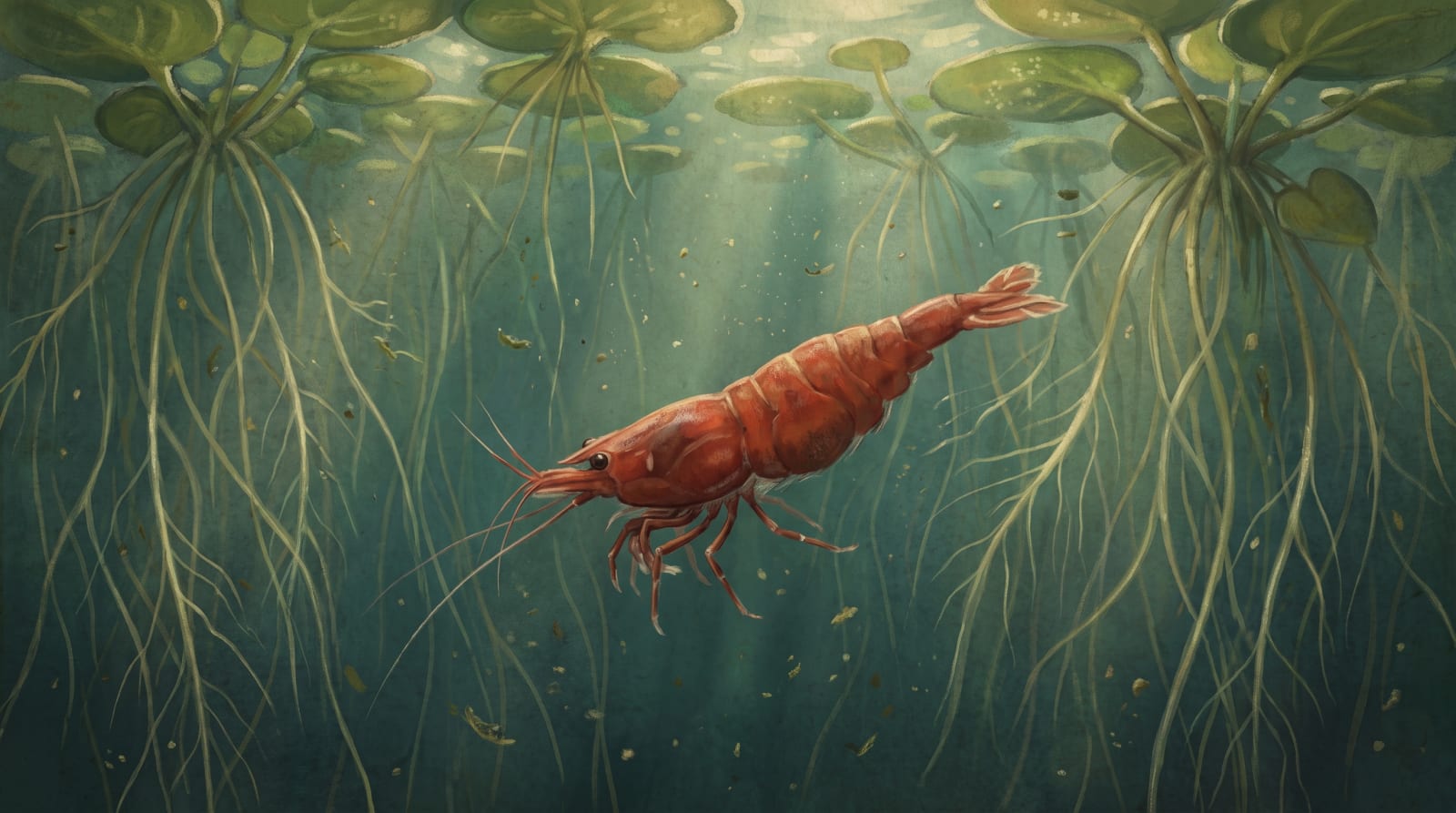
Floating plants are the most underrated cover in a shrimp tank. They sit at the surface, out of the way of everything else you're growing, and quietly do three of the jobs a shrimp keeper cares about most: they grow trailing root curtains that shrimplets graze and hide in, they mop up nitrate faster than almost anything rooted, and they shade the tank. A colony under a floating canopy behaves like a colony that feels safe, which is exactly what it is. Here's the roster we actually run, and the one you'll wish you'd never let in.
Why floaters suit shrimp so well
The magic of a floating plant is that its leaves are in the air. That gives it unlimited access to CO2, so it grows fast with none of the fuss a submerged plant demands — and that fast growth is what drives all three benefits below.
Root curtains. Floaters trail long roots down into the water, and those roots film over with biofilm, the primary food shrimp graze from the day they hatch. For a 1–2mm shrimplet, a dense root curtain is a vertical maze it can feed and hide in without ever crossing open water. It's some of the best shrimplet habitat you can add, and it costs you nothing to maintain.
Nitrate sponges. Because they grow so quickly, floaters pull nutrients hard, stripping nitrate and ammonia out of the water between changes. When you're holding nitrate under 20ppm, a mat of fast-growing floaters is genuinely useful export — every handful you scoop out takes a share of the tank's nitrate with it.
Shade and confidence. Floaters cut the light reaching the tank below, which helps hold algae in check and softens harsh lighting. It also changes shrimp behaviour: under overhead cover our colonies graze boldly out in the open rather than skulking at the edges, because a canopy reads as safety to a prey animal. The trade-off is that a solid mat can starve light-hungry plants beneath it, which is where managing the surface comes in.
The roster
Every plant here is easy, shrimp-safe and low-tech. They differ mostly in leaf size, root length and how fast they try to take over.
Frogbit (Limnobium laevigatum) is the house favourite. Round, lily-pad leaves sit on the surface while long, generous roots trail well down into the water — the best root curtains of any floater we grow, and prime shrimplet cover. It's easy and forgiving, and the leaves are big enough to scoop out by the handful when you thin it. Its one dislike is condensation: a tight lid dripping onto the leaves can rot them, so give it a little air gap or airflow.
Salvinia (Salvinia natans and its relatives) has smaller, oval, water-repellent leaves and shorter roots than frogbit, but it multiplies fast into a dense floating mat. It makes excellent surface cover and copes with a lidded tank better than frogbit does. A good pick where you want quick, thick shade without the longer trailing roots.
Red root floater (Phyllanthus fluitans) is the pretty one. Small leaves that blush deep red under strong light, with red roots to match — a genuinely beautiful floater. The honest caveats: it wants good light and lean nutrients to hold its colour, it grows more slowly than frogbit or salvinia, and its roots are shorter, so it's more of a display plant than a heavy-duty shrimplet curtain. Lovely, but not the one you'd choose purely for cover.
Dwarf water lettuce (Pistia stratiotes) grows rosettes of soft, velvety leaves above thick, dangling root masses that make superb cover and strong nitrate export. The catch is size and vigour: it gets large and can dominate a small tank's surface quickly, so it needs regular thinning to stop it swallowing the whole top of the tank. In a nano tank it's a commitment; in a larger colony tank it's a workhorse.
Duckweed (Lemna minor) does everything the others do — root curtains, ferocious nitrate export, dense cover — in tiny, single-leaf plants. And here's the warning every shrimp keeper eventually learns the hard way: you will never fully get rid of it. It arrives as a hitchhiker on other plants, regrows from a single fragment, sticks to your hands and nets, and gets sucked into filters. Some keepers run it deliberately as free shrimplet cover and a nutrient sponge, and if that's a considered choice, fine. But go in with your eyes open, because duckweed is a decision you can't easily reverse. We don't let it through the door.
Never release a floater to the wild
One rule sits above all the plant care, and it's the same rule that governs your shrimp: nothing from the tank ever goes into the wild. Several floating plants are vigorous enough to choke a UK pond or waterway, and releasing or letting certain aquatic plants spread into the wild is against the law here for exactly that reason. When you thin your floaters — and you will, constantly — they go in the bin or the compost, never down a drain, into a stream or over the fence into a pond. Bag surplus and bin it.
Managing floaters (the half people skip)
Floaters are easy to grow and easy to let run riot, so the real skill is control. Left to themselves they'll claim every inch of the surface, block the light your other plants need and cut the gas exchange the tank relies on.
Corral them. Pen your floaters into one part of the surface with a ring of airline tubing, a floating feeding ring, or a length of airline stretched across the tank on suckers. That keeps a clear zone for feeding, viewing and surface movement, and stops the mat smothering the plants below. It's the single best habit for living with floaters happily.
Thin them, and treat it as export. Once established, scoop out handfuls every week or two. This isn't just tidiness — it's how the nitrate leaves the tank, so a bin bag of removed floaters is doing real water-quality work. Never let a mat get so thick that no light or air reaches the water.
Mind the lid and the flow. Most floaters dislike two things: hot, dripping condensation under a tight lid, and strong surface current that pushes them under or piles them in a corner. A small air gap or a little airflow keeps the leaves healthy, and the gentle output of a sponge filter suits floaters as well as it suits shrimp. If your tank has a fierce surface flow, floaters will struggle. The wider point about light and shade is covered in our shrimp tank lighting guide.
Floaters for a breeding colony
If you're growing shrimp rather than just keeping them, floaters punch above their weight. In a community tank, a thick raft of trailing roots is one of the best survival tools you can give shrimplets — it breaks up the sightlines a hunting fish uses and gives the babies a dense refuge at the top of the tank, far from most predators. It's a recurring theme in our raising shrimplets guide: cover equals survival, and floaters add a whole storey of it.
In a species-only tank the roots are simply a free biofilm garden hanging in open water, grazed around the clock. Either way, floaters slot neatly alongside the moss, wood and botanicals in our breeding décor guide — the cheap, cluttered, layered cover a colony rewards. Watch a berried red cherry female fan her eggs from inside a frogbit root curtain and you'll never run a bare-topped tank again. For where floaters sit among all the other plants worth growing, our best plants for shrimp tanks list has the full picture.
FAQ
Are floating plants good for shrimp?
Very. Their trailing roots grow biofilm for grazing and give shrimplets a dense place to hide, their fast growth strips nitrate out of the water between changes, and their shade both calms the colony and helps control algae. Cherry shrimp graze and shelter in floater roots constantly, and they behave more boldly under overhead cover. The only real downside is vigour — floaters will take over the surface if you don't thin and corral them.
What is the best floating plant for a shrimp tank?
Frogbit, for most people — it's easy, forgiving, and grows the long trailing root curtains that make the best shrimplet cover, with leaves big enough to scoop out when you thin it. Salvinia is the better pick if you run a tight lid or want fast, dense shade from a smaller plant. Red root floater is the beauty of the group but more of a display plant, and dwarf water lettuce is superb cover that needs regular thinning to keep in check.
Do floating plants help baby shrimp survive?
Yes, markedly, especially in a tank with fish. A thick curtain of floating roots gives newly hatched shrimplets biofilm to graze and a dense refuge at the surface, and it breaks up the open sightlines predators rely on. Cover is the single biggest lever on shrimplet survival after stable water, and floaters add that cover at the top of the tank where little else reaches. In a species-only tank they're a free grazing garden for the babies.
How do you stop floating plants taking over?
Corral them into one area with a ring of airline tubing or a floating feeding ring, keeping part of the surface clear for feeding, light and gas exchange, then scoop out handfuls every week or two. That regular thinning is also how nitrate leaves the tank, so it does double duty. Never let a mat grow so dense that no light or air reaches the water below — that starves both your plants and the surface.
Is duckweed bad for a shrimp tank?
Not bad for the shrimp — they graze its roots and shelter under it happily, and it's a strong nitrate sponge. The problem is you, and the fact that you will never fully remove it: duckweed regrows from a single fragment, hitchhikes on everything, and clogs filters. Some keepers run it on purpose as cheap shrimplet cover, which is a fair choice made deliberately. Just know it's effectively permanent before you let a single leaf in.